Appendix N.5: This Time With Feeling
If you're a player in my Fortunes of Ewistar game, please don't read this post.
This month, Vulcan Stev at Vulcan Stev's Database hosts the RPG Blog Carnival with the post, "Inspiration! Where Does Yours Come From?"1 (Thanks for hosting it this month, Vulcan Stev!) Normally I'd dig a bit more into the prompt's discussion because that's often where the interesting stuff is, but in this case I think the post title does a good job of capturing the prompt in its entirety: Vulcan Stev's asking us where we get our inspiration. Clear enough, right?
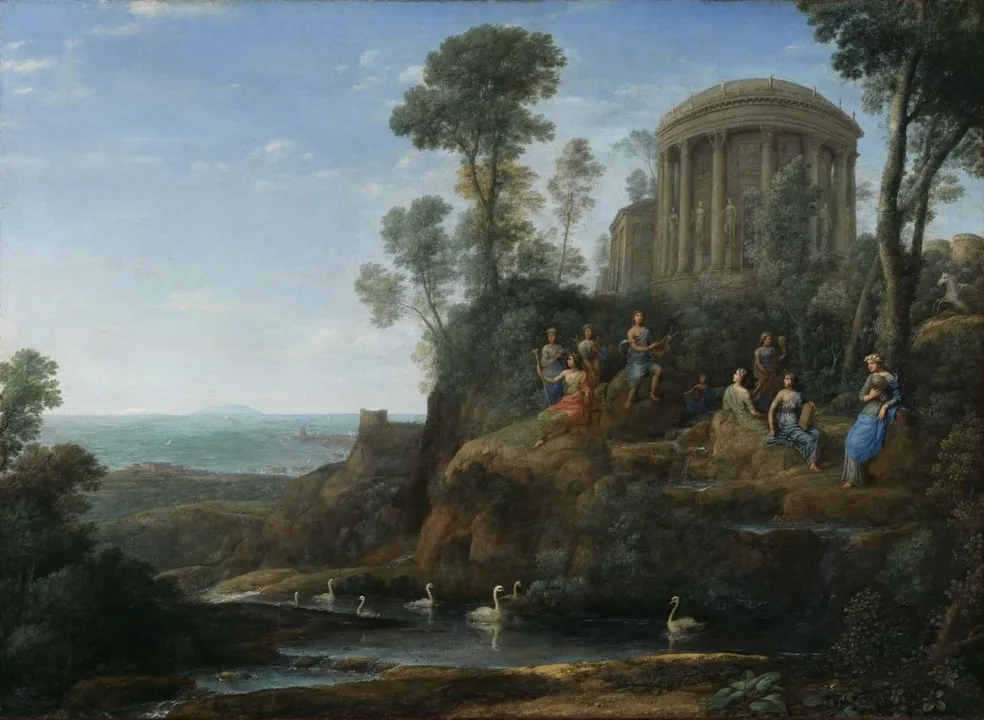 Credit: Claude Lorrain, Apollo and the Muses on Mount Helion (Parnassus), 1680.
But, on reflection, maybe it's not quite so clear after all. I've never really understood what "inspiration" is supposed to mean. Or, I suppose, the word is used for so many things that it's rarely clear to me how a person's using in any given case. For instance, "inspiration" can often just mean a story, image, or slogan that motivates you to work toward a certain goal. So-called thinspiration is an obvious example here. Other times, "inspiration" means something (usually but not always a work of art) that prompts an idea in you unasked and unsought for. There are also times when a person means those sets of ideas, symbols, images, affections, moods, and so on that slowly work on you, that over time so inform (perhaps infect) your thinking that anything you touch bears their traces. Related, but perhaps not quite the same, is the work of art whose images and ideas won't let you go, not through subtle influence but in a brute obsession. And there are times when they mean something you keep returning to when the well is dry, where you actively look for something to get you going. And this last one seems to come in two further subtypes: one reminds you of the kind of thing you want to make, while the other provides a tiny kernel around which an idea will grow. (In some cases, it's an irritant you need, like an oyster makes a pearl around a grain of sand.)
I have shared a lot of my inspiration (in one sense or another) here already. For instance, I participated in the Appendix N blog bandwagon last year with "The AoA Fiction Bookshelf," which might be the kind of thing Vulcan Stev is looking for. "The AoA Non-Fiction Bookshelf" is, of course, the non-fiction precursor to that one. And then we have "The Minimum Necessary Changes" and "How I Plan Horror Games," which both brush on the topic. Heck, even my About Me page, "My Character Sheet," talks about it in broad strokes. But, well, those are broad strokes. If I were to do the Appendix N post again, I might take the more popular route of getting into specifics. What occasions insight? Where do I go when the well is dry? And what finds its way into everything I do and just won't let me go? This is that: this is my second, stranger, more selective Appendix N.
Particular Systems and Their Particular Problems
As I say in the post itself, for many of the creatures in my "AllOut Apocalypse Bestiary" I started with a mechanical gimmick and then built a beast or 'bot around it. In some cases, this was just my attempt to respond to something interesting in the AllOut rules that Nick wrote, but in a few cases it was an attempt to find a solution in those rules to a problem he was telling me he faced: how do you pose a challenge to a very large party in AllOut without just serially one-shotting its members? Dice pools are built up from the number of hit points you have remaining, so any creature that can survive being pummeled by seven PCs for a few rounds is likely to have a very large dice pool. You can load it up with armour instead of hit points, if you like, but that just means the creature will not hit very hard; it does nothing to help spread the damage around. My first attempt to solve that problem was the hydreel; the second attempt was the breaker-tank. Both engage with AllOut's core mechanics in one way or another to allow the creature to have many hit points while spreading around its. damage or debuff, though the breaker tank is, I think, the better solution to the particular problem Nick faced.
I hope you see where I'm going with this. I don't often go out of my way to build concepts out of mechanics, but every so often, I engage with a particular ruleset in such a way that something comes to me. This is inspiration unsought. Of course, it happens most often when there is a problem for which I need a solution. Necessity is as always the mother of invention. I suppose when I need a mechanic to solve my problem, I am looking for something, but I would not call what I'm looking for "inspiration"; nonetheless, that mechanical solution usually winds up being inspiration for quite a lot more. My "AllOut Apocalypse Bestiary" is full of ideas that came to me while working on the hydreel and the breaker-tank: the sneak-thief and sneak-thief shellbreaker, attacking other parts of the character sheet (with a nod to Arnold K); the thirster pack beast, which encourages the game's cooperative combat actions by rewarding fewer, harder hits; and the junk gunk collective, which has effects that trigger on inventory breaking.
Of course, a problem is not always needed for mechanical possibilities to prompt some kind of idea. As I've mentioned before, I'm interested in creature types, spell schools, and the other taxonomies games like 5th edition Dungeons & Dragons build into their systems; in "Items That Play With Taxonomies," I share some of the fruits of that interest. At this point, though, perhaps we aren't talking just about things that occasion insight, but a recurring preoccupation...
What Can You Take From This?
This source of inspiration has a simple enough lesson for other GMs, I think: you don't always need to be fiction-first. Sometimes the most interesting thing is to start with the mechanics, build something tricky but elegant out of that, and then decide what those mechanical tricks narratively express. Such an approach has three benefits: first, it improves your encounters; second, it introduces something for you to interpret, which can be creatively fruitful; and third, it can lead to a seamless integration of the ludic and the narrative.
René Girard's Theory of Mimetic Rivalry
If I ever need to create some social dynamic to enliven a settlement, court, or other social setting, I draw on René Girard's ideas about mimetic rivalry.
René Noël Théophile Girard (1923-2015) was a French scholar of literary criticism and philosophical anthropology who developed a totalizing theory of all human behaviour based on mimesis (a Greek word for “imitation”). Of his many works I've read Theater of Envy: William Shakespeare and I Saw Satan Fall Like Lightning, though it's the first I have listed on my Non-Fiction Bookshelf (linked above) and it's my recollection of the first that I turn to when I need to grab some social complication and can't think of one by myself. For any of you who are interested in him, your best starting places might be first the CBC Ideas episodes "The Scapegoat: The Ideas of René Girard," Parts 1 through 5, and second the Know Your Enemy podcast episode "René Girard and the Right, with John Ganz."
One of Girard's basic insights is that, beyond needs like food, water, and shelter, we learn what to desire by imitating what the people around us desire. If I take someone as my model for desire, though, they will become my rival the moment I imitate their desire for something we cannot share: a wife, say, or a position of influence. In Theater of Envy, he emphasizes that friends want to be models of each other's desires, and that desiring the same thing is the basis for much friendship and strengthens it, so long as the object of their mutually-coordinated desire is something they can share. For example, a shared love of certain music can encourage friendship. The same force that binds friends together, reciprocal mimesis, also tears them apart. Of course, this does not simply stay between two people; if someone notices two rivals desiring something, they are even more likely to learn to desire it and become a third rival. Under certain conditions, he argues, mimetic rivalry spreads like a plague or a wildfire through a society, threatening severe social breakdown. In I Saw Satan Fall Like Lightning, he describes how this leads naturally to the scapegoating of some vulnerable member of that society. Because that scapegoating removes all the prior tensions in a way the perpetrators don't understand, they retroactively remember the scapegoat as a kind of god; Girard claims all the gods of polytheism are these distorted recollections of scapegoats. I, personally, do not buy some of his bigger claims. I do have use for his smaller ones, though.
Theater of Envy is Girard's argument that Shakespeare explored these dynamics, often in disguised or fragmented form, in his plays. Therefore much of the book recounts the many variations of mimetic rivalry that appear in Shakespeare's work:
the friends who argue about whose beloved is better, each trying on some level to make the other his own rival;
the rivals who become friends when the object of their desire becomes unavailable to both of them, only to become rivals again when the object becomes available once more;
the woman who, being doted on by her suitor, learns from him that she is herself desirable and comes to spurn him, preferring her own company;
the vain woman who, spurning her suitor, desires the man who spurns her because she believes he must love himself and so learns from him to love him;
the man and the woman who fail to get together because both play hard to get, each fearing the other will become self-loving if they outwardly express their desire;
the braggart husband who can only sustain a desire for his wife if he can encourage his subordinates to desire her, too;
the disaffected bachelor who seeks a woman to spurn him, knowing only such a woman can hold his interest;
the many go-betweens who carry on their friend's or employer's praises, inevitably getting caught up in the affair someway or another (either falling in love with the lover or the beloved, or becoming the beloved's beloved, or finally only being able to feel any desire vicariously, through the people they set up together); and
the homoerotic charge between rivals, who are bound together by their shared desire and who might each see the other in elevated terms whenever they feel they're the inferior rival.
Of course, romantic desire is not the only kind that people can imitate. Political offices, public acclaim, and property are common objects of desire in Shakespeare and in Girard's analysis. You can alter about half of the examples above into non-romantic variations. Quarrels over inheritance are common in Shakespeare.
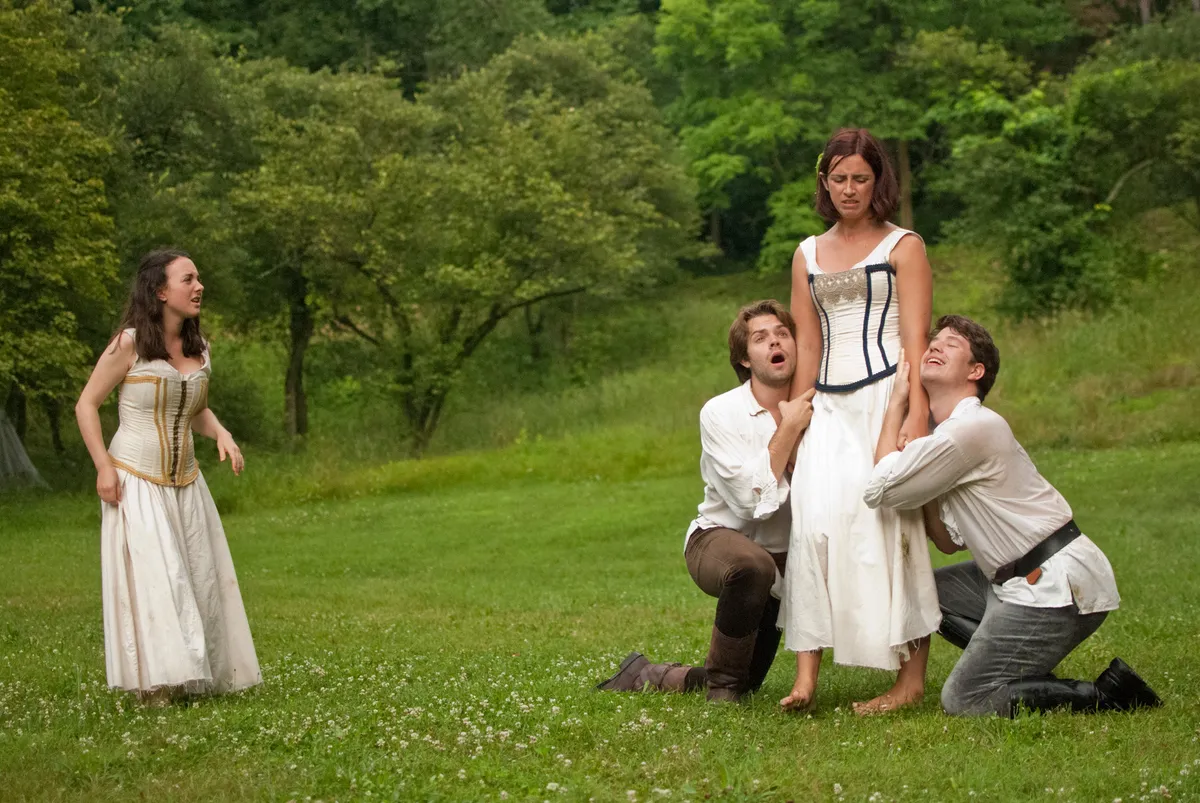 Scene from a production of Shakespeare's A Midsummer Night's Dream. Source: Phil Dokas, 2010, CC BY-NC-SA 2.0.
As I hope you can see even in this brief summary, there are lots of variations on this dynamic. That means it is flexible and extensible; some fragment or mutation of mimetic desire and mimetic rivalry is probably appropriate in any social situation. I understand the way his theory works well enough that I don't need to use a specific situation he discusses in the book; I can use some other variant that must theoretically be possible based on what he describes. It also always involves one or another character wanting something, and it usually involves conflict, so mimetic desire leads to dynamic situations that the party can get involved in. Furthermore, I disagree with Girard at various points: for instance, I think hierarchy is much less reliable a safeguard against out-of-control mimetic contagion than he thinks it is. Therefore I have a handful of counter-examples ready to go in a case where one of those fits. Altogether, the many faces of mimetic rivalry are useful sources of inspiration for social dynamics.
Let me give you an example. In my AllOut Apocalypse Char game, I started with a little domestic drama in Mister Hallywell's Caravansary: The robot Mister Hallywell, loving his establishment very much, wants his adopted human children Jessie, Preston, and Niri to love it as well. On some level, he believes all three of them should want to own the trading post, and so openly encourages them to compete to inherit it when he's gone. His children feel uncomfortable about this, and are more worried about keeping him up and operating for quite some time yet … but they're starting to argue over how the place should be run. It's simple enough, yet it provides a bit of character to the caravansarie. Now, contrary to the received wisdom, I firmly believe that not every bit of local colour in a game must be something the players can interact with; these little details do all I need them to do if they ground the game with verisimilitude or surprise the players out of their assumptions. However, this situation does provide something they can grab onto: knowing there's a minor conflict between Jessie, Preston, and Niri, the party can in theory support one or the other step-sibling in order to gain access to the caravansaries admittedly-meagre resources.
Let me give you another, more metaphorical, example. In my Fortunes of Ewistar campaign, the party are currently in the Feywild, and they have been warned to never, under any circumstances, dally with the fey there. Of course, I must tempt them! So as the party stayed at the Court of a Thousand Boughs for three days and three nights, two swamp nymphs, Meadowsweet and Loosestrife, propositioned the bard Melchellor, more boldly each night. The rumour they party heard from a courier-cat was that these two nymphs, retainers of the Maid of the Murmuring Mire, herself the companion and retainer of the Lilypad Princess, were in the latter's hall when an ogre arrived and demanded compensation for damages. The compensation he demanded was the Princess's own heart, but he would accept the heart of any of her retinue so long as they gave it willingly. Brave Meadowsweet offered her own, and he tore it from her chest. Loosestrife, her boon friend for as long as either could remember, could not bear to see Meadowsweet die, so she gave the other nymph half of her own heart. Now they always desire the same person and, should one die, so will the other. They aren't at all interested in sharing a lover, however, and the custom in the fey courts is for romantic rivals to duel to the death (though that is more common among archfey, which they are not). Things have gotten very complicated for them. They spent three days doing everything in their power to involve Melchellor in that complication and, on the third night, they succeeded. We will have to see how that turns out! As you can see, this is taking a Girardian metaphor and making it literal: the two friends share a heart.
For that matter, drow society in the same campaign is in large part built around the idea that friends ought to be rivals, that learning to manage rivalrous friendships is a fundamental part of maturity, and that it's a superior's duty to foster competition between her subordinates (such as a knight between her squires). That seemed like an appropriate and interesting gloss on how I already imagined the drow and, besides, Girard's ideas are always near to hand for me.
Of course, as the comment about the drow suggests, it's not quite true that this is just something that I turn to when the well is dry. Mimetic rivalry is an autistic special interest of mine, as well. It's fair to call it something that finds its way into everything I do and just won't let me go. But for that, I've chosen a more fitting example.
What Can You Take From This?
Of course if you want to use Girardian theories of desire and rivalry as a plug-and-play social dynamic, that option is open to you; I've given you resources to start with. However, any theory of social dynamics could work here, so long as it has aspirations to universal scope. It need not actually be true all the time, just so long as it's sometimes true. The point is simply that you could fill any social situation with the relationships implied by such a dynamic when you cannot come up with anything else.
Michael Ward's Astrological Reading of C. S. Lewis
Many years ago, I started reading Michael Ward's 2007 Planet Narnia: The Seven Heavens in the Imagination of C.S. Lewis, ready to be unconvinced; I finished the book an advocate. The main thesis is that C. S. Lewis, who had a lifelong interest in astrology, wrote the seven books of the Chronicles of Narnia to correspond with the seven classical planets, as they were understood not so much by the Greeks or Romans but by later medieval Christian interpreters. Whether or not Ward is correct is mostly irrelevant to this post, though I think he makes a compelling case for it. What's relevant is that I find myself returning again and again to the seven classical planets or, more accurately, to Ward's description of Lewis's depiction of the medieval understanding of the seven classical planets.
Each of the seven planets has various symbols, moods, and associations that it inherits from the god with which it's identified and from its role in medieval astrology; it also, at least for me, has associations from the Narnia book it animates.
Luna, the moon, is associated with water, shadow, paleness, and lunacy, which is named for her; therefore she is also associated with illusion and misdirection and melancholy, and with having two dissimilar sides (the light and the dark), with the indirect reflection of the sun, and with mutability or inconstancy of temperament or form; she presides over animals both watery and subterranean, as well as a kind of femininity distinct from Venus's; her metal is silver, her day is Monday, her book in the Chronicles is The Silver Chair (1953) and her adjective is lunar
Mercury is associated with quickness, money, theft, speech, messages, messengers, and twins; everything about him moves, changes hands, meets and parts, joins and separates, is first one and then several and then one again, all fission and fusion; he is eloquent and, linked with Castor and Pollux, also an equestrian and a boxer; he's a psychopomp, escort of the recently dead; his metal is quicksilver, his day is Wednesday, his book in the Chronicles is The Horse and His Boy (1954), and his adjective is mercurial
Venus is associated with love, sex, beauty, fertility, womanhood, motherhood and mothers, pregnancy, childbirth and children; she presides over those animals known for copulation, especially goats and doves, and also over fruiting plants; her domains are orchards, wedding chapels, brothels, and womb-like caves; identified with Aphrodite, she is also associated with surf, oysters, and pearls; her metal is copper, her day is Friday, her book in the Chronicles is The Magician's Nephew (1955), and her adjective is venereal
Sol, the sun, is associated with light, vision, knowledge, gold, medicine, and therefore also alchemy; connected with Apollo who slew Python, Sol is associated too with dragons and dragon-slaying, and with generosity as the opposite of hoarding gold; he promotes liberty, including liberality with gifts and the liberal arts (learning for its own sake); his metal is gold, his day is Sunday, his book in the Chronicles is The Voyage of the Dawn Treader (1952), and his adjective is solar
Mars is, of course, associated with war and martial masculinity, but also with duty, discipline, just obedience, the willing endurance of hardship, violence of all kinds, loyal knights and heartless mercenaries, spears and shields and other arms, blacksmiths, history, and ruins; he is also a forest god, patron of trees and vines and wolves and bears and horses; therefore he is god of carpentry and, also, crucifixion; his metal is iron, his day is Tuesday, his book in the Chronicles is Prince Caspian (1951), and his adjective is martial
Jupiter, or Jove, is the king of gods and the god of kings; he is associated with kingship, of course, and just and wise authority, but also fathers and fatherhood, lightning and storms, oak trees, empires, peace, calm, gift-giving, and leisure, especially sport hunting; his animal is the lion and his bird is the eagle; he is also god of spring, and the triumph of good over evil, life over death; as it is a king's privilege to grant mercy to the condemned, so too is he associated with forgiveness; his metal is tin, his day is Thursday, his book in the Chronicles is The Lion, The Witch, and The Wardrobe (1950), and his adjective is jovial
Saturn is associated with death, autumn harvests, and winter snows; he presides over all dooms, disasters, prophesies, and inevitabilities, and furthermore over the endless march of time and the end of time itself; he is hard-won wisdom, bitter but true, and the ill luck that fosters it; he clears the ground for something new, though he is not himself associated with that something new; he is, finally, associated with astrology itself; his metal is lead, his day is Saturday, his book in the Chronicles is The Last Battle (1956), and his adjective is saturnine
I find I bring these planets reflexively into many of my own projects. They just won't leave me alone. Despite disbelieving the claims of medieval (and contemporary) astrology, I am compelled by these families of symbols. If I make up a setting with several kingdoms, expect there to be seven exactly, each corresponding to one of the classical planets. Take a look at the seven diseases I homebrewed for high fantasy settings, here and here: you can likely figure out which planet presides over which.
There are nine provinces in Ewistar, the setting for my Fortunes of Ewistar campaign, but that's only because the lunar Frithlands and the mercurial Merrimults are both divided in two. In "My Plan For Better Locations," I described North and South Frithland like this:
North and South Frithlands are somewhat like moonlit fog over a lake at night, full of frogs and silvery confusion, where important events tend to happen in obscure or obscured places (in the shadows, in the clouds, underwater, underground). I often set the Frithlands' encounters in swamps, temperate rainforests, cloud giant castles, cellars, caves, white marble quarries, bullywug villages, stony riverbeds, and the Underdark beneath them all.
The shorter version is, simply, that the Frithlands are lunar. (As it happens, I adapted that name from a lunar line in Lewis's long poem "The Planets": "By friths and shallows of fretted cloudland.") And then I described Valerose with the following language:
Valerose is bursting with fruiting plant life, romantic entanglements, troublesome desires, overgrown creatures, mothers with children, local beauties, and anything else you might associate with a fertility goddess. (Indeed, more than a few fertility goddesses are worshipped there.) I often set Valerose's encounters in farmers' fields, grassy meadows, womb-like grottoes, and castle ruins overrun with verdant plants and quivering oozes, all among rolling hills like pregnant bellies.
Again, I could just say that Valerose is venereal. And all of Ewistar's provinces are like this for their own planets.
As with mimetic rivalry, one of the major benefits here is that these symbol-sets are very extensive. If I'm ever stuck for a scene or an adventure hook or a creature in one of the provinces, I can usually turn to the region's presiding planet for inspiration. If I need a wandering monster in saturnine Ledwelgin, I will probably use the undead, or maybe some astral horror from beyond the stars; if I need an NPC in solar Gulldarrow, I'll first consider a scholar, explorer, alchemist, or artist. Structuring the campaign's geography around the planets is very useful for those purposes. But, again, I'm confusing my types of inspiration again, aren't I? Because as much as these planets have exerted their influence over me time and again, inserting themselves into various projects, what I'm describing now is turning to them when the well is dry.
Maybe that's why people aren't always clear with the word "inspiration": the place you had a flash of insight is one you'll turn to again when the well is dry; the thing that just won't let go of you is also the thing that motivates you to create. Some places are sources of only one kind of inspiration, but they may be fewer than the places that are sources of many.
What Can You Take From This?
In much the same way it can be helpful to have a theory of social interaction, it can also be helpful to have a set of linked symbols that can structure and populate different regions of a setting. In order to work, each group of linked symbols must be extensive and must make some kind of deep sense; superficial similarity will quickly become tedious and obvious. The classical planets are one such set of symbols, but I can think of other possibilities: the five colours of Magic the Gathering (and more usefully the derived pairs, arcs, and wedges, which I use to animate and elaborate factions); the five elements or "moving ones" of Wuxing; and Catholic saints, Buddhist bodhisattvas, or Taoist xian.
–-
Note, for those who find this kind of thing objectionable enough you wouldn't want to click through, that Vulcan Stev's post uses an Adobe Stock image produced by a text-to-image model.↩