My Plan For Better TTRPG Locations
I've decided that in 2026, as something of a new year's resolution, I will work to have better locations in my tabletop games.
For the month of January 2026, Duncan S. Rhodes at Hipsters & Dragons is hosting the RPG Blog Carnival, on the topic of Fantasy Locations.
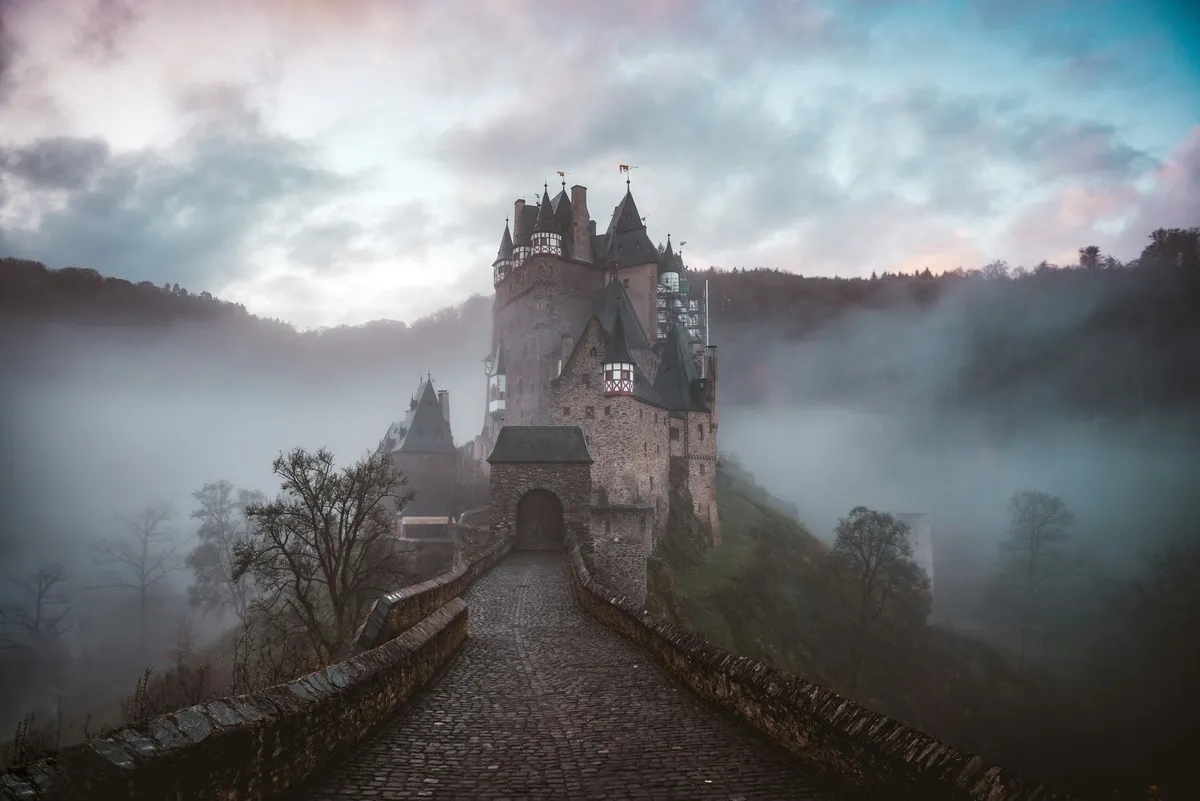 Source: Cederic Vandenberghe, 2017.
My first thought was, "I have nothing to say about locations." And on considering that, I concluded it must be because my locations haven't been terribly good. Oh, there might be a few I was happy with, but for the most part I didn't have many cool, dramatic settings: no battles over a dragon's mummified remains,1 no duels on a slick log over a river torrent, no fights inside stormclouds,2 little lava and no quicksand. So I decided that I wanted to have better settings.
To that end, I wrote a long post about what I have done right and what my encounter prep workflow looks like so I could identify what my strengths are, what my successes have been, and how I could adjust my current prep practices to improve my sessions going forward. I also asked my players for help identifying these successes and had some surprises as a result: maybe I've had more successes than I had thought and was thinking about locations a bit wrong. On reflection, though, while the process of writing that post helped me organize my thinking, it doesn't make for very good reading. So let me start over: what is a good location, and how can I make more of them? With luck, if you also want to improve your locations, my overall plan or the concrete steps I plan to follow will also sound useful to you. (Also, it may contain ideas you can steal.)
What Is A Good Location?
A good location is one that contributes to creating the experiences you're aiming to create for your players. That is probably obvious and probably trivial. The salient point here is that you can't point to any particular trait and say it's necessary for a location to be good, or even helps it be good, because whether or not a location is good depends on the kinds of experiences you're trying to create for the specific players you're trying to create it for. I feel this almost goes without saying, though perhaps it's good to remind ourselves of it every once in a while. This observation isn't really all that useful for my purposes here, though.
Instead of focusing on what's good in the abstract, I'll focus on what's worked for my campaign and what I wish I was doing better. Let's start, then, with locations that my players or I thought were good, and what it was about them that worked. One presumes that these judgements will, by the nature of being based on successful locations in my campaigns and one-shots, already be aligned with the kinds of experiences I hope to create for my players and the ones my players have come to hope for from me.
So, what are my existing strengths?
- Anthropological viewpoint. This is something my brother Nick Hendriks pointed out, though it rhymes with conclusions of my own. He said that my locations are designed for the people who live in and use them. I think this mostly comes down to two things: first, a restless dissatisfaction I have with certain ways things are unrealistic (though, of course, I'm fine with other ways things are unrealistic) and, second, my delight in little cultural touches, like a mosaic on a wall or a tidy way of circumventing – while still observing – a taboo.
- The tacky and the quaint. Adding to the point about little touches, another thing I like in fiction, and therefore include in games, are the tacky and the quaint. I once set the opening of one short campaign in a conference room at a creationist dinosaur theme park, something along the lines of Dinosaur Adventure Land; I set the beginning of another campaign in a little 24-hour diner, with a painting of Paul Bunyan and Babe the Blue Ox covering one wall. I don't know if the latter served the purpose I hoped for it, but I'm confident the first did. The tacky, the kitsch, and the quirky are both realistic and unexpected, which is an ideal combination for contemporary settings as far as I'm concerned.
- Minigames and bespoke mechanics. Nick pointed this one out, too; I would never have thought of it myself. But he mentioned some pointcrawl mechanics I made for the Char, a region in the All-Out Apocalypse game I sporadically run for Nick and his daughter. He also mentioned a number of battlemaps in The Kobold Chronicles, a drop-in campaign I used to run partly as a kind of sandbox where I could play with mechanics in a way I didn't feel like I could in my main 5e campaign, The Fortunes of Ewistar. In The Kobold Chronicles, all the PCs were kobolds, who in 5e have Sunlight Sensitivity; I used shaded areas and areas in direct sunlight to make positioning matter more in the encounters. These aren't the only little mechanical tricks I used, either, of course, but I would never have thought of that campaign as having memorable locations. Nick, however, mentioned it most of all!
- Locations that reinforce atmosphere. When I was trying to come up with my own strengths, this is one I eventually thought of. First, the creationist dinosaur theme park I mentioned before set the tone for the game, I think: weird, conspiratorial, low-budget, sleazy, distinctly American,3 painfully and beautifully earnest. Often I put some effort into making a one-shot or mini-campaign's first setting stand out. Second, in The Fortunes of Ewistar I pay a lot of attention to characterizing each of the regions that make up the Kingdom of Ewistar, even if I don't commit the same amount of thought on individual locations. However, part of this does involve using individual locations to support each atmosphere's region, even if they are not always impressive by themselves:
- North and South Frithlands are somewhat like moonlit fog over a lake at night, full of frogs and silvery confusion, where important events tend to happen in obscure or obscured places (in the shadows, in the clouds, underwater, underground). I often set the Frithlands' encounters in swamps, temperate rainforests, cloud giant castles, cellars, caves, white marble quarries, bullywug villages, stony riverbeds, and the Underdark beneath them all.
- Valerose is bursting with fruiting plant life, romantic entanglements, troublesome desires, overgrown creatures, mothers with children, local beauties, and anything else you might associate with a fertility goddess. (Indeed, more than a few fertility goddesses are worshipped there.) I often set Valerose's encounters in farmers' fields, grassy meadows, womb-like grottoes, and castle ruins overrun with verdant plants and quivering oozes, all among rolling hills like pregnant bellies.
I haven't heard from my Fortunes of Ewistar players, yet; they might of course say very different things on the topic.
And what do I feel I'm lacking?
- Fantastic, visually impressive locations. I don't usually have very spectacular environments, either with magical settings (a mummified dragon corpse) or with mundane ones (thunderheads). I don't have many locations that I feel would make for a good film set or video game map. The exception here was a cloud giant castle, I think, which was massive and luxurious and which eventually featured an airborne battle against the cloud giant countess flying over the parapets; that's the kind of thing I think I should do more often.
- Locations that are both tactically interesting and nice to look at. One of the reasons I would never have thought of the Kobold Chronicles settings as good locations is that I made the battle maps with Roll20's tools, which can be fairly compared to Microsoft Paint. It was not fun just to look at them. Meanwhile, I use many of 2-Minute Tabletop's beautiful maps, which one of my players has commented on approvingly. However, I only rarely have an environmental mechanic to make those more impressive maps really provide much beyond walls and sightlines. Sometimes I make maps in Dungeon Alchemist, but that is very time-consuming and the program has its limitations (as, I presume, does my knowledge of how to use it).
- It might be worth noting that there's a real and practical constraint here: for The Fortunes of Ewistar, I have observed that at least one of my players is much more comfortable using battlemaps than using theatre of the mind. If I try to use theatre of the mind, the players will ask for a map and I will eventually wind up drawing one badly during the session. I've learned the hard way that, for this campaign, it's much better to just prepare one beforehand if I can. When planning combat encounters, therefore, I need to make sure I can provide a battlemap for it. Of course, not every location needs to have a fight in it, but it's still often a constraint.
- Memorable cities. I tried, at first, to have distinctive cities: Glammire, the first regional capital that the party visited in The Fortunes of Ewistar, is on a river on a swamp, and so most of it is on stilts and boardwalks, excepting the temple to Selûne built atop a massive white erratic rock hill towering over the city. Nearby Mothart was distinct enough, too, I guess: mossy, with many stray tressym and the lord's daughter's pet crag cat often seen slumbering on roofs. However, the party has never had a reason to return to Mothart, I don't think I did enough to remind the players of Glammire's unique features on visits after they were first there, and most of my other cities lack the same character.
How Can I Make More Of Them?
Maybe most importantly, if I want better locations I need at the very least to keep doing what works. Satisfying my anthropological curiosity and my own need for internal cultural coherence has paid dividends so far, as long as I don't go overboard with it. As a general approach, I think you should do what you do best for your table. This isn't an intention to keep doing what I've always been doing, though: I will try to be more conscious of this.
As for impressive fantastic locations, I've been meaning for a while to start planning encounters more often with the cool battle maps I've collected and find a reason to use them, rather than starting with what makes sense in the story (or for the region) and then trying to find or make a battlemap to match it. Along the way I've picked up maps with collapsed construct giants, immense trees, sulphur springs, and so on, but I never use them. In a sense, perhaps I need to be less fiction-first than is my custom. A less fiction-first approach might have some additional benefit, in fact: introducing artificial constraints creates more opportunities for narrative kitbashing, which I enjoy. Because I can't bring myself to handwave away the ridiculous but cool location, I'll need to be creative and come up with a plausible explanation for it. My players have expressed their interest in those kinds of explanations and their (sometimes unintended) implications, so I don't think this is just self-indulgence on my part.
On a similar note, I need to get more familiar with Dungeon Alchemist's updated capabilities, so I can learn what it can do. Instead of turning to it in my hour of need, I could play around with it more proactively, make some interesting maps, and then build locations and encounters out of those maps. That, of course, will take time that I might not always have in abundance, though it might also be a fun activity to do while listening to podcasts.
Further, I want to build mechanical elements earlier during combat prep. I should ask myself how I want the encounter to feel, and think about what mechanics or minigames could reinforce that feeling. I already do this when choosing or homebrewing enemies. Adding environmental effects will be an additional step, but it should fit right in with my existing practices – provided I'm not rushed in my prep, which I can't always count on.
I also shouldn't be afraid to reuse mechanics for different players. That means running something like The Kobold Chronicles again as a testbed for The Fortunes of Ewistar (and vice versa). Reusing bespoke mechanics and minigames should help reduce prep time while still allowing me to make more memorable locations for encounters.
Finally, when it comes to cities, I should actually put what's interesting about it to use. If Glammire is on boardwalks in the swamp, I should put something interesting under the boardwalks. If Foamcavern is in a massive mountain grotto, I should give the party a reason to climb up the cavern walls. If Chantowl's town guards ride giant owls, I should put a threat next to Chantowl and send the town guard alongside the party to defend against it. A backdrop can be beautifully painted and nice to look at, but built sets often lend themselves to more interesting stagecraft.
Concrete Actions
- Revive my Kobold Chronicles game, in a format that works better than the drop-in one, and where possible use it to experiment with mechanics.
- Take more time to just play around in Dungeon Alchemist.
- Review the maps I've already bought, downloaded, or made; choose four or five and think of two or three ways I could bring each into an existing campaign.
- Study how other GMs make cities work for them. (I've already watched "You're running cities wrong" by Daði at Mystic Arts and plan to watch "Get Players to Roleplay by RENDERING Scenes.")
- Pay attention to ideas in other game systems (like dynamic terrain from Draw Steel Monsters, which can be as simple as a frozen pond).
- Re-read the relevant sections of the Dungeon Master's Guide (2014).
- As always, read books and watch documentaries: a lot of the coolest ideas grow out of real life, not out of games or fiction.4
Suggestions for other concrete steps are, of course, welcome. My comments are hosted on Bluesky, but will appear below.
This is unrelated to locations, but there's a thought, no? As a dracolich is to a lich, so a mummy dragon might be to a mummy lord?↩
I do have plans for this, though.↩
I'm not, as it happens, American. I'm Canadian. That game, however, was nonetheless all about American Protestantism and American cultural institutions. I hope my American players got something out of my outsider's perspective on it all, or at least did not find it too jarring.↩
In Nick's OSR swashbuckler game Falling Tides, for example, there's a valley of stone pillars like in Zhangjiajie National Park, which has made for at least one dramatic moment so far.↩