Settlements of the Lakelands, Part I: Three Samples and Some Tables
A Lakelands post
When it comes to tabletop games, I generally handcraft settlements, encounters, and so on rather than roll on tables. So far my approach to the Lakelands has been in line with this habit. However, I'm coming to appreciate the pleasures of what I'm calling narrative kitbashing, the underlying mechanism of and draw to emergent narrative, among other things. Furthermore, I know many people like semi-random generation of game elements. To this end, I'm going to try both here: I'll give a brief description of three of settlements that I see dotting the Lakelands around Tricity, and then I'll include some procedures for rolling up your own.
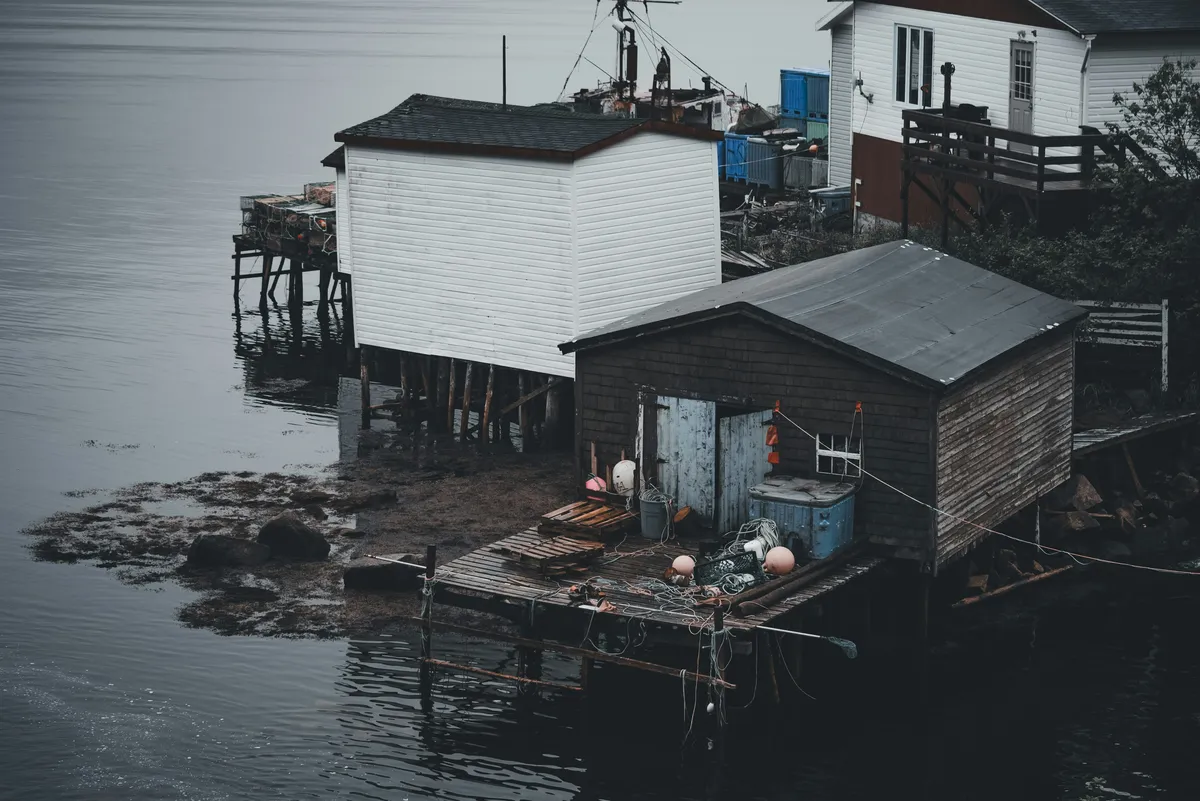 Source: Erik Mclean, 2023, Unsplash license.
Sample Settlements of the Lakelands
Locomotive
Running along the railroad line between the ruins of Kitchener and Sarnia is the train town of Locomotive. Its seven passenger cars are inhabited by all manner of people: amazons and geminites, Old World exiles and the locally-born. They move slowly with their two diesel-solar hybrid engines, often pausing to clear and repair the track, until they reach the next of their regular stops.1 Here they unload and set up the temporary structures they store in six of the cargo cars, assembling a village over the course of a day. They live mostly off of trade, though a few of them are also itinerant artisans who make the kind of durable goods that most communities don't need to buy or repair often. Locomotive stays in one place for a while, until sales start to dry up, and then they'll move on. Other settlements are equal parts excited and apprehensive when the train town arrives: though they promise to bring in goods and news from abroad, a few residents are troublemakers and flirts, so they also bring other kinds of baggage. Once upon a time, Locomotive used to go out Goderich way, too, but they haven't done that for nearly a decade now. Rumour has it that they'll try it again this year, however.
While PCs will generally have to travel to other settlements, Locomotive will travel to them, or at least part of the way. It could be useful for bringing in rumours, and you can put experts and merchants on it that you'd prefer the party had only occasional, and not regular, access to.
Millbank
A little village on the Nith River in Perth County, Ontario, Millbank was notable in the pre-Arrival period for its Mennonite-run small businesses and for having been the home of the regionally-famous clairvoyant Vera McNichol (1910-1988). Now Lakelanders from kilometres around travel to Millbank to seek the aid of its many resident psychics. The locals, mostly mundane humans and many of them still Mennonites, all have their own opinions about the dozen or so diviners, healers, and brauchers who hang a shingle there, and about the people who seek them. Two inns and a campground accommodate these visitors as best they can, and local provisioners (including a restaurant known for its pies) profit from the trade. Although many of the outsiders are in desperate conditions and aren't likely to enrich Millbank much, Lakelands aristocracy also visit it for amusement and advice.
PCs might travel to Millbank in order to consult with one of its various psychics. While there, they can encounter visiting Lakelanders, including both local power-players and their scions, and regular people in desperate need of help (who can therefore provide adventure hooks).
Sinjack
In the Lakelands, where electronic media and the technology to play it are rare, theatre has again become a popular form of entertainment, and more than a few pre-Arrival theatre towns continue to be cultural destinations. Among these is Sinjack, a farming new hominid community clinging to the ruin of Waterloo's northern edge, where the St. Jacobs County Playhouse once again operates, though now as the Sinjack Playhouse.2 The theatre proudly develops and disseminates the new hominid dramatic style, and once plays have had their run in town, travelling players are then sold the scripts so they can tour the shows. Because of the town's vacationing tourists, other cultural attractions have grown up around the theatre: a small casino, a lively beer garden, and two dance halls (one posh by Lakelands standards and one more rustic). Sinjack is also a market town, both for the outlying farms and artisans but also for the various scroungers and tinkerers who brave spectre-haunted Waterloo for salvage. Although it remains independent from nearby Tricity, it's friendly with its larger neighbours and will surely take Tricity's part if the conflicts with New Guelph boil over into outright war.
PCs might visit Sinjack for the variety, and the roleplay opportunities, of going to see a play and visiting the other cultural attractions. It's also a good place to "accidentally" run into various movers and shakers in the Lakelands, if your players hope to secure an audience.
Rolling Up a Settlement in the Lakelands
Not every village, town, or hamlet is going to have regional economic or cultural significance. For the kind of regular, everyday Lakelands settlement that your players might encounter on the way to somewhere else, roll on the following tables. The particular combination may take some work to explain – but that's half the fun, isn't it?
Population
Roll on Table 1.1 to determine the settlement's general composition, and then roll on Table 1.2 as many times as necessary to determine what peoples make up each faction of the settlement, rerolling duplicates.
Table 1.1: Settlement Composition
| d10 | Composition Type |
|---|---|
| 1 | Overwhelmingly one people (A, 95%) |
| 2-3 | Majority one people (A, 80%), with a mix of others |
| 4-5 | Majority one people (A, 70%), with a minority of another (B, 30%) |
| 9 | Majority one people (A, 70%), with a minority of two others (B, C; 15% each) |
| 7 | Half one people (A, 50%) and half another (B, 50%) |
| 8 | Plurality one people (A, 45%), with a minority of a second people (B, 30%) and a mix of others |
| 9 | Plurality one people (A, 45%), with a minority of two others (B, 30%; C, 25%) |
| 10 | Plurality one people (A, 40%) and the rest varied |
Table 1.2: Peoples
| d20 | People |
|---|---|
| 1-6 | Mundane humans |
| 7-9 | Farming new hominids |
| 10-12 | Mining new hominids |
| 13-16 | Geminites |
| 17-18 | Mould nymphs |
| 19 | Amazons |
| 20 | Drakemantids |
So, for example, if I roll 8 on Table 1.1, that gives me, "Plurality one people (A, 45%), with a minority of another (B, 30%) and a mix of others." I therefore roll twice on Table 1.2, once for population A and once for population B: I get 7 (Farming new hominids) and 5 (Mundane humans). Therefore the town is 45% farming new hominids, 30% mundane humans, and the rest are a mix of other peoples.
Resources and Amenities
Roll on the table below associated with your town's largest population to determine why there is a town here at all. Reroll if the result does not make sense for the region your PCs are travelling through, or replace it with something appropriate (ie. for a coastal community or something on the inarable Canadian Shield, a farmers market might make less sense than something to do with another kind of food production, like a fish market or a trappers post).
Table 2.1: Why Are People Here? (Mundane Humans)
| d20 | Reason the town is here |
|---|---|
| 1-5 | Farmers market and/or mill |
| 6-7 | Lumberyard and/or sawmill |
| 8-9 | Salvage site |
| 10 | Mine or quarry |
| 11-12 | Factory or factories |
| 13 | Religious site |
| 14-15 | Travel hub (ex. port, river confluence, crossroads, train terminal) |
| 16 | Archives and/or museum |
| 17 | Cinema and/or playhouse |
| 18 | University and/or research centre |
| 19-20 | Roll twice more, use both results |
Table 2.2: Why Are People Here? (Farming New Hominids)
| d20 | Reason the town is here |
|---|---|
| 1-10 | Farmers market and/or mill |
| 11 | Lumberyard and/or sawmill |
| 12 | Salvage site |
| 13 | Religious site |
| 14 | Travel hub (ex. port, river confluence, crossroads, train terminal) |
| 15 | Cultural site (ex. archives, museum, theatre, research) |
| 16-20 | Roll twice more, use both results |
Table 2.3: Why Are People Here? (Mining New Hominids)
| d20 | Reason the town is here |
|---|---|
| 1-2 | Lumberyard and/or sawmill |
| 3-5 | Salvage site |
| 6-9 | Mine |
| 10-12 | Quarry |
| 13-15 | Factories |
| 16-17 | Religious site |
| 18-19 | Travel hub (ex. port, river confluence, crossroads, train terminal) |
| 20 | Roll twice more, use both results |
Table 2.4: Why Are People Here? (Geminites)
| d20 | Reason the town is here |
|---|---|
| 1-5 | Farmers market and/or mill |
| 6-7 | Lumberyard and/or sawmill |
| 8 | Salvage site |
| 9 | Mine or quarry |
| 10-11 | Factory or factories |
| 12 | Religious site |
| 13-16 | Travel hub (ex. port, river confluence, crossroads, train terminal) |
| 17 | Archives, museum, and/or theatre |
| 18 | Education or research centre |
| 19-20 | Roll twice more, use both results |
Table 2.5: Why Are People Here? (Mould Nymphs)
| d20 | Reason the town is here |
|---|---|
| 1-5 | Farmers market and/or mill |
| 6-7 | Lumberyard and/or sawmill |
| 8-11 | Factory or factories |
| 12 | Religious site |
| 13-16 | Travel hub (port, river confluence, crossroads, train terminal) |
| 17 | Cultural site (ex. archives, museum, theatre, research) |
| 18-20 | Roll twice more, use both results |
Table 2.6: Why Are People Here? (Amazons and Drakemantids)
| d20 | Reason the town is here |
|---|---|
| 1-4 | Farmers market and/or mill |
| 5-6 | Lumberyard and/or sawmill |
| 7-8 | Salvage site |
| 9-10 | Mine or quarry |
| 11-12 | Factory or factories |
| 13-14 | Travel hub (port, river confluence, crossroads, train terminal) |
| 15 | Cultural site (ex. archives, museum, theatre) |
| 16-17 | Education or research centre |
| 18-20 | Roll twice more, use both results |
In the example I gave before, farming new hominids make up a plurality of the town, so when I rolled 16, the result is "Roll twice more, use both results." I subsequently rolled 1 and 17, getting 12 when I rerolled the 17. That means the town is built around a farmers market, a mill, and a salvage site. In the context of an actual game, what kind of salvage site it is would probably emerge from the town's location, but as an example let's say it's an abandoned pre-Arrival town nearby, once home to about 10,000 people, with a few agricultural equipment factories. It remained untouched for a few decades post-Arrival because of serious chemical hazards from an accident in one of those factories. Once it was safe to excavate, though, people started doing so. Now it's picked over and at this point people are dismantling the houses and stores, stripping them for whatever building material remains intact.
Local Flavour
Roll on Tables 3.1 and 3.2 to round out your settlement.
Table 3.1: Landmark(s)
| d8 | Landmark(s) |
|---|---|
| 1 | An enormous, knotty, living tree in the middle of town, which the locals decorate with lanterns |
| 2 | A big stone in the middle of town, painted with locally-significant images |
| 3 | Animal statues flanking the main thoroughfare, all the same shape but each painted differently and dramatically (either pre-Arrival or post-) |
| 4 | On the edge of town, an improbably large object from the pre-Arrival world (ie. the world's biggest birdhouse, the world's longest shovel, etc.) |
| 5 | In town but not in the middle of it, a pre-Arrival memorial garden and monument commemorating soldiers killed in war or workers in an industrial accident |
| 6 | A wide pavilion in the centre of town with picnic tables under it, for public use |
| 7 | A wooden structure housing a colony of feral cats, named something like the Parliament, the House of Commons, the Senate, the Lower House, the Upper House, etc. |
| 8 | A well-maintained children's playground, on the edge of town |
Table 3.2: Trouble
| d8 | Trouble |
|---|---|
| 1 | Weird monsters periodically wander out of a nearby dreamzone |
| 2 | Local farm was lost to cnidarian parasites; zombie livestock roam about |
| 3 | Raiders keep coming by to demand tribute |
| 4 | Feuding local families |
| 5 | Well is befouled |
| 6 | Major crime last week (d6: 1-3 for theft, 4-5 for arson, 6 for murder), perpetrator unknown (d4: 1-2 for no obvious suspects, 3-4 for too many obvious suspects) |
| 7 | Religious rivalries |
| 8 | Dangerous animals spotted in area, locals nervous (d6: 1-2 for hellpigs, 3-4 for wargs, 5-6 for a lampwyrm) |
Continuing with the example, I rolled 8 on Table 3.1 and 7 on Table 3.2, which are "A well-maintained children's playground, on the edge of town," and, "Religious rivalries." The playground might have been scavenged from the town salvage site and reassembled here. For the religious rivalries, given the town's diversity, I might say there are three religions: Amilsjatda, the United Church, and more recently Exoreception. The Christians and the new hominid animists got along just fine until the Exoreceivers moved in and started poaching their members; not only do the more established religious communities distrust those of their neighbours who have adopted this strange new creed, they have also become chilly toward one another as their suspicions grow and their leaders start grasping for control of the town's public life.
Please feel free to roll up a settlement or two and post them (with your interpretation) in the comments.
As always for my Lakelands posts, everything in this post is provisional and subject to change.
This detail I took from Irwin Huberman's 2001 The Place We Call Home: A History of Fort McMurray As Its People Remember. The train up to Waterways would have to move slower than a walking pace for long stretches, because the track was built on muskeg and would frequently sink. When this happened, the train operators (and its more able passengers) would have to get off and dig the track out of the mud. Other passengers would take the opportunity to wash clothes and diapers and hang them to dry on tree branches. They would also pick berries and flowers on these stops, but they might even do that while the train was moving, because it went slowly enough that a person could catch up once they were done.↩
I don't know why St. Jacobs County Playhouse, St. Jacobs Farmers' Market, and St. Jacobs Outlets are all on the outskirts of Waterloo instead of in the nearby town of St. Jacobs. At any rate, Sinjack occupies the area around the theatre, not the town after which it appears to be named.↩