Esoteric and Exoteric Traditions in the Lakelands
A Lakelands post
In the broadest strokes, there are four approaches to understanding, avoiding, confronting, and harnessing the Weird: scientific experiment, exoteric tradition, esoteric tradition, and invented idiosyncratic ritual. Of these, scientific experiment and invented ritual are the least common and the least successful. Enough of the Weird is roughly consistent that a person can work out the basic rules of a particular Weird phenomena through patient observation. Unfortunately for the scientifically-minded, each kind of phenomena is not apparently consistent with any of the other kinds: insight into the ogre drug and its effects does not seem to shed any light on the hrönir, for example. Moreover, for most Weird phenomena the observer effect is unusually powerful; the psychological baggage of an experimenter will wreak havoc on spectres and dreamzones. Worst of all, harnessing occult powers seems to have very little to do with the habits of mind that science cultivates, and by and large the inhabitants of the Lakelands lack the neuroimaging tools needed to research the kind of cognition that does help. A few scientists have returned to older, rejected models, like neoplatonist science, but this has had more success as an esoteric tradition than as a science.
On the other hand, while some occult practitioners manage incredible feats with symbols and rituals produced solely out of their own experience, laden with autobiographical rather than communal meaning, these extremely personal methods have little to offer when it comes to countering other occultists or various Weird phenomena. The Weird sometimes seems structured according to communal symbols and meanings, and it is sometimes structured in ways alien to human (or indeed, all known sapient) minds. Neither structure is penetrable by a private mythology. Moreover, the abilities such an occultist develops cannot be passed on to students, unless those students have unusually similar lives and habits of thought: this means such idiosyncratic occult practice is limited to an individual or to a few generations of a secluded family.
Fortunately for them, Lakelanders have a wide range of more communal symbolic structures to draw on, broken into roughly two categories: exoteric traditions and esoteric traditions. In anthropology, esoteric refers to those traditions which share their teachings with only a few initiates; they often require the initiates to undergo a series of tests or trials before they can learn any of the group's secret wisdom. Exoteric, by contrast, refers to those traditions that share their teachings openly, with anyone who wishes to hear. These traditions have different roles in the life of their communities or society and cultivate different attitudes of mind; this also means that esoteric and exoteric practitioners manipulate the Weird in different ways. Some religions or philosophies, however, can take the role of either an esoteric or exoteric tradition for a particular member; in this case, the public-facing wisdom tradition has a hidden occult tradition running within it.
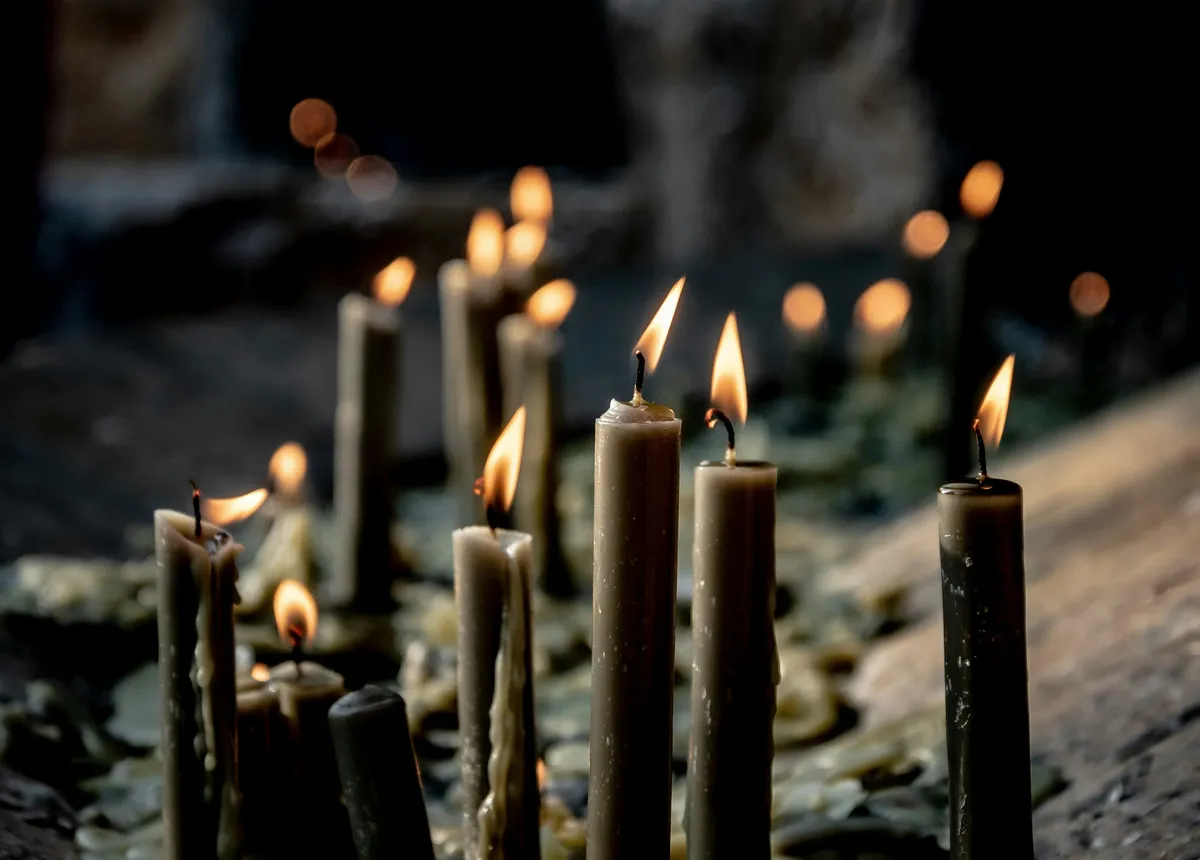 Source: Michael Starkie, 2022 (cropped).
Most of Earth’s major religions are exoteric, and indeed most of its exoteric traditions are religions by any useful definition. From the point of view of those looking to study the Weird, the downside for exoteric traditions is that Earth’s religions do not, for the most part, contain any doctrines about dreamzones or hrönir, and moreover the doctrines they do have concerning supernatural beings are outright misleading if applied directly and literally to the sorts of things people now encounter in North America. Crystal zombies are not demon-possessed in any straightforward or obvious way, nor are the Unbound especially comparable to neopagan gods. This means that the followers of these religions need to do some work adapting these religions to new circumstances and new discoveries. (The alien religions brought from Yir and Sdikga do have doctrines concerning one Unbound in particular, but otherwise they have many of the same limitations.) Regardless, although the exoteric religions don't offer much in the way of explanation for the Weird, they do offer their practitioners the tools to wield and especially to defend against the occult. Nearly every mundane human community large enough to support a team of religious clergy or elders has thereby established a defense against supernatural incursion. Although both exoteric and esoteric traditions involve spellwork and second sight, abjuration remains the domain of the first.
Meanwhile, esoteric traditions prove particularly potent in giving their initiates access to occult power. Practiced in secret, many of them are descended from pre-Arrival esoteric traditions like Rosicrucianism, Christian hermeticism, and theosophy, as well as movements that straddle esotericism and exotericism, like New Age beliefs and some neopaganisms. A few esoteric traditions emerged from post-Arrival religions like Amilsjatda or Sarladhiner religions like Kitnasat. Regardless, in all cases the esoteric traditions rely on but significantly modify exoteric symbols and systems, becoming something new in the process. The occultists who rely on them to approach the Weird typically do not find themselves thereby well-equipped for abjuration, but they are capable of many other things: in addition to spellwork and second sight, they can also manipulate the minds of others. Within a dreamzone, such sorcerers might create terrifying illusions, prevent a person from thinking of or noticing something, or even cause their victim to manifest psychosomatic injuries.
There are at least as many exoteric traditions as there are religions in the Lakelands, and though there are fewer esoteric traditions, there are still plenty. Below are brief descriptions of a non-representative sample.1
Black Hills Hexcraft
The esoteric arm of Amilsjatda, the new hominid ethnic religion, Black Hills hexcraft is highly focused on its originating tradition's animism, seeing the world as spiritually active and inhabited. It's especially well-suited to interacting with dreamzones, perhaps because its first practitioners fought their way out of and across the Unbound Empires. Besides being reliable guides through those strange spaces, hexcrafters are also relied upon for divining the location of hidden objects.
Braucherei
Also known as Brauche or powwow, Braucherei is a system of Pennsylvania Dutch folk magic. In the Lakelands, the tradition straddles the line between esoteric and exoteric, and is largely practiced by Anabaptists, though it's also compatible with other continental Protestantisms. Brauchers, as its practitioners are called, most often concern themselves with healing, agricultural blessings, and protection from sorcery (which they call Hexerei). The best-known brauchers in the Lakelands are a family of witch-hunters operating out of Troyer's Flats.
Christian Exorcism
Many Christian churches and denominations practice exorcism, though the rite was in significant decline in the pre-Arrival world due to a widespread lack of belief in demon possession. In the post-Arrival Lakelands, where spectres and ghosts can and do possess people, many Christian clerics have begun performing it again. Although the details and doctrines vary between Catholic, Orthodox, and Protestant clergy, the general emphases remain the same: calling on Christ's power through standardized rituals to free victims from spiritual affliction. Some pious laity also perform exorcisms, even when they aren't supposed to.
Christian Hermeticism
Where Christian exorcism is a practice officially endorsed by many mainstream churches in the Lakelands, Christian hermeticism is an esoteric tradition within Christianity but often disavowed by it. Descended directly from the pre-Arrival Christian hermeticism of western esotericism, the post-Arrival version heavily emphasizes knowledge, especially alchemical knowledge, as a means of spiritual purification. Hermeticists also use tarot and astrology as forms of divination and meditation.
Enchanter's Witchcraft
Known sometimes just as black magic, enchanter's witchcraft is a relatively new esoteric tradition cobbled together from western esotericism, eclectic neopaganism, and pre-Arrival pop culture ideas about witches. It focuses largely on creating spectres and compelling them into the enchanter's service, and it uses Circaea lutetiana and Circaea canadensis extensively in its rites. Although not all enchanters necessarily use their craft for evil, working with spectres is inherently dangerous and only those willing to take such risks with themselves and others follow the enchanter's path.
Lidjetira
The alien exoteric religion Lidjetira seeks balance between division and synthesis and between the One and the many. Its adherents believe simultaneously that there is only one God and that there are many gods, by stipulating that these many gods are fragments of a higher God. Similarly, it insists that all people are both individuals, in some ways irreducibly alien to one another, and connected, in some ways irreducibly the same as one another.2 Perhaps this is why Lidjetiran abjurers have unique insight into egregores, those powerful ephemeral beings that emerge from the united ideas of a community.
Psychological-Therapeutic Method
PTM, which stands for the psychological-therapeutic method or the psychotypical method, is a rational-scientific set of therapies and mental exercises combined with a set of hypotheses about the nature of the Weird. Its practitioners believe (rightly, as it happens) that most successful sorcerers and abjurers are religious because the Weird responds to and works on sapient minds, and religious practices help people discipline their minds. A number of rationalist Lakelander psychologists and psychiatrists therefore set out to make a non-religious equivalent of religions' mental technologies. PTM is the result. Many Lakelanders are skeptical that PTM is quite as non-religious as its adherents insist.
Spiritualism
Because ghosts now incontrovertibly exist in North America, spiritualism has had a minor resurgence in the Lakelands and elsewhere. Teaching that ghosts have always been a reality on Earth, but are now more active and accessible due to the Unbound's disturbances, spiritualists strive for non-confrontational relationships with the spirits of the dead. However, modern-day mediums recognize that some ghosts are hostile, so they also make sure they have the ability to protect themselves – which is not to say that novice or ill-prepared mediums never fall prey to possession.
Therilatrian Sorcery
Although Therilatria is widely feared across the Lakelands as a sorcery cult, it is for the most part a normal exoteric religion, if an unfamiliar one. However, that's not to say there are no Therilatrian sorcerers; even though its teachings are public, the religion emphasizes mystery and secret knowledge, allowing it to acknowledge the esoteric stream within it. Its sorcerers follow the Divine Monster Eris's call not to shirk from needful conflict; they therefore prepare to defend their communities in psychic combat.
Traitor Cults
The Unbound have uses for loyal mortal servants willing to act as enforcers in their territories or to infiltrate free societies, for the purposes of suborning those societies or capturing and returning escapees. These collaborators have varied sets of skills, but often the Unbound find it useful for them to possess sorcerous powers or psychic insight. The Unbound have no inherent way to grant such abilities, so many of them have invented one (or more) exoteric or esoteric traditions. Sometimes these are called the grim philosophies, but most Lakelanders who know of them call them traitor cults.
Rumoured traditions
People tell tales. In the Lakelands, some of those tales concern necromancy, vampirism, and lycanthropy. Skeptics might call these mere fables or suspect they're folkloric interpretations of the monsters borne of dreamzones. Others have a different idea: esotericists might well have figured out a way to animate the dead, or prolong their lives by drinking blood, or turn themselves into wolves. No one yet knows what limits, if any, the Weird has.
As always for my Lakelands posts, everything in this post is provisional and subject to change.
Although Christian is the most common religion in the Lakelands, people follow other exoteric and esoteric paths there, too, including Judaism, Islam, Buddhism, Sikhi, Wicca, and any other religious practice that has a presence in North America today. I haven't detailed these here partly because it would take too much time and mostly because I don't want to misrepresent religions I'm not as familiar with. When I've finalized the mechanics for these traditions, I will include instructions for designing esoteric and exoteric traditions for your own table.↩
I owe thanks, yet again, to Amod Lele's Love of All Wisdom for introducing me to the ātmanism vs. encounter distinction. I see Lidjetira as a religion formed from the fusion of two religions that took the opposite position in many of the perennial questions Lele outlines: an ascent-intimacy-ātmanism tradition and a descent-integrity-encounter tradition.↩