Hronir and History
"The time is out of joint."
— William Shakespeare, Hamlet, Act I, scene 5
The White Pages Society is a network of local historians, archivists, and librarians who exchange encouragement, questions, new findings, and insights about best practices. Their vision is a Lakelands in which each community can keep accurate historical records and understand its own past in context. Over the course of the last decade and a half, as the group's couriers and senior scholars have tried to connect researchers and answer members' questions, certain anomalies have begun to crop up: some artifacts seem difficult to reconcile with each other or with the physical world. A VHS tape of a regional news program includes footage of an apartment complex burning down in 1995, but that building is still standing. Delvers dug up a safe from a village that had been buried in a mudslide in the first generation post-Arrival; inside it they found a script for a stage musical indisputably written within the last five years. Two well-worn and otherwise-identical pocketwatches have different engravings inside the cover, one for the tenth wedding anniversary of Sarah Tully and Maxi Vaillencourt in April 2017 and the other for the same couple's tenth wedding anniversary in March 2017. Over the decades, hundreds of these contradictory objects have emerged, and it's difficult to write them all off as hoaxes or misunderstandings. One thing is becoming quite clear: history is broken.
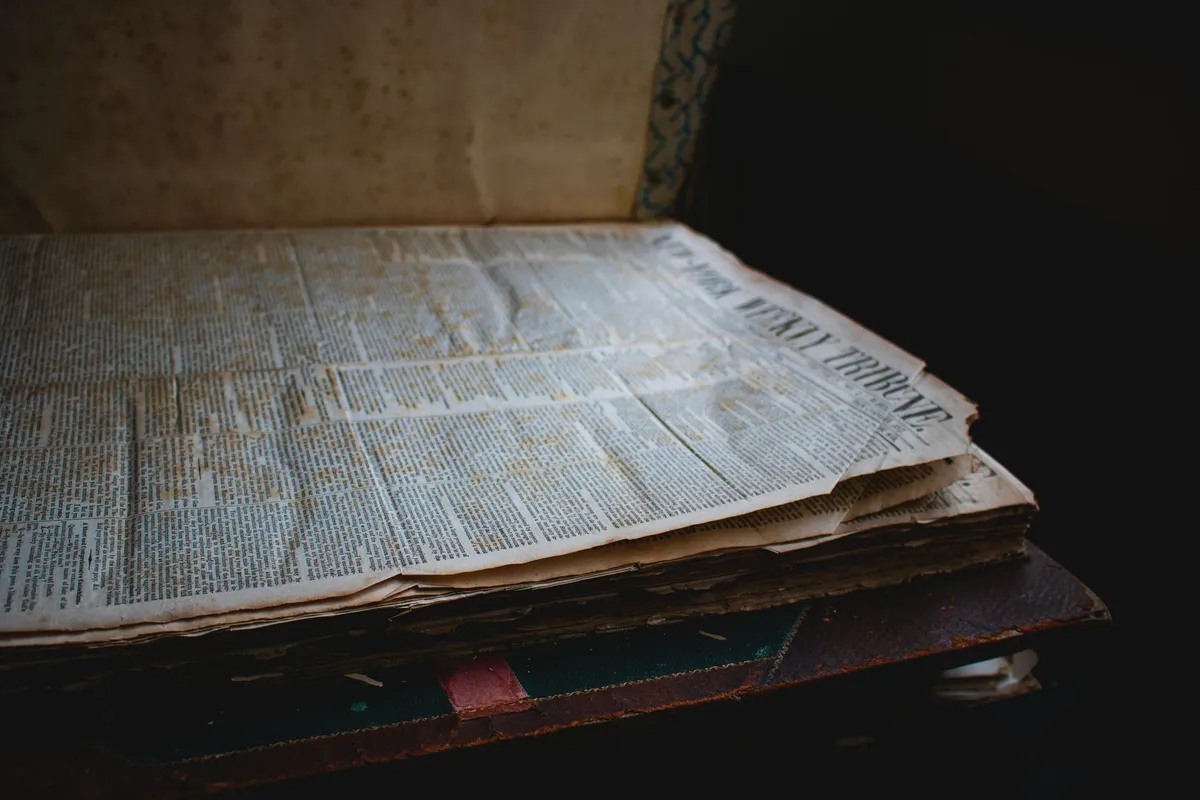 Source: Walter Lee Olivares de la Cruz, 2019
First of all, and most simply, time does not run evenly across the world. That has always been true, of course: we've known since Einstein published his special theory of relativity that time runs faster or slower for an object depending on its speed and on the gravitational forces acting on it. Those differences, however, have been insignificant on Earth, to the point of being unobservable under normal conditions. Post-Arrival, differences in regional time have been quite clearly observed. The Howling Rustic has warped the passage of years so that generations of new hominids lived and died in the Black Hills National Forest in the passage of a few decades. Smaller but still relevant differences have created long days or weeks in the Lakelands, apparently spontaneously. Although these effects are real and have tangible consequences, they do not account for the majority of discrepancies between different communities' annals.
The real problem is the hrönir (singular hrön). Named so for fantastical objects in Argentinian fabulist author Jorge Luis Borges's short story "Tlön, Uqbar, Orbis Tertius," they're artifacts of a false history. Hrönir can be any kind of object, though they're usually some manufactured item: a piece of technology appearing in an impossible context, paper records that document events that never occurred, a teapot with the maker's mark of a non-existent maker, a nineteenth-century penny made from twenty-first century alloys. The bulk of these items appear to date from the post-Arrival decades, but there are still plenty that seem to have far earlier origins. The first identified hrönir are clearly wrong, like the three Queen Victoria pennies made out of a high-entropy alloy, found in a piggy bank in Ashtabula County; these are the least dangerous. Worse are the anomalies where scholars cannot definitively identify the hrön or hrönir. If there are two photo albums showing mutually exclusive versions of the past, how can someone tell which is real? Maybe there will be other documents that researchers can compare them against, but what if there aren't? Or what if, checking the existing archives, researchers discover some records that support the first album and other records that support the second? That's not a hypothetical situation: an intern at the Rainy River Historical Society had exactly this predicament, discovering rival obituaries already in their collection that corresponded to two conflicting scrapbooks.
The obituary problem, as it has come to be called, therefore brought to the White Pages' attention an alarming complication: some of the hrönir reinforce each other's stories. Indeed, those few individuals studying the problem have concluded that the incorrect artifacts create at least two distinct narratives (though they arrived at this number because there are a minimum of three such versions of events, one of them presumably corresponding to reality). This has led to a number of hypotheses about the hrönir's origins:
- they're objects from parallel timelines that diverged from our own, brought over somehow by the Weird ripple-effects of the Arrival;
- they're relics from timelines that could have happened but somehow collapsed, possibly as a result of the Arrival;
- they're goetic objects (things conjured in dreamzones by sapient minds) that just so happen to have unfortunate historiographical consequences;
- they're goetic objects that the Unbound specifically created to destabilize the Lakelands;
- they're normal objects that have been misunderstood (ie. parody newspaper articles, film props, printing errors, advance obituaries, etc.);
- they're well-crafted hoaxes, which history has always had.
It has proven difficult to conclusively disprove any of these hypotheses; after all, even if someone proves that one hrön is a hoax, that doesn't mean they all are. Those scholars who have access to the most information about hrönir, however, mostly agree that none of those theories is fully satisfying. Maybe there are multiple kinds of anomalous artifact, all with different origins, that have been lumped together into one unhelpful category, or maybe there's a single cause that no one has yet considered.
The unfortunate consequence of the hrönir is that there's no consensus history. Of course, there already wasn't one, not before the Arrival and certainly not after, when communication and education were ruinously impaired. Delvers looking for ruins to plumb curse the trickster artifacts when they point to a facility that isn't there, of course, and scholars find their mere existence offensive. But the worst casualty is the loss of joint understanding: settlements can cling to their own versions of the world, with unassailable documentary evidence to back it up against the neighbouring town's version. Most people do not think all that much about hrönir and consequently only worry about very narrow difficulties, like the merchants who were relying on another timeline's MapArt backroad atlas and consequently got lost. Those who've thought longer about them, and more thoroughly, frequently have troubling sleeping at night and struggle not to feel as though the world is built on shifting sands.
Two and a half years ago, six members of the White Pages Society convened in Tri-City, with no fanfare or announcement. None have shared with anyone else the three questions they met to discuss:
- Can a memory be a hrön?
- Can a place?
- Can a person?
I mean for the unreliability of time and history to do two jobs in Lakelands games.
First, it is a built-in reason to hand-wave away unforeseen problems or contradictions. For this idea I'm indebted to David Somerville's Planegea setting, which uses shifting geography to let overland travel match what works for the narrative and to let GMs tweak the setting's scale according to the table's needs. Where in Planegea space is effectively plastic, in the Lakelands it's the past that shrinks or expands as needed. Hrönir can also explain the game's inconsistency with the real world. If you include a hometown landmark in your own game, only for the real city to demolish the real landmark while you're halfway through your campaign, that's just fine: maybe the version in your game has slipped in from another universe, or was manifested by locals' belief that the landmark should never have been destroyed. Who's to say what really happened in the pre-Arrival past?
Second, and more importantly, the hrönir should be unsettling and should foster the epistemologically destabilizing atmosphere of cosmic horror. Even in real life the past is never certain, as records are scarce, accounts conflict, and hoaxes appear now and again; history is always a process of discovering and interpreting evidence, not an objective recounting of solid facts. This truth can, for some people, cause the kind of anxiety which cosmic horror is meant to invoke. The hope here is to deliberately create that anxiety and harness it to the Weird: the very real way in which the past eludes human understanding, and history is a created thing, is now compounded and magnified by the Arrival of the Unbounded. Jorge Luis Borges explored the epistemological challenges of history in "Tlön, Uqbar, Orbis Tertius," from which I took both the idea and the name of the hrönir; I once read an interesting paper that argued Borges was also responding to the Nazi's historical revisionism, and the way that an authoritarian state can make its fabulist version of history indistinguishable from reality.1 I think there's something similar going on with the image and videos created with Midjourney and similar websites – though of course historical hoaxes are not new at all and these real-life hrönir typically still have tells that let the attentive among us see them for what they are. Despite those tells, this kind of uncertainty, this kind of imperfect and incomplete knowledge, gets closer to the heart of cosmic horror than any number of tentacles and unfamiliar consonant clusters ever could.
As always for my Lakelands posts, everything in this post is provisional and subject to change. Alas, for whatever reason, I am unable to include the umlaut in the title of this post.
See also "How I Plan Horror Games" for a similar discussion, including about a game in which I deliberately tried to invoke anxieties about historical revisionism.↩