Mould Nymphs
One way the world changed with the Arrival is that ghosts have become an indisputable reality: sapient minds sometimes leave echoes when they die, of various complexities. More often than not, this is nothing more than an ephemeral double lingering around the deceased’s body as it decomposes; these doubles remain unnoticed by everyone except the few who handle the dead, and even that would be inconsequential if it weren’t for the scavengers. Animals that eat human corpses–and, increasingly, the dead of other sapient species–occasionally become haunted or possessed by ghostly bodies and minds and slowly become changed by them. The people of the Lakelands now know of the valravns, whose ancestors were ravens that ate from the glut of human dead shortly after the Arrival, and who are now somewhat more human in mind and form; the bone dukes were once vultures and are undergoing the same transformation. Rumour has it that elsewhere in North America the process has advanced further, with truly sapient valravns and other uplifted carrion-eaters besides.
The Lakelands have their own unique version of this, however: the mould nymphs.
No one knows the details, but at some point the fungal colonies that grew from human corpses began mimicking the forms they consumed, modelled off those residual ghosts. Beneath any cluster of mushrooms there might have been a vaguely human-shaped multi-species mass of fungus in the ground. Over generations, the pattern of human anatomy became part of their own pattern, a strange inheritance; as that pattern became more and more refined, as mushrooms and moulds began to more accurately create human brains, so too did the human mind become part of their pattern. The mould nymphs’ earliest ancestors were no more than rumours, strange swampmen who lunged out of the dirt to kill passersby for fertilizer. But at some point these swampmen became mould nymphs, as mentally capable as any mundane human, and a new people emerged into the Lakelands.
Each individual mould nymph, sometimes called a mycanthrope, is a colony of many species of fungus, arranged roughly into the form of a human, though no one would mistake them for one.1 Mould nymphs are obviously, visibly, people made of mushroom and lichen, with mottled multicoloured flesh coming in the various whites, greys, browns, greens, and oranges of indigenous Lakelands fungus, depending on the species present in the symbiotic colony which forms them. Instead of hair they have webs of mycelia tracing their scalp, thick mats of lichen, or temporary clusters of fruiting bodies: bracket fungus, toadstools, or clubs. Though their eyes shine, their tears are more viscous and their irises less complex. Only vaguely approximated vestiges of reproductive organs remain, now useless. The mycelial networks that act as both circulatory system and nervous system have not yet perfectly replicated the latter, though that may come in time. However, while they are much more omnivorous than humans and can digest wood, bone, and rotting meat, they still eat like humans: they swallow their food and allow it to dissolve in a stomach-like sac, after which their mycelia share the nutrients to the whole colony. Their faces also make human expressions. Their voices sound human. Their minds, more often than not, have humanish thoughts.
Mould nymphs wonder how many of their kind wandered alone in the woods, or in twos and threes, before wild creatures killed them, and how many stumbled into towns that could have nurtured them but instead destroyed them. Whatever the truth is, an Oxford county settlement of mundane human Quakers found a few of them in the forest and, marvelling, took them in. A mould nymph first awakens in the form of an adult, with a nearly adult brain, but possessing all the knowledge of a newborn; with their strength and rapid development of basic motor functions they stand a better chance alone in the woods than a newborn human would, but they are still very vulnerable and unable to develop anything like a society. But under the incredulous, curious parentage of the Quakers, about 40 years post-Arrival, a dozen of them achieved anything expected of human maturity: language, skill in a trade, stable interpersonal relationships, a sense of self. They searched the woods to find more of their own kind emerging bewildered from the soil, and they began to reproduce deliberately, cultivating beds of earth and compost. They now number in the low thousands, with a nascent culture of their own.
The name “mould nymph” is not wholly mistaken: each of them is, in part, made of mould. This unfortunately means that they can spread mould to objects around them given enough time and the right conditions. Most people do not want their homes and belongings damaged this way, so some communities put limits on how many nymphs may live in the settlement, and where; these settlements might restrict mould nymph movement to a shantytown on the outskirts or exclude them altogether. Other communities, like Tri City, focus instead on risk reduction through practical measures to prevent the spread of mould nymph spores while also ensuring mould nymphs can still participate fully in their city or town. However, because not all places take this approach and even those that do often require certain compromises from them (however understandable), many nymphs prefer to live in their own separate settlements. Living apart gives them the freedom to plan their towns and villages, and to develop folkways, according to their own needs and interests.
While mould nymph language, agriculture, and industry are all borrowed or adapted from those of post-Arrival mundane humans in the Lakelands, their communities are organized along lines which privilege mould nymph comfort over human comfort. During the warmer months they might wear clothing most mundane humans would find inappropriately revealing; after all, while they occasionally retain the romantic and sensual drives built into the human brain, they lack the corresponding sexual urges and find human preoccupations with nudity to be alien. In the colder months of course, or when otherwise appropriate, mould nymphs do wear more and heavier clothing. Regardless of the temperature, clothing must either be mould-resistant or easy to replace, because organisms from the nymph’s own body could spread to and break down many organic fabrics. Mould nymphs therefore prefer plastic for their clothing, from heavy transparent drop cloths and green tarpaulins tailored into smocks to scavenged polyester shirts and fabrics woven from surviving shopping bags. Otherwise they prefer hide or leather which they prepare themselves; these can be replaced annually by hunting, involve no spinning or weaving, and do not require the mould nymphs to grow specialized crops like cotton or to herd animals for their wool. Mould nymphs only differentiate gender through clothing in small ways, largely because they don't differentiate gender nearly as much as most other peoples do: each nymph's body vaguely suggests a male or female human form, but this has no correspondence to the actual sex of the various fungi that make up their body, and mould nymphs in general have far less attachment to any particular gender than any other people in the Lakelands in general do.
The most obvious differences between the nymphs and their neighbours, however, comes from the fact that mould nymphs will also inadvertently spread some of their symbiotes onto any structure or furnishings they use for extended periods of time, meaning their dwellings will inevitably have fungus problems, too. When they build, they therefore use stone, brick, concrete, plastic, and metal instead of wood, fabric, paper, or other organic materials the mould will break down. They favour buildings and salvage made with these hardier materials as well when repurposing pre-Arrival structures. Mould nymphs aren’t repulsed by mushrooms and moulds the way humans are, however, since most fungus isn’t a potential source of sickness for them.2 Instead, in a practice that combines aesthetics, agriculture, and pride in their people, they deliberately cultivate colourful moulds and funguses on the walls and roofs of their dwellings. They have learned how to paint specific nutrient washes onto surfaces in order to encourage differently-coloured lichens, slimes, or toadstools to grow in pre-arranged patterns. In many settlements, they have extended this practice to include mosses, ferns, and ivy. (Anything important these gardens might degrade, like pre-Arrival paper documents, the mould nymphs must keep sealed in vaults or store off-site.) In the eyes of mundane humans and most other residents of the Lakelands, these wall-gardens make it look like the wilderness is reclaiming their town as it has reclaimed so many others, but the nymphs find it beautiful and vibrant, and the farming new hominids with their sod-roof houses will sometimes exchange notes with them.
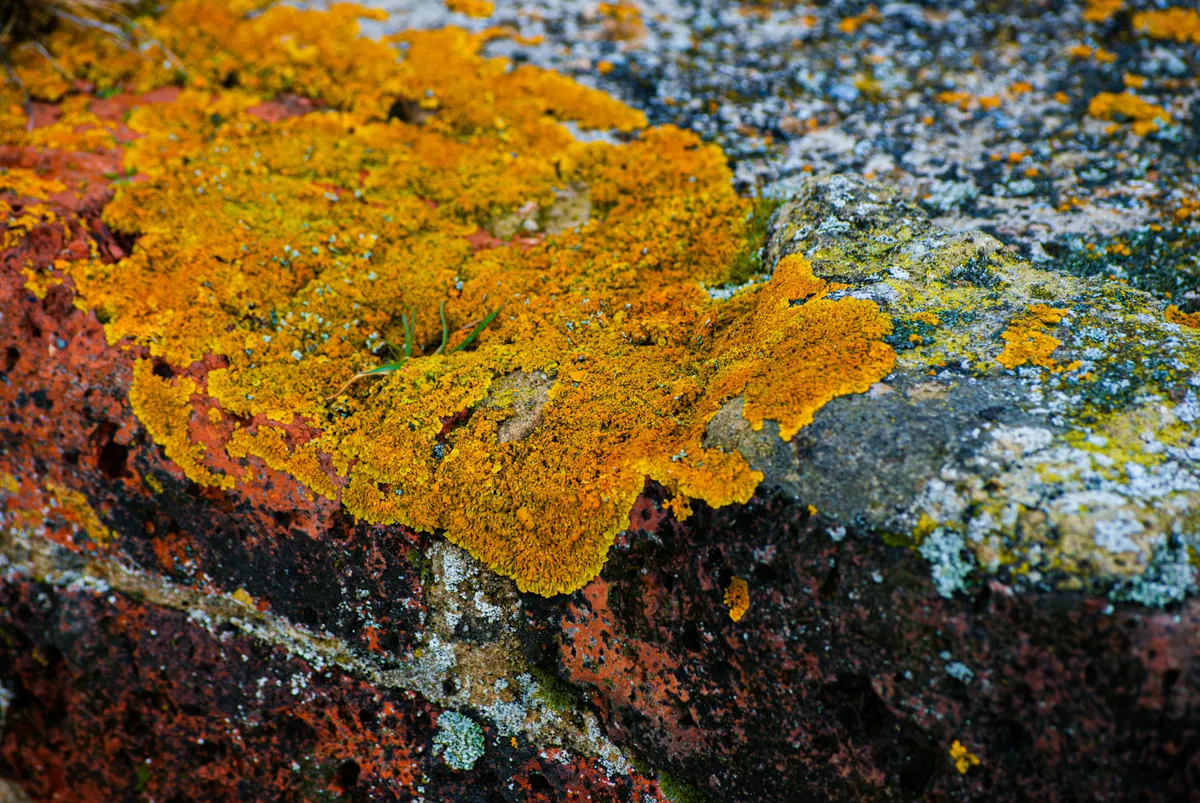 Source: Alex Preusser, 2022.
The Quaker faith of their first caregivers is still common among mould nymphs, and it seems to have had a strong influence on what other religions and philosophies they would adopt: Zen Buddhism, which shares its inward focus and practice of silent sitting, has more adherents among the mould nymphs than does any other religious tradition, while a secular humanist atheism philosophically descended from broader Protestant Christianity is also prevalent. Although they follow the general democratic norms of the Lakelands, their economic and political philosophies vary as much as mundane humans’ do; the only trend is that older mould nymph communities tend to egalitarianism and religious pluralism, clear evidence of those Quaker roots.
Sample Mould Nymph Communities
Bedrock
In the deep woods of northern Ontario, a mould nymph village called Bedrock has been built around a remote former paramilitary contractor HQ and training facility; its founders deliberately settled it to live apart from non-nymphs. The surrounding country is a mix of boreal forest and swamp, all over the rocky Canadian Shield to which its name is partly a reference. (It also symbolizes a desire to build a mould nymph society up from the bedrock.) Its residents live mostly by hunting, fishing, and gathering, which is in some ways easier for them than it is for most other sapient peoples in the region because they can digest woody plants, dessicated meat, and rotting compost much better than anyone else can. During the harsh winters and chilly autumn months they wear clothing made of animal hides and adorned with feathers, evergreen boughs, river snail shells, and other natural materials. They hunt mostly with traps, bows, and spears, but defend the town with the guns they buy on their occasional trade runs to settlements farther south. Despite their heavy reliance on the resources they can extract from their environment, the nymphs of Bedrock have no objection to using scavenged or manufactured goods, and their tools are usually made from a mix of bone, hide, wood, imported and local ceramic, and imported metals that their blacksmiths can easily reshape. The most important goods they acquire on their trade runs, however, are the components they need to repair the wind and solar generators they use to heat and light their homes. When they build new structures, they prefer either temporary timber dwellings they can quickly replace, or else solid stone buildings when they're willing to spend the time mixing mortar and collecting pieces broken off of the exposed bedrock of the Canadian Shield. Although they also use the original HQ and its outbuildings, the by-now elaborate mould and moss gardens that have been growing on them for decades have caused structural damage, and the mould nymphs have had to replace parts of the buildings over the years.
Although the people who live there are mostly non-religious, living according to secular humanist ideals, Bedrock still requires its new residents to undergo an initiation rite: anyone who wishes to be a member of the town must enter a nearby dreamzone with the settlement's abjurers, and they must stay in that tract of swamp until they have found an item of some value they can come back out with. More often than not, what they find is a goetic object that conforms with their hopes or fears. Only mould nymphs are welcome to attempt this rite and become members. Though the town is not unfriendly to other visitors, it is a place apart, and non-nymphs will be encouraged to move along soon enough.
Sarah Grubb Corners
Named for its founder, who in turn named herself for the eighteenth- and nineteenth-century Quaker businesswoman whose collected letters inspired her, Sarah Grubb Corners is a majority-Friends mould nymph hamlet built around a factory that makes PPE as best they can out of the material available. The Bruce Energy Authority (BEA) relies on the hamlet's hazmat suits and other protective gear for work in their nuclear plant, and either despite or because of their commitment to fair dealings, the mould nymphs have done well for themselves in terms of trade. Rather than ornamentation or luxuries, however, they trade for educational materials, electricity, and necessities. Underneath the riotous colour of the typical mould nymph fungal gardens and moss walls, the community's houses tend toward the same clean and minimalist style as its Quaker meeting house has. These houses are typically made from brick, plastered white and washed with nutrients for growth. (The bricks might be scavenged from ruined buildings or made new.) As is common among mould nymphs, they don't wear clothing for purposes of modesty; however, they also take the idea of plain dress seriously if not literally, and they tend not to use clothing as self-expression or beautification, either. When they do wear clothes, it's for utilitarian purposes.
Not only are many of Sarah Grubb Corners' residents vegetarians, most of them are also committed to non-violence and refuse to take up arms in defense of their own town. Only a handful of the mould nymphs maintain a town guard, building and patrolling watch towers around it; these few have successfully convinced the Bruce Energy Authority to invest in them, however, and they have purchased a number of guns and hired a number of mercenaries to preserve the village against beasts and pillagers. These mercenaries are not popular in pacifist Sarah Grubb Corners, but they are well-compensated.
Tri City's Mould Nymph Quarter
Like many cities that are large for the Lakelands, Tri City has a small mould nymph population. Unlike some of those cities, the mould nymphs live within the town limits, rather than in an outlying village. This neighbourhood is vibrant and growing, and many of its residents make plastic-based fabrics for both themselves and for the rest of the city, putting pre-Arrival trash to good use. They make their clothes from these materials, conforming to their neighbours' nudity norms when outside their own homes; most of Tri City's mould nymphs have a fierce civic pride and insist on participating in its public life and its traditions while still working out what it means to be mould nymphs.
As an amalgamation of many once-independent communities, Tri City is religiously diverse, and its mould nymph population is like it in that respect. A large plurality of mould nymphs is Zen Buddhist, however, and indeed Tri City's only Buddhist temple and monastery are in the mould nymph quarter. Out of respect for their neighbours' health, most of the mould nymphs here do not use nutrient washes to grow colourful fungus on their walls, restricting themselves to hardy house plants indoors and elaborate mosaics on building exteriors. These mosaics, made out of colourful bits of scavenged garbage, mostly depict decomposers like mushrooms, mosses, insects, snails and slugs, worms, woodlice, millipedes, and the like, as an elaboration on the fungus gardens they replace. Tri City's mould nymphs can't adopt the local custom of having one's family tree tattooed on one's back, both because they don't take tattoo ink well and because many of them don't have much in the way of family trees. Instead, they sew maps of both family and friends on the insides of the aprons Tri City residents traditionally wear.
Sample Mould Nymph
Earthstar
High Concept: Phlegmatic Wetlands Sniper
Trouble Aspect: A Soft Touch
Peoples Aspect: Mould Nymph
Other: Morning Person
Other: Nerd About Longarms
Other: Raised by Bandits
Top Skills: Notice, Shoot, Wilderness
Basic Fear(s): Suffering
Manifest Fear: ogre-folk
Consolation: decorative gardens
Ideal: Sincerity
Earthstar's earliest memories are of life in a small raider gang camped in the ruins of a swamp farmhouse; he does not know whether the raiders found him stumbling in the wilds, took him from a mould nymph settlement, or otherwise came to look after him. They never told him. Regardless, look after him they did, and a half-nymph woman named Ashley especially made sure he was as comfortable as she could manage, though there was little comfort to go around in that chilly, damp hideout. Under the gang's tutelage he became a competent tracker and sharpshooter, and they put him to work as a spy, sentry, and sniper. Unfortunately, the kindness they showed him taught Earthstar to treat others with kindness, too, and soon enough he was unwilling to continue in a life of pillage and brigandry. With no malice in his heart, he left.
Earthstar, like all mould nymphs, is made from a unique medley of fungi; his colony tends toward plain browns and greys, with the exception of greenish lichen on his head, vaguely resembling short curls, and speckles of bright red splashed across his chest and back. He's knowledgeable about raider gangs, wetlands, and longarms. The last one is a particular hobby of his and though he's not otherwise interested in book learning, he'll peruse any libraries he comes across in the hopes of finding material about historical firearms; most of his information, however, comes from the collectors and gunsmiths he chats with. He works mostly as a guide and escort, supplementing this with hunting, and has repeat clients who appreciate his calm and self-assured demeanour. Although Earthstar is not prone to materialism, he is very attached to his replica Model 1885 Remington-Lee rifle and his large reversible hunting jacket, which is green camo on one side and buffalo plaid on the other.
A Brief Note
There's some hazard, I'm aware, in making up a group of people who pose a contamination risk, in that fascists tend to describe out-groups they don't like as contaminants. I've thought a lot about whether that means I need to change this aspect of the mould nymphs, but I decided to keep it in for two reasons.
The first reason, and the less important, is that as a matter of plausibility I find it hard to see how people made out of fungus wouldn't get their spores on valuable resources. My feeling about hand-waving things away is that you need at least a kernel of an explanation for it, even if that explanation doesn't really work on closer examination. I can't think of any such kernel.
The second and more important reason is that the trouble with fascist rhetoric about contamination is its part in a wider project of dehumanization. There's no reason to share their perspective. We can already live in a society with people who have contagious diseases without treating them as subhuman. I'd be interested in exploring the various workarounds that mould nymphs and their neighbours use to avoid mould outbreaks in food stores and paper records; there's no reason you can't tell stories which allow this to be a practical concern that doesn't result in heartless treatment. Of course, again as a matter of realism, I think it's unlikely that all communities will respond to the mould nymphs as neighbours, even though one of my central outlooks in this game is that kindness and inclusion are important even when they're difficult. That's why this post is the way it is: there are places like Tri City, in which mould nymphs and non-mould nymphs try to make it work together, and there are other settlements which push mould nymphs to the margins or push them out entirely. You can adjust this as needed at your table. In other words, I've come to see this as a repudiation of fascist rhetoric: people are people, and we need to find ways of living with each other even if there are challenges to that.
Of course, if you think I'm still not handling this correctly, please do let me know at cerhendriks [at] proton [dot] me. I promise I'll hear you out.
As always for my Lakelands posts, everything in this post is provisional and subject to change.
It's not quite true, in the same way, that each human is a colony of bacteria, archaea, protists, animals, and indeed fungi in human form, but there is at least a sense in which that's true.↩
Most fungi are not threats to the mould nymphs, but mycoparasitic ones are, such as Spinellus fusiger, also known as bonnet mold.↩