Religion in the Lakelands
A Lakelands post
Religious service was a function never neglected in pioneer days. Whatever the pioneer's circumstances or environment, this, at least, was always vouchsafed to him: that he could meet in a shanty with those of his own denomination and worship God.
— William Johnston, History of the County of Perth from 1825 to 1902, 1903 (reprinted 1976).
Some were surprised by the increase of religiosity in the Lakeland post-Arrival, given that the Unbound's appearance upended many assumptions about the universe, but they shouldn't have been: religiosity typically increases in populations that experience uncertainty, precarity, and hardship, three constant companions in post-Arrival North America. Although there remain more than a few "nones" in the Lakelands, virtually every settlement is majority-religious, and not by a small margin. What follows is by no means a complete account of religion in the Lakelands, but is instead a survey of its major trends.
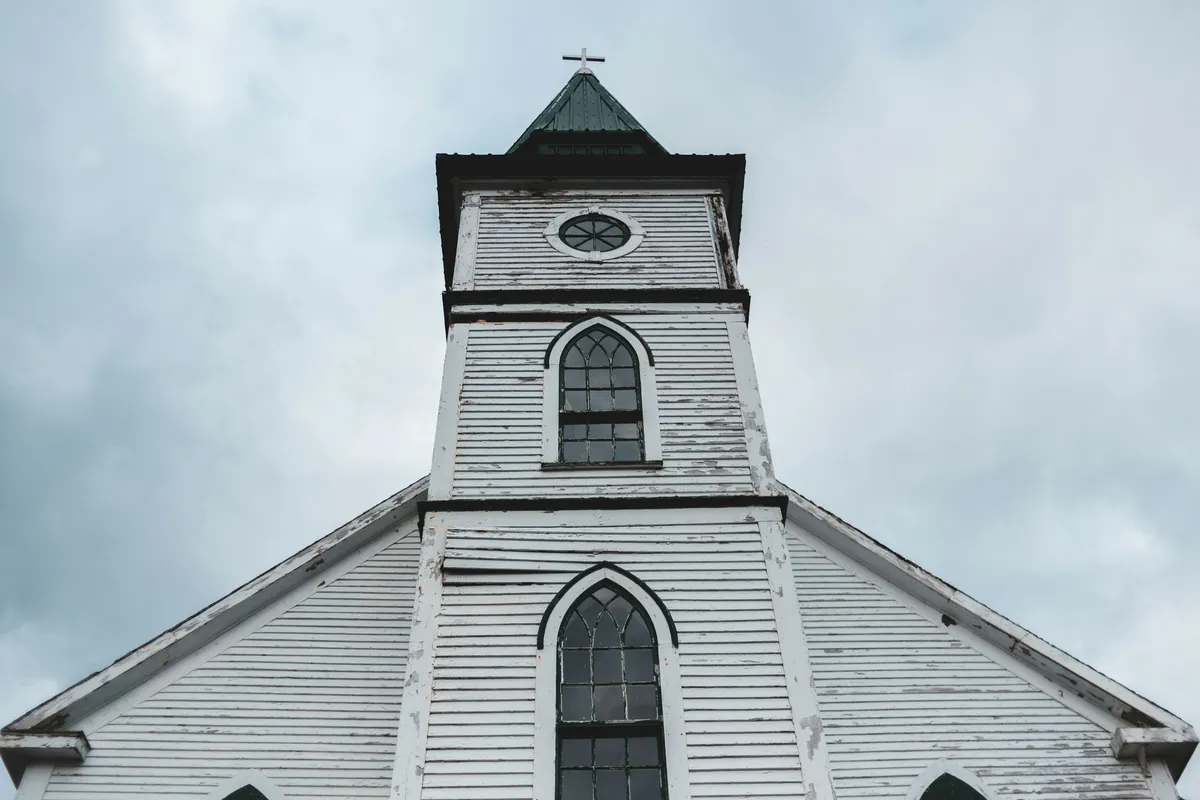 Source: Erik McLean, 2019
If high religiosity remains the same across the Lakelands, what does vary between settlements is religious composition: one town's residents might all attend the same Ukrainian Orthodox church (including the Sarladhiner families), while the neighbouring town of identical size might be split between two small churches, a mosque, and a gurdwara. These different religious compositions create a different texture to public life in those towns: in the first case, Orthodox Christianity almost certainly pervades the first town's civic institutions, either officially or unofficially. In the second town, meanwhile, a certain amount of interreligious acceptance, cooperation, and dialogue is necessary and maybe even celebrated. Regardless, in all cases, religion is as much a community affair as it is a private one and it plays a role in public life that differs according to the community's religious composition. (See, for example, Amilsjatda and Presbyterianism in Mun Dzaadzhazad, Wicca in Voyage, and Quakerism in Sarah Grubb Corners.)
In other words, religion continues to play the same kinds of roles it has played throughout history, with a few very modern exceptions. It also, however, plays a new role: it helps provide a defence against the Weird. Abjuration and spellcraft require a kind of mental discipline and an ordering of desires and attention that is most easily cultivated by religious practice, so abjurers and spellworkers are usually committed to one religion or another. The primary exception is the Psychological-Therapeutic Method (PTM), which uses techniques from cognitive behavioural therapy, dialectical behaviour therapy, and other methods of scientific psychology to provide the same mental discipline, and there's some argument about whether it might technically count as a religion, too. Regardless, although few Lakelanders practice a religion in order to manipulate the Weird or defend against it, certainly everyone has noticed that religious rituals and prohibitions seem to help protect communities from post-Arrival supernatural enemies, which influences how they feel about them. For those seeking Weird powers, meanwhile, there are many small esoteric societies willing to help them on that journey.
As a general rule, among mundane human, geminite, and half-nymph populations, the largest religions in the Lakelands pre-Arrival are still the largest religions post-Arrival. Catholicism has more members than any other single religion, but is slightly smaller than all other Christian traditions combined. Among these other Christian traditions the United Church is largest, followed at some distance by Anglicanism – though the strict separation of Protestant denominations is eroding, as Lakelands churches have stronger connections with their neighbours than they have with their global communions.1 However, Islam as a whole and Hinduism as a whole are each larger than any of the individual Protestant or Orthodox churches, though of course they both have their own internal divisions too. Sikhi, Judaism, Buddhism, the Baháʼí Faith, various neopaganisms, and other pre-Arrival religions also have a presence in the Lakelands, and each boast a slightly larger share of the population than they did in the 2020s, though not always by much.
The biggest difference, of course, is the presence of many new religions, whether they are just new to the planet or new to develop at all. Amilsjatda is the new hominid's animistic ethno-religion, for instance, while Therilatria emerged mostly among mundane humans and Exoreception synthesized and re-inculturated pre-existing UFO religions, both in response to the Arrival and the changes that followed. The drakemantids and amazons, meanwhile, introduced religious traditions of their own, one of which has since been syncretized with Christianity. It's also notable, though, that Catholicism has also undergone serious divisions since the Arrival, as the Lakelands' partial isolation has created an epistemo-ecclesiological crisis.
The Catholicisms
The Roman Catholic Church2 has been divided before and, in the Lakelands, it is divided again. Only a few decades post-Arrival, apparent representatives of the Vatican began arriving in the Lakelands with conflicting teachings and instructions from the Magisterium, on issues pertaining to the Weird and on other pastoral and theological matters. Various explanations were floated for these rival messengers:
- garden-variety grifters and enemies of the Church saw an opportunity in degraded communication channels to gain advantage or weaken the faith;
- the Unbound, unable to cross the Great Lakes themselves, sent agents in yet another attempt to traumatize humanity;
- some of the missives are hrönir, while the representatives have come through from a parallel reality in which the Pope or the Magisterium made different pronouncements.
Unfortunately, no one knows for sure which of these explanations are true and, even if they did, it would not always help identify the fakes. With little way to authenticate which messages were truly from Rome and which were not, a crisis began brewing among the Lakelands' Catholic parishes.
In the midst of this confusion, a group of Catholic integralists congregated in Rochester, on the coast of Lake Ontario. As with all integralists, they envisioned a political order subordinated to the Roman Catholic Church, despite the Church's official rejection of integralism. That might seem like a paradox, but they had a solution: given Catholic Lakelanders' inability to trust any messages from the Vatican for the time being, they organized an American Magisterium to act as a local representative for Church tradition and hierarchy until confidence in communication with the Pope could be restored. This Magisterium, of course, supported integralism, and Rochester became a Gelasian dyarchy, with its government subordinated to the American cardinals.
Most Catholics reject Rochester Catholicism and consider it to be Protestantism, sedevacantism, or both, by another name. (Although it isn't in any meaningful sense Protestant, it has always been influenced by sedevacantism.) However, there are parishes and individual Catholics throughout the Lakelands who find the Rochesterian arguments convincing and its more dogmatic and authoritarian style attractive, and the Catholic community in several towns and regions is increasingly divided between those who try to remain faithful to the Pope and those who have thrown their lot in with the American cardinals. In the intervening decades, the American Magisterium's teachings have drawn increasingly on sedevacantist rhetoric and attitudes, and it seems likely that it will soon stop describing itself as a provisional body that only has authority until confidence in communication with Rome can be restored.
Rumours flew when conflicting messengers first appeared claiming to be from the Vatican, and so too did rumours fly when Rochester became an integralist dyarchy. Some say that the integralists sent their own false messengers claiming to be from Rome, purposely destabilizing the faith, or even that the Rochester Catholics are secretly controlled by an egregore, an idol, or even an Unbound. In reality, that's all half-true. Though the integralists were not responsible for the earliest false missives, they did get in on the action when they realized how it benefited them. And while the integralist movement long pre-dated the Arrival, and no eldritch horror controls them outright, an Unbound called the Concord of Dust does support them and has agents and informers embedded within the movement.
New Religions Among Mundane Humans
Two major religions have emerged among the mundane humans of the Lakelands: Therilatria and Exoreception.
Therilatria is a transtheistic religion focused on the worship of a number of monster-deities called the Divine Monsters, emanations and revelations of an ineffable Divinity or God-Beyond-God. Although Therilatrians believe that all or most other religions worship different revelations of the same God-Beyond-God, they claim that the deities of Therilatria are the most appropriate channel for contemporary Lakelander worship. According to them, that's because these monsters reveal3 facts about Divinity and the world that other religions have historically obscured and for the most part still obscure, and they say these facts are uncomfortable or confusing when first encountered but are comforting when better understood. Therilatrians attribute the discovery or rediscovery of the Divine Monsters to a circle of prophets who appeared in the decades following the Arrival, but religious scholars are quick to point out that Therilatria has obvious roots in classical and Norse mythology, Paul Tillich's theology, the mythopoetics of William Blake, Jungian psychology, the fiction of H. P. Lovecraft and his collaborators, and (to a lesser extent) late pre-Arrival religious movements like Discordianism. It doesn't have a stable pantheon of Divine Monsters across communities, but common ones include Eris, the patron of needful conflict; Saggath, agent of change and instability; and Kerberus, warden of death and the arrow of time. Other Lakelanders often consider Therilatria a cult and believe Therilatrians practice sorcery and worship egregores or the Unbound, but in truth theirs is a more-or-less normal religion, if unconventional.
Exoreception is a syncretistic blend of UFO religions that emerged out of the immediate post-Arrival decades as non-religious urbanites and suburbanites, then relocated to small towns and countryside refugee camps, reckoned with the appearance of extradimensional beings. These seekers and their neighbours turned to various scraps of UFO churches, cults, and conspiracies for answers. It most strongly resembles Raëlism, especially in its materialist philosophy, but it also incorporates elements of Scientology, the Ground Crew Project, Falun Gong, Mormonism, the Church Universal and Triumphant, and other historical UFO religions. It usually reframes the New Age or traditionally religious elements in more modern scientific (or pseudoscientific) language. Furthermore, it developed novel beliefs and practices in response to the Unbound, which it teaches are enemy aliens opposed to the Ascended extraterrestrials from whom the Exorecipients await deliverance. Smaller than Therilatria and even less influential, Exoreception is more likely to become the high-demand, high-control groups that many Lakelanders fear the Therilatrians are. Not all of its communities become cults, however, and some of those that do are only dysfunctional in mundane ways, not involving egregores, idols, or the Unbound. However, the catastrophic ruin of New Buffalo and the disappearance and likely deaths of several travellers through the so-called Saucer Belt suggest the religion is more vulnerable than usual to cooptation by supernatural forces.
Amilsjatda
When the new hominids migrated out of the Black Hills, they brought with them the animistic beliefs that gave them identity outside of the society the Howling Rustic created for them and helped support their resistance. After they encountered other peoples with other religions, they started calling their own system of belief and practice Amilsjatda. Since then, it has both become more institutionalized and more internally diverse.
Amilsjatda teaches that a host of spirits protects and guides the new hominid people, and these spirits come in two types: the angels, or animal spirits, and the saints, or folk heroes. However, no one worships or treats with the whole host of spirits; instead, each individual is expected to venerate three of these spirits in particular and to champion those spirits' moral values or adhere to their moral laws. When a new hominid is born, their mother chooses one tutelary spirit from among her own and places her child under that spirit's protection, while a trusted Amilsjatda teacher assigns the child their second tutelary spirit. Each new hominid finally takes a third spirit for their own when they come of age, after a period of instruction in the names, characters, and expectations of all the angels and saints known to their teacher. Negotiating the different moral and ritual expectations of these three spirits characterizes the new hominid's spiritual and ethical life for the rest of their days. By aligning with the angels and saints, the practitioner also thereby aligns with the true laws of the world that are hidden from most mortals, and thus begins to escape from their enslavement to the chaotic powers that pervade the world.
That said, although Amilsjatda can have an individualistic character, like all religions it is communal in at least some respects, especially as the inherited spirits are usually shared by most or all of a family and the teacher-assigned spirits are usually common to a settlement or caravan. Everyone in a region who shares an angel or saint takes care of the spirit's shrine together, and the whole community celebrates the feast days of those spirits most popular among them. Moreover, new hominids might honour a spirit on their feast day, even if that spirit is not among those they call their own, and new hominid workplaces and delver crews often take spiritual patrons whom all members call upon, regardless of their relationship with that spirit.
Amilsjatda acknowledges many spirits, but the following six are the most prominent and widespread:
- the saint Pfajtrod Rist,
- the saint Swandentun Rist,
- the angel Zun Bineen, or Pony
- the angel Zun Muhaadu, or Sheep-Goat
- the angel Zun Tstawla, or Crayfish
- the angel Zunnandur, or Turkey.
Extraterrestrial Religions
Although the planet Yir and its moon Sdikga were home to many religious movements, each with its own internal divisions, the drakemantids and amazons brought only three of these to the Lakelands. There, they developed a fourth.
The oldest of these religions is called Lidjetira in Ladhis (a Sarladhiner creole common in the Lakelands), roughly meaning "the great service." It tries to establish balance between the One and the many, and between the two principles that eternally emerge from their interaction, synthesis and division. In practice, this means both adherence to the Law and personal devotion to "the God and the gods" that emerge, in turn, from the eternal interaction between synthesis and division. Lidjetira pre-existed the Sulphur Herald's first empire on Yir, though it was then not so much a single religious movement as it was a family of syncretisms between two older religions, one monotheistic and one polytheistic. It was suppressed during the Herald's empire and afterwards it was one of only a few ancient religions to get a revival. This revival significantly systematized, institutionalized, and updated Lidjetira.
Kitnasat, by contrast, emerged as a resistance movement against the Herald's regime and ideology, and survived the empire's collapse. Under the Unfolding Emperor's control, and pessimistic about their chances of escaping the regime, a number of Sdikga philosophers felt the only hope of liberation was through denouncing the fallen world in general, systematizing that hope and denunciation in Kitnasat. The earliest generations of this new religion tended toward political resignation, staking everything on mystic experiences and the promise of an afterlife. Later generations, however, found a radical potential contained in Kitnasat: if the body doesn't matter, then there's no reason to avoid the risks of political resistance. Extremists even argued there was no real harm in collateral damage in their terrorist attacks. Of course, the Herald's agents swiftly began suppressing the movement. Afterwards, when the Herald left Yir and Sdikga, Kitnasat became a mainstream religion, though still with politically resigned and politically radical elements. It also still teaches that mortals are divine fragments trapped in the material world, and that true freedom lies in renunciation.
Chanitad has a different story altogether: the panentheistic tradition descended from the Sulphur Herald's own cult. When the Unfolding Emperor's agent finally left, lower-level local leaders successfully attempted a reform movement in the cult, and succeeded. The cult once taught that the Herald was the emanation of the Unfolding Emperor, who was in turn the emanation of Fate (Dha in Ladhis, sometimes translated into English instead as "the Origin," "Truth," "the Creator," or, controversially, "the Way"), that created and contains all universes. In worshipping one, they said, the peoples of Yir and Sdikga worshipped them all. The hierarchy tried to continue fostering the worship of the Herald even after it left, but the clergy most directly involved with the people understood that approach was doomed to failure. They began asserting that the Unfolding Emperor had only pretended to be the emanation of Dha, usurping its rightful place in worship. In this way they were able to maintain much of the cult's lower-level structures while substantially democratizing them. Due to its history, Chanitad can tend toward the impersonal, without gods or prophets or saints; despite this, it is not disembodied, fostering an awareness of the physical world as an emanation of the Creator and encouraging people to nurture relationships with one another in respect of every individual's participation in the Creator.
In the last forty years, a Lidjetira-Christianity syncretism has emerged in North America. It may have started not as syncretism but as an attempt by amazons and drakemantids to inculturate Christianity (Kristatira in Ladhis) into their own inherited cultural norms and philosophical frameworks; however, before too long it borrowed enough from Lidjetira that it is better understood as a fusion of the two religions. Called Trintetira, it sees the Trinity as a revelation of God as both One and many. In other words, where Lidjetira sees the God and the gods as subordinate entities that emerged out of the interplay between two primordial forces, Trintetira sees the One and the many as aspects of God, coeternal with God. Although they have much of the same physical stuff as Christianity, with churches, crucifixes, bibles, rosaries, and communion trays, how they use and understand these is most often quite different. For instance, their bibles exclude books from both the Old and the New Testaments (which they call the First and Third Testaments respectively) and including various books of Lidjetira law and devotional poetry as part of a Second Testament.
No Lakelander has yet discovered what creeds the psanzomv hold.
According to Statistics Canada, in 2021 the single largest non-Catholic Christian group in Ontario is "Christian, not otherwise specified"; this group might be composed of all sorts of denominations, but my guess is that a large share is a specific kind of Protestant Christian that resists denominational labels (sometimes even to the point of denying they're Protestant) while drawing almost exclusively from the American evangelical movement for its theology, polity, and rhetoric. I'm more or less ignoring that here because I don't think this kind of denial of historical and denominational identity is really going to be tenable in the Lakelands; these groups will either join up with a network that has an actual name, or they'll fracture into highly idiosyncratic little churches that are only related to one another by history and no longer by shared practice or belief.↩
I understand some Catholics consider "Roman Catholic" to be derogatory and, although I'm not persuaded that's true, I would in general prefer to use an endonym anyway. Unfortunately, the Roman Catholic Church's endonym in English is just "the Catholic Church," which a) frustrates attempts to disambiguate it from other churches who call themselves Catholic and b) concedes too much to the Church's claims to sole catholicity that every other Christian tradition denies. I do actually need to distinguish the Roman Catholic Church from the Old and New Catholic Churches in this situation (and, furthermore, I don't like speaking as though the Union of Utrecht isn't also Catholic). When the Roman Catholic Church chooses an endonym that disambiguates it from other Catholicisms, I will happily use it; until then, I'm going to have to use "Roman Catholic" sometimes, as in the above paragraph.↩
I'm deliberately invoking the etymological relationship between "monster" and "revelation," if you're wondering.↩