What My Games Look Like
Back in February a handful of ttrpg bloggers, starting with Grace at 400 independent bathrooms, wrote posts describing what their games look like. (See, for instance, xaosseed's at Seed of Worlds and Phlox's at Whose Measure God Could Not Take.) The purpose, as Grace puts it, is to help you figure out where a particular blog is coming from and assess its author's opinions accordingly:
Something I read recently (I'm sorry, I don't remember what it was) reminded me of just how differently people play elfgames, even when they don't realize anyone else plays another way. Thought it might be useful for readers of my blog to know what my games look like, in order to calibrate the way you read my opinions and material.
I think that first line suggests another benefit, however: a lot of disagreements in this hobby (or at least in the online chatter about this hobby) come from the fact that many of us take for granted things that really can't be taken for granted. One step toward solving this problem is just for more people to describe what they do when get together at a table with friends to roll dice and to play roles. To that end, I think posts like these are a great idea.
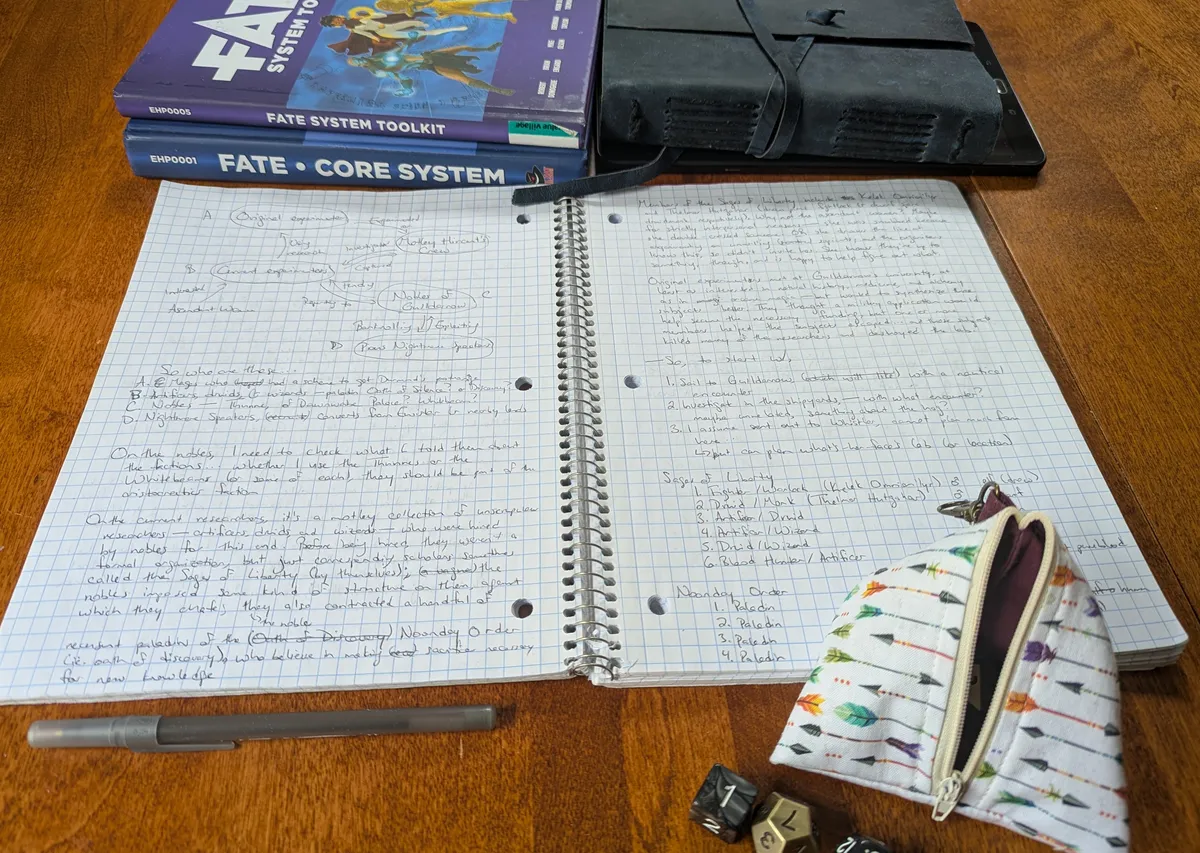 Source: my own photograph, April 2026.
What follows are descriptions of my three current games, for various definitions of "current." I'm not restricting myself to so-called elfgames1, because if I were to do that I'd fail to show how different the games I run can be. I reserve the right to add more points to each as they occur to me. In the future I might describe some of the games I once ran, which all had their own idiosyncrasies.
I highly encourage you to write a similar post of your own.
The Fortunes of Ewistar
I run a 5e Dungeons & Dragons campaign for three players that I call The Fortunes of Ewistar; we've been playing with the same characters, and the same storyline, since early 2019. It's come up on this blog a few times, so I have a tag for all posts concerning this campaign. I've never met the in person; two of them I knew on Twitter and recruited to the game from there, and one of those introduced me to his friend, who's now the third player. We started at level 3 and will play to level 20 so long as everyone is still interested. This was my first campaign, so a lot of what I do now was developed through trial-and-error. In no particular order, our games look as follows:
- We play exclusively on VTT. We started out on Roll20, then migrated to Foundry hosted on Forge, and now play on Foundry hosted on one player's home server.
- Due to player timetable constraints, our sessions run for one-and-a-half to three hours. We usually start with chitchat, catching each other up on our lives or discussing things that have been in the news.
- We try to play every week, but that doesn't often happen. If one player cannot make it, we play one of the back-up anthology sessions I have prepared, as I discussed in a previous post. These anthology sessions take place in the same setting but aren't focused on the PCs. If two players cannot make it, we don't play.
- When we know we won't be able to play for an extended period (a month or a month and a half), we will blue-book a bit, though this has been more successful some times than others.
- I now extensively use battle maps, various digital handouts, and occasionally complicated minigames (like this one), which creates a not-insignificant prep burden. At the start I planned to use theatre of mind much more often, but it didn't really work for us. I eventually realized that I was going to have to provide a map one way or another, so it's better to make good maps in advance rather than poor maps in the moment. The setting map we use, on the other hand, is still the amateur-looking one that I made in Google sheets, which has the benefit of allowing me to keep track of distances. Unlike battle maps, however, I prepared handouts from the start. The minigames initially were a response to things the players wanted to do that were better handled with bespoke procedures, but I now plan for them in advance.
- Most of my planning happens in a notebook dedicated to the Fortunes of Ewistar, but I do also have a Google sheet for anything that is better handled as a spreadsheet and a Google doc for anything I don't want to bother writing out by hand (like vendor lists). I also have private handouts in a DM Aides folder in the VTT, for things I need even more readily available. I have all of the D&D books I own lined up next to my desk for quick consultation, and of course anything else I might need is a Google search away.
- In theory we use milestone levelling but Matt Colville is mostly right that it's levelling by GM fiat, in that I determine what counts as a milestone. (I'm pretty sure it was Matt Colville who said it, but I can't find the video now.) I have an idea for changing to something more player-driven, but I have yet to implement it. Levelling has been unusually slow by most people's standards, in part because of short sessions and fairly frequent absences.
- The Fortunes of Ewistar is a homebrew campaign in a homebrew setting. I stick pretty close to 5e Dungeons & Dragons stat blocks, flavour-text, deities, and planes, but I do make adjustments for reasons of anthropological plausibility or expand on things that I feel are underdeveloped. I also draw from Kobold Press products, Hit Point Press's Humblewood Campaign Setting, and Atlas Press's The Star-Shaman's Song of Planegea. Specific locations, characters, and factions are all original, however, and I have homebrewed some items and creatures.
- I started with a tightly-scripted adventure in order to segue into a sandbox framework. However, my players seemed to flounder a bit with less structure and one of them told me that he doesn't mind "sitting on a rail for a while," so I've started to make much clearer adventure hooks and to direct the party toward particular situations for them to explore or problems for them to solve. The players have responded very well with this approach (in combination with the next point) and will sometimes seek explicit confirmation about what we are headed to next. They, of course, remain free in how they confront a situation and they often surprise me in that regard. I also often tell them explicitly that they don't have to pursue a particular adventure if they don't want to, but they haven't turned one down yet.
- In order to compensate for the above shift, I solicit player feedback on a roughly annual basis using Google Form questionnaires, asking which hooks they are most interested in pursuing and what kinds of topics they want to encounter more often. I take this feedback quite seriously, though it sometimes takes a while for me to get to the material they're interested in pursuing.
- We tend to oscillate between zoomed-in roleplay and zoomed-out roleplay; players are more likely to act out their characters' conversations with each other, with beloved NPCs, or with enemies before and during combat encounters, and are less likely to do so with shopkeepers, their patron the queen, and so on (though they still do so with the queen, depending on the situation). I'm OK with people describing the general shape of what their characters say rather than trying to say it word-for-word, especially when there's a gap between a player's eloquence and their character's.
- I very rarely roll on encounter tables or otherwise use random generation. Until recently, the most frequent randomization was to help me make a decision for an NPC who I didn't feel I knew very well, or to determine things like, "Is the NPC present in their quarters right now?" if something along those lines comes up. However, for the current Feywild arc, I decided to try a hexcrawl, so that's what we're doing now. I've used a few activities that used encounter tables but, otherwise, everything is pretty hand-crafted.
- My players do not tend toward shenanigans and tomfoolery, except in the service of the campaign, ie. unexpected and dramatic moves that change up the story but make sense for their character within the fiction.2
- My players take some notes, but it's not really a priority for them unless I specifically call attention to the fact that they might want to do so at a particular point. I try to facilitate notetaking by building documents in the VTT for notes (including both public and private notes for each player). One player is more diligent in notetaking than the others, which I believe is normal.
- I originally rolled behind a metaphorical screen, but I now roll openly so that players can more easily apply damage and such. This means I can't fudge dice, but I didn't really fudge dice anyway.
CoD/Fate Core Horror Game, aka Three Friends Horror Game
Three Friends Horror Game is a misnomer, I suppose; I run it for three of my friends from grad school, so there are four of us. At best you could say that each of us plays it with three of our friends. Still, that's what I call it. I discuss this game much more extensively in my post last October about prepping horror games, but I'll still give an appropriate breakdown here. It started as a Chronicles of Darkness mini-campaign that ran longer than intended, but I've run a few more scenarios in Fate Core for the same three players using the same (converted) characters.
- We're geographically dispersed, so we play in Roll20 and always have.
- We play extremely infrequently, due to player limitations. By "extremely infrequently," I mean a handful of sessions a year. It's really more like a few attenuated mini-campaigns than a proper campaign. We only play when everyone is available, though at the start we did occasionally play when one player wasn't present, by her own request. Her character and the initial scenario were designed with this in mind.
- Originally we played for two- to three-hour sessions, but lately we've been carving out time for longer ones (three and a half or four hours).
- Although I didn't originally, I now prepare notes in the book I've recently started using for all my ttrpg one-shots and short campaigns. I have a copy of Fate Core next to my desk for consultation, as well as digital copies of the relevant Chronicles of Darkness books saved to a drive on my computer in case I need them (though I usually convert any material I need into a Roll20 doc or notes in my notebook before the session, so I haven't needed those PDFs so far).
- I stick pretty close to the Chronicles of Darkness entities and cosmology, though my players know none of it and therefore I probably wouldn't have to. Still, this kind of fidelity is in my nature and, besides that, I just like Chronicles of Darkness stuff.
- I sometimes prepare "battle maps" ahead of time, which in Fate Core are mostly just vague shapes labelled for the different zones; however, I don't always know in advance where combat will be, so sometimes I make them on the fly or use theatre of mind. I sometimes also prepare image boards to set the stage. What I use much more heavily are handouts, describing artifacts they find or detailing information characters discover during research. For the most recent adventure, I also prepared a document setting up the scenario and recruited one of the players to help me introduce it.
- We have occasionally done a bit of blue-booking between adventures, though as is frequently the case, I am more invested in it than the players tend to be.
- I always come up with the scenarios, which the players are free to engage with however they like, though most recently we had to have a conversation about how I envisioned the game going because they were suffering from objective creep. (It was my fault; I was trying to hint at a more expansive world, and they were reacting to each hint as though it were a hook.) However, for diegetic reasons the characters are now starting to move from "people who keep running into supernatural problems" to "amateur supernatural investigators," so going forward I will probably involve the players more heavily in the campaign-planning phases.
- I almost never use random tables, though I might roll a die to determine the answers to questions I have unprepared (like, again, "Is the NPC in the office right now?"). The exception is dreams: I started last session by rolling on a table to determine broadly what each PC was dreaming about, and asked each player to give me more detail. I think I'll continue this practice for this campaign.
- The players try to avoid fooling around, but sometimes wind up doing silly things anyway or going off on a wild tangent by accident, because their attempts to engage with what I have prepared become chaotic misadventures. They say this is because they aren't very good at ttrpgs, but I suspect some portion of it is that I could work a bit on my signposting. Different groups interpret signs differently.
- We tend toward zoomed-out play, but do zoom in at various points; in these points, we often oscillate between zoomed-in and zoomed-out. Even during zoomed-out play, however, the players are usually pretty careful to characterize the PCs. Planning and interaction between the PCs is mostly done out-of-character and we use in-character roleplay more often with interaction with NPCs.
- I have prepared private and public documents so players can take notes. One player, however, is the unofficial notetaker, and she's quite thorough. We did all go to grad school together, after all, and she's very much the note-taking type.
AllOut Apocalypse Char Game
I very sporadically run a game for my brother Nick and his 9-year-old daughter, using the rules-light AllOut Apocalypse system he designed. Some, but not all, of what I've tagged "All-Out Apocalypse" is about this campaign (if it can be called that).3 These games happen whenever I visit them for long enough that we can make time for a few sessions. I can't remember whose idea it was for me to run this game – it might have been Nick's? Anyway, part of the idea is to help him playtest the system. It takes place in a toxic burnt-out landscape, drawing partly on Fallout 76 and partly on my own experiences in forests and parkland after Albertan wildfires.
- We play in person at a kitchen table. Character sheets are written on scraps of paper, which we try (and sometimes fail) to keep track of. My plans are kept in my current general-purpose notebook, though I borrowed some hex paper from my brother for the pointcrawl map.
- Our sessions are between one and three hours long, probably with a mode of an hour and a half, though I don't trust my memory on that. However, I usually visit for a few days when I'm there, so we'll often get two or three sessions in over the course of a long weekend.
- It started out as a fairly tightly-scripted scenario based on the character motivations my two players gave me in our Session 0; I had approximately no ideas for the game at that point and built a scenario out of the motivations they provided. After that little adventure was resolved, I decided to proceed with the game as a pointcrawl, representing a portion of the Char, especially focusing on the elements the players reacted to and said they wanted to engage with further. I haven't read much about pointcrawls, so I might not be doing it the way most people do, but my brother's read or heard much more about pointcrawls than I have and he seems to think it's fine.
- Everything is theatre of mind, though on one occasion my brother (a trained and professional artist) usually sketched out a caravansary's layout based on my description. I have my tablet available with the AllOut rules document and my own system-compliant bestiary ready for consultation at a moment's notice. (You can find an abridged version of my bestiary here.)
- The players have access to the pointcrawl map and can fill out the key I've prepared as they explore. I have a master key in my notebook; the players don't have access to this. Otherwise there are no handouts.
- In theory we level up however it says we're supposed to it in the ruleset. I think this winds up being mostly GM fiat. It has not yet come up much, because we don't get to play much.
- There is no standard AllOut setting nor any AllOut modules, so this campaign is by nature pretty original. That said, some of the creatures and robots from the original ruleset do borrow liberally from other post-apocalyptic franchises, and I also repurposed by own necessarily-doomed Fallout 5 ideas for this game.
- We roleplay a bit more zoomed-in than in my other campaigns, but do zoom out sometimes for certain conversations, depending on how the players feel. In some ways, this feels a lot like an evolution of the pretend-play I used to do with my niece, so zoomed-in roleplay feels fairly natural. We can spend a lot of time on roleplay or very little time on roleplay depending on her investment. (See my post about beginnings for more on that.)
- As I mentioned before, I prepare material based on what the players tell me they want to do. However, sometimes my niece gets big ideas mid-session and wants to go do something else; my brother kindly helps me redirect her toward the material I had prepared. As always, the players are free in how they approach problems, and a pointcrawl intrinsically affords a certain player agency. It's also worth mentioning here that my niece wants to scavenge very frequently, so we spend a lot of time on it. That's fine. I like seeing what comes up on the scavenging tables, and it's genre-appropriate.
- Other than the two above points, they mostly avoid in-game goofing off, though the 9-year-old may at times get distracted out of the game. She is, after all, nine.
- Now that we're in the pointcrawl part of the game, I use encounter tables extensively. The map key is not randomized, of course, but nearly everything else is.
- My brother takes some notes, though it's not a game that requires a lot of notetaking and I frankly haven't paid much attention to how many notes he's taken. There are different factions at play in the world, so there are some things to keep track of, but interacting with those factions is strictly optional.
Of course there's a lot more that can be said about all of these campaigns, but there is such as a thing as too much detail for the situation. Perhaps I'll write other posts which look at specific topics like "romance and relationships" or "pacing," which necessarily vary greatly across tables.
I read recently that "elfgames" means something more specific than "generic heroic fantasy," and indeed may not include heroic fantasy at all? I think most of the time I see it used, however, it refers to standard kitchen-sink fantasy games, contra that original meaning. Regardless of Grace's intent or anyone else's, I don't like the term and I don't care much about whether my games fit in that category.↩
Grace relates in her description of Bart's games something that might pertain here: some players seem less inclined to goof around when the GM has put more effort into the campaign narrative or situation. That's maybe what's going on here, or maybe I've chosen players whose sensibilities are more like my own in this regard.↩
I thought he was using a hyphen in the name when I started tagging these posts, but the mistake might well be mine.↩