Guest Post: What Some Other Guy’s Game Looks Like
In my excitement about the "What My Games Look Like" post trend (see the first here and mine here), I told the other GMs in a Discord server I'm on that I'd host their posts on this topic if they cared to write one up and didn't have a blog of their own. One such GM, Luke, has taken me up on it; what follows is his account of a 5th edition Dungeons & Dragons campaign.
What Some Other Guy's Game Looks Like
Hello there, this is not your regular captain speaking, but rather the titular Other Guy. My name is Luke, and Christian, who has run a game for me previously using the Fate Core system, invited others that he knew ran TTRPG games to write about their games as well. My experience with TTRPGs started with D&D 5th Edition in 2020 (likely a common experience), and I’ve since played short games in various systems, including Call of Cthulhu, Pathfinder 2nd Edition, Dungeon Crawl Classics, and the aforementioned Fate. However, I primarily still play the 2014 version of D&D 5th Edition, and the two campaigns I run use the same. Here, I’ll be talking about my main campaign, a heavily homebrewed version of the 3.5e module Red Hand of Doom, which I discovered through the recommendation of Matt Colville (this post will include some spoilers for the module, although most big spoilers are things I homebrewed in).
Campaign Overview
This campaign has spanned nearly four years and 71 sessions now, running from character levels 5-10, and is my first (and only, so far) long-running campaign (although I had run several campaigns on the ~6 session scale prior, two of which were prequels to this one). I have three players currently, unfortunately only one of whom has been a player for the entire campaign; I began with four, lost one and gained two after the first arc, then lost three throughout the second arc and gained another.
The campaign itself centers around the premise of a goblinoid warband marching on the valley civilization of the Elsir Vale, threatening to conquer the various towns along the way and ultimately overtaking the Vale’s largest city, Brindol. Throughout the campaign, the party has realized there is more going on beneath the surface: the horde’s leader, Azarr Kul (a half-hobgoblin and half-dragon), has set the stage for the siege of Brindol to be a large scale ritual sacrifice to unleash an ancient primordial imprisoned beneath the nearby ocean.
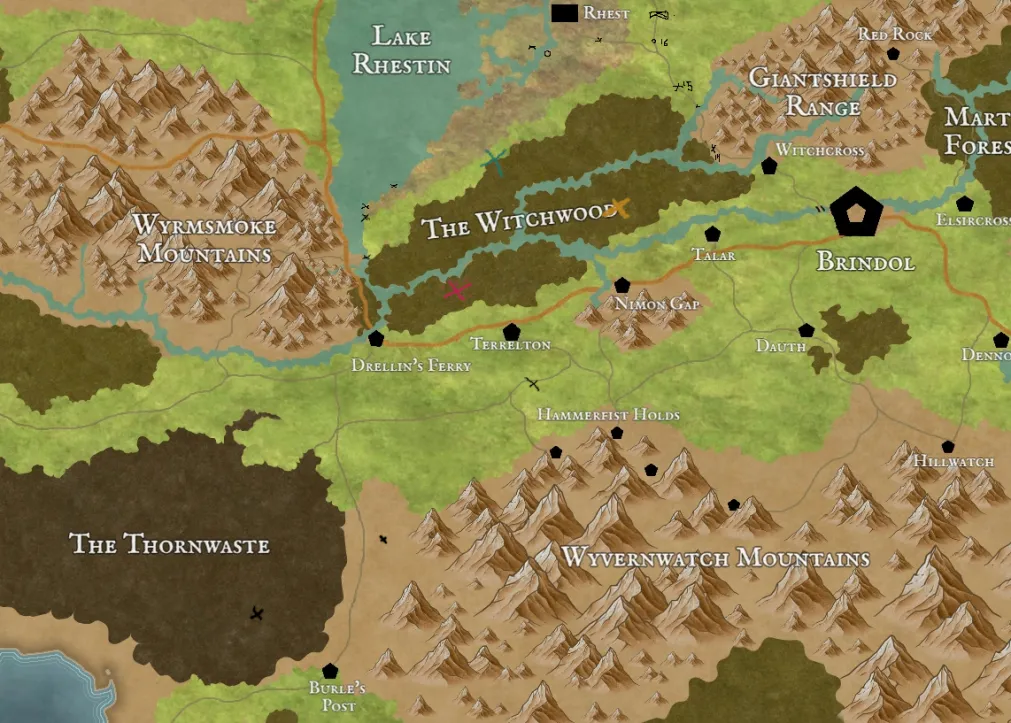
My campaign map, with various markups to track player travel. I used the measuring tool in GIMP to count pixels and converted pixels to distance when determining travel time.
Core Philosophies
The thing that makes my campaign tick, at its core, is decision making based on limited resources. Perhaps stated another way, mechanical and narrative limitations (such as character abilities, time, or available resources) serve as the fuel for actualizing the players’ agency.
The biggest example of this is time. Underneath the entire campaign, there is a running clock: the Red Hand’s army will arrive in Brindol, if unhindered, in just under forty days from the beginning of the campaign. This immediately lets every choice of where to travel, how long to spend somewhere, what to pursue, etc. have an actualized consequence in the form of how it affects this final battle: perhaps in which allies are recruited or arrive in time, which antagonists are still kicking by the time the battle starts, and even the date of the army’s arrival, which can be delayed by taking particular action to impede their march.
The same is also done with smaller-scale timelines; several extended processes in the campaign world are placed in the timeline with incremental steps, some resulting from the PC’s actions and others from something in the background. This lets me track where certain factions are and how much progress they’ve made, which further allows the PCs to organically interact with them in a concrete way.
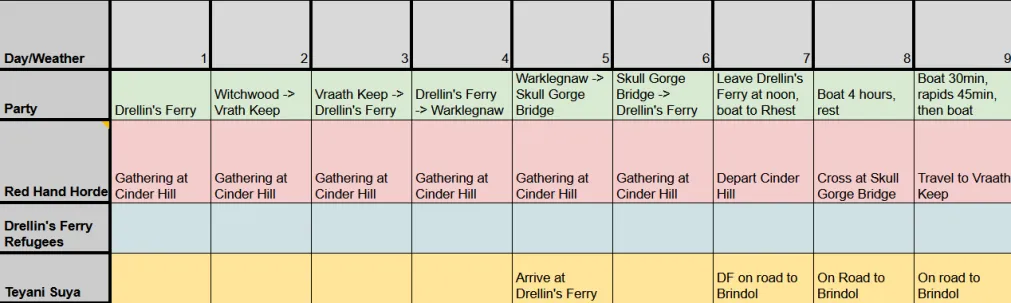
A screenshot of my campaign timeline, which I keep in Google Sheets.
This idea of agency actualized through concrete limitations goes in tandem with another core philosophy, that being Don't Prep Plots (per The Alexandrian’s article). I believe fairly strongly in setting up a situation and its context, and then allowing players to choose how they want to operate from there. I’m not so convinced this actually requires less work, like Justin Alexander suggests (in short, I think prepping a plot just feels worse to play, but is probably less work if anything), but that’s another topic. This does require a good bit of up-front planning (like making the map of the campaign setting traversable to key points within the expected timeframe, for example), but having a concrete situation that the players can operate within is, in my opinion, critical to the sort of tangible decision making that is core to my game. I also don’t always have all the details of every last thing ironed out beforehand, but it does mean I try my best to continue prep in accordance with a sort of “current status agnostic” or “per original intent” mindset; for instance, I might not have the next fight prepped, but I will not prep that fight based on how well the last one went. Instead, I will prep it in accordance with how hard I intended it to be; if the players have made smart choices, it might end up easy, and if the players have had some bad luck, it might be worth reconsidering.
This is not an end-all be-all mindset in my games (nor the only way to have meaningful choice), but I find it works well as a basis. However, when running a TTRPG, there will always be things that need to be a little more floaty than concrete. A simple example might be an investigation; information being in precisely a certain location rather than floating around with multiple avenues for discovery is probably going to grind your investigation to a frustrating halt (The Alexandrian has another good article on this here: The Three Clue Rule). In any case, this idea is still core to how I prep and how I run, and I have consistently gotten feedback from my players that it makes their decisions feel impactful and important.
At the Table
I talked a lot about the core mentality I take when running, but haven't said much about what it looks like practically. In terms of The Six Cultures of Play, I think my game is fairly solidly in the Trad camp. I do a lot to integrate my PCs’ stories into the campaign and its setting (such as replacing a high ranking Red Hand leader with a backstory character, or working with another player to let him play a hobgoblin tribe leader that escaped the horde’s recruitment), but, ultimately, regardless of who the PCs are and what they personally want, Azarr Kul is marching to Brindol to destroy it; so, what will you do?
We have played (all but one session) online, using Discord and Roll20. I have told myself I’d figure Foundry out and switch to it for, like, two years now, but just never have. I have made zero battlemaps myself during this time; my method is that I save any battlemaps I think I might use as I’m wasting time scrolling Reddit and pull those in, searching for maps if I still don’t have one I need. But I certainly prefer having a battlemap, as my encounters are usually fairly tactical and involved.
My players and I both enjoy the “in-character” aspect of roleplay a considerable amount, so we spend a lot of time speaking in funny voices. If there is something that we don’t feel a desire to play out (like shopping, information gathering, etc.), one of us will suggest that we “high-level” it, moving to just a description of character actions. This also happens frequently if we have been in heavy roleplay scenes for several sessions as my players scramble between multiple NPCs at a time, trying to gather as much intel as they can.
For better or worse, I don’t do much to pace these sorts of things out dramatically. Perhaps in keeping with the core philosophies, I mostly allow them to spend time however they’d like; this typically leads to strings of roleplay-only sessions where the PCs plan, rest, and negotiate, and then strings of sessions filled with combat or exploration when they begin acting.
On that note, I find that my “hands-off” approach to letting players decide how to approach scenarios is best complimented by being fairly liberal with information (be it info from checks, unique monster mechanics, or even just in establishing the scenario). I’m much more interested in asking the players how they will navigate something than I am in asking them to figure out what something is, and think that more informed choices tend to let my players feel like they have more agency. I also find that the information fidelity between what’s going in a DM’s head and what is actually communicated to players is almost always worse than expected, so aiming for subtlety with information has tended to leave players with misunderstandings or faulty assumptions at no real fault of their own. Of course, I think all of this is stylistic rather than “correct,” and also not necessarily true for other types/genres of games; but for my 5e games, it has generally worked well for me.
As for mechanics, we play with relatively few homebrew rules, but there are a couple of crucial ones:
- The biggest, probably, is that we operate on an extended timescale and use “Safe Haven” resting. For most spell/ability durations, 1 hour becomes 8, and 8 or more hours becomes “until you Long Rest.” There are some weird cases where that scale doesn’t quite work, but it covers most things. Then, a night’s rest is usually a Short Rest; a Long Rest is instead achieved only in places that are explicitly deemed “Safe Havens” and require 24 hours. This prevents me from needing to squeeze inordinate amounts of combat into a single day to meet the typical 5e balancing assumptions, and also does a lot to force the players to plan ahead and spend resources wisely. This does come with some weird results, like 14 sessions between Long Rests.1 Overall, though, I prefer this timescale for D&D 5e, and most games I run and play in use it.2
- I grant players additional homebrew feats throughout the game: one at character creation, to represent their backstory, and have granted another two throughout the game based on character choices. I choose entirely what the features are, but take player input into account. To me, I really like the idea of a unique character that is crafted throughout the game, and want my players to feel that.
- I don’t roll monster crits. In short, it boils down to the fact that monster crits eat into the power budget that encounters could use on things I find much more interesting than randomly nuking a PC.
Planning
I definitely spend more time prepping than I do running, although I don’t think that’s necessary for a GM to do (I will say, 5e doesn’t do DMs any favors here). I try to roughly plan out to the next “milestone” ahead of time, establishing the overarching scenario details, characters, and a rough encounter budget. I will usually keep a document with various “node” subtitles for the arc, where I detail anything I need to run that node (a node being an event, a place, etc.). Sometimes that is very little, because I’ve done a lot of daydreaming about what goes on in a certain place or what drives a certain character, but I almost always need to write down a list of important narrative details that the node will need to convey. I also fully script the many “dream sequences” that I have used as exposition (my players all have a visceral, groaning reaction to being told, “You wake up underwater. It’s dark, and cold.”).
I will typically find music to go with certain important scenes or fights. I keep a link to the YouTube page of a given track in the notes for the relevant node and play them through Discord using Kenku FM. Music matters a lot for me when setting the tone for a scene, so I usually try to be quite intentional about preparing it ahead of time.
I spend probably the majority of my focused prep time on building encounters, which is why I say 5e doesn’t help much here. I find that 5e’s monsters are not particularly interesting, nor its encounter math particularly good, so I tend to either homebrew monsters or pull them from MCDM’s Flee, Mortals! or Conflux Creatures (u/Oh_Hi_Mark) on Reddit. I do not typically do random encounter lists, instead using some combination of fixed encounters that I will use on some percentage chance/failed check (usually during travel) and fixed sets of enemies that are a given for the scenario (such as a leader in the Red Hand and the enemies directly under their control). I budget them based on how difficult I expect approaching the scenario straightforwardly to be, and usually aim for that to be relatively hard in one way or another. I then expect my players to take advantage of the circumstances to lessen the difficulty and create a more achievable victory; of course, sometimes they don’t, or they’re unlucky, or they push their resources beyond when I budgeted in a rest; I don’t change the difficulty in any of these cases, at least if nothing narratively justifies a change. This has led to both my players taking out a boss way earlier than expected and to two PC deaths throughout the campaign, so there is definitely give and take there.
Scheduling
Our sessions have varied wildly in terms of schedule over the years. Initially, I would run for around 3-4 hours every other week. Eventually, we moved to 2.5 hour sessions every week, since it was easier to fit in after a workday (we typically played on Mondays). Sooner or later, I burnt out on, well, a lot of things, and went back to bi-weekly but kept the 2.5 hour session length. Once we went down to three players, they didn’t enjoy playing as much if someone couldn’t attend, so scheduling became more erratic; every other week was the goal, but it would frequently range from 2 to 4 weeks between sessions. Nowadays it is much the same, except we play for 4 hours on Saturdays, since one of my players works a night shift during the week (the other two really don’t love playing on weekends, which I think may be abnormal for D&D players?).
Retrospective
The long-running nature of my game has brought about many moments that I have thoroughly enjoyed, with encounters, lore, or NPCs introduced earlier on becoming relevant later and players connecting the dots; even still, I have become a bit disillusioned at long-running games throughout. Maintaining the same set of players is difficult over such a long timespan, even among very dedicated players, simply due to life circumstances. In a game with a heavy emphasis on narrative, players leaving and players replacing them need to have their characters sent off or introduced, respectively, which takes time in the game. Changing schedules throughout the years have also forced sessions to be scheduled less regularly. Ultimately, while I have enjoyed many moments throughout this campaign, I don’t think I will be running a grand, high-stakes, multi-arc adventure again, at least not anytime soon. Instead, I think I’ll likely return to the 6ish session adventures I had run before, although I have been pondering doing so with a consistent setting in a West Marches fashion; maybe this would allow players to drop in and out as needed without narrative issues, but still allow a player that stuck around for multiple adventures to see some of the same payoff they get now.
I’m also very interested in trying some new games out, especially MCDM’s Draw Steel! and maybe Crows (when that is released). As of now, I’m not sure what I’ll land on for most of my games going forward.
All that said, I hope that this has been helpful to someone in providing a picture of my game, be it as perspective or as inspiration. In any case, though, I should probably get back to spending too much time writing up my BBEG’s boss fight.
Footnotes
14 sessions between Long Rests was the campaign’s maximum; the number also, of course, increased when we moved to shorter sessions. On average, across the campaign’s 9 Long Rests, it has been about 7.6 sessions between them. This also affects leveling, which we run Milestone/DM-fiat; 4/6 levels lasted two Long Rests, the other two lasting only a single Long Rest. On average, they’ve spent 11.6 sessions at each level.↩
If I were to edit my ruleset for a new campaign, I think I’d probably implement a limit of three total Short Rests between a Long Rest. In the 2014 version of 5e, balance wise, it doesn’t seem to me that it’s crucial for Fighters or Monks (both of which I have had in this campaign) to have limited Short Rests, but Warlock did begin to stretch beyond how effective they likely should have been for the time I had one in the game (at level 7). I know classes are generally stronger in the 2024 version of 5e, so it may also be a problem for other classes now, but I can’t speak from experience there.↩