How I Find Pictures For My Posts
When it comes to pictures for my blog posts, I'm committed to only using images in the public domain or ones with Creative Commons or similar licenses, such as Unsplash's license. How I find these images has come up in conversation with my brother a few times now, so I figured I should write a quick post about the process, especially as I would prefer it if everyone else adhered to citational ethics like mine, too. (It did not, however, turn out to be quick.) Of course, I don't always get it right, either, but I try, and one way of trying is to make it easier for others to try as well.
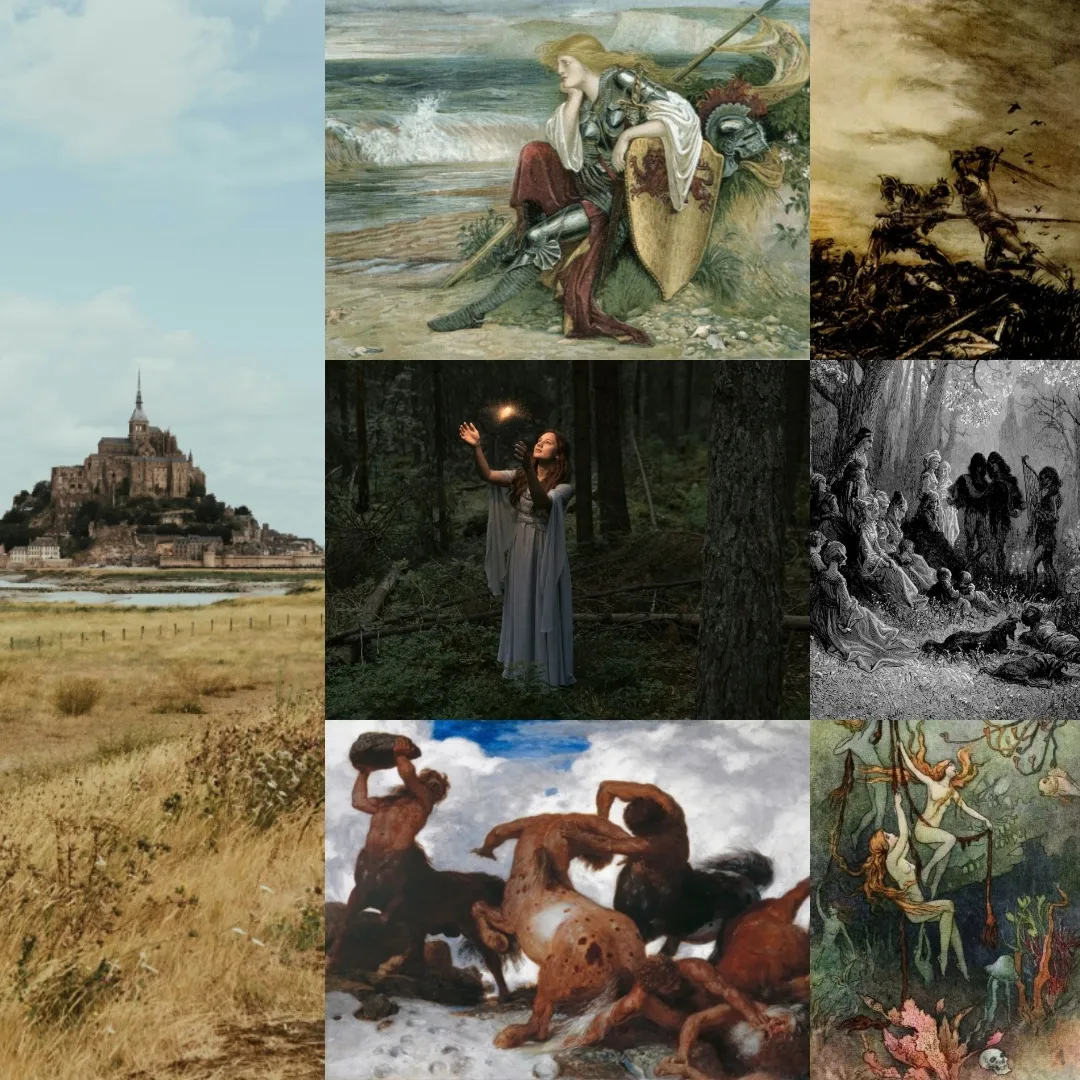
Clockwise from upper left: Céline Chamiot-Poncet, 2020; Walter Crane, "Britomart," 1900; Arthur Rackham, "How Mordred was Slain by Arthur, and How by Him Arthur was Hurt to the Death," 1917; Gustave Doré, "Troubadours singing the Glories of the Crusades," 19th century; Warwick Goble, illustration in Dora Owen's The Book of Fairy Poetry*, 1920; Arnold Böcklin,* Battle of the Centaurs*, 1872-1873; Alexey Turenkov, 2023.*
General Process
The process for finding images starts before I've even written a post: any time I see an image I think might be useful for a future blog post, I save it to a folder on my computer and give it a file name that will help me identify its source again in the future. Periodically I encounter a painter's work for the first time and look for a few galleries of their paintings, or I might spend a half hour some evening poking around Unsplash. This helps me build not just a repository of images ready for use, but it also helps me develop a sense of what's out there, which winds up being just as helpful. I have these folders divided into subfolders by artist and/or media type for my own convenience.
Once I've written a post, I look through those folders to see if I already have anything that works. If not, I try to envision the kind of image I'd like to use. The overwhelming majority of the time I'm not looking for an image that will help the reader understand the post; I'm looking for something that makes the post more interesting and that makes embedded links to it more attractive. (If I'm looking for an actual visual aid, like a diagram or chart, I'm of course going to produce that myself, probably in Paint, Google Sheets, a VTT, or some combination of them.) I'm quite picky about the images I use as far as accuracy goes, but I try to be open-minded about the kinds of images I can use.
I then identify the most likely place I'll find the kind of image I'm looking for. If I wrote something post-apocalyptic, I'll usually start with Unsplash and, failing that, move to Flickr. If I'm looking for a fantasy image, I might go to Unsplash or Flickr if I think they could have something appropriate in this particular case; for instance, I figured I could find an image of a woman wearing a dress and bearing a sword for "Why Isn't Every Bride A Paladin?" However, for fantasy I more often start with public domain images, which often have medieval or mythological subjects. If I'm looking for an image of dice and miniatures and battlemaps, I'll likely start with Flickr, but often enough nothing there quite works for me, so I'll take my own photos the next time the lighting is right. Wherever I start, I'm always looking for something in landscape orientation,1 and I keep a close eye on what uses its license allows.
Sometimes I can't find what I'm looking for. My first step then is to stop searching by landscape orientation and try to find some portrait images that I can crop. I'll also consider if anything I've found already would work if I cropped it, either to change the orientation or to remove an anachronistic object. If that fails, I either think harder about what kind of image might work (as in the case of the image I chose for "LLMs, RPGs, Citational Ethics, and Lineage") or I don't use an image at all. In this last case, I might use a barely-related image for the meta_image attribute, meaning the image will show up when I post the link to social media but isn't in the post itself, and I'll provide the image credit in the footnote of the post. For an example of that, see "New Hominids."
Let's go over each of the sources I mentioned above: Unsplash, Flickr, the public domain, and my own photography.
Unsplash
The source that's newest to me, Unsplash has worked well lately. The photographs are generally of high quality and you can search them by keyword, orientation, and license. It has generally been better for post-apocalyptic images than for fantasy images or generic gaming images, but I've found a few things I've liked and used for the other two categories as well. I think it could also work well for cyberpunk, western (ie. cowboys and outlaws), or supernatural horror games.
I have only a few problems with Unsplash. First and worst is that it tends not to have many pictures of crowds or otherwise have images that feel busy and warm, which is the impression I want to give sometimes in my Lakelands setting posts. The tagging is also a bit odd; I doubt that the photographers supply their own tags, which on the one hand means the images have more tags than some photographers would likely give them, but on the other hand means that the tags are sometimes inaccurate. Furthermore, some of the pictures are text-to-image generated, which I need to keep a watch for; however, most of these have the Unsplash+ license, so I don't see as many of them after I filter the posts by license anyway. Finally, Unsplash just has less selection than my other sources, though the better quality control generally makes up for that.
I want to particularly bring to your attention the work of Lance Reis, who has a number of photos of a woman in a dress with a sword or a hawk, or in a castle, as well as a few of a bearded man in a castle2 or a woman clad as a cowboy with a horse. I think they're excellent for a certain kind of fantasy or western ttrpg post and I'm looking for an excuse to use more of them. For weird supernatural images, I suggest starting with Keagan Henman, who plays with lighting conditions, exposures, and colour grades to create eerie rural and suburban scenes.
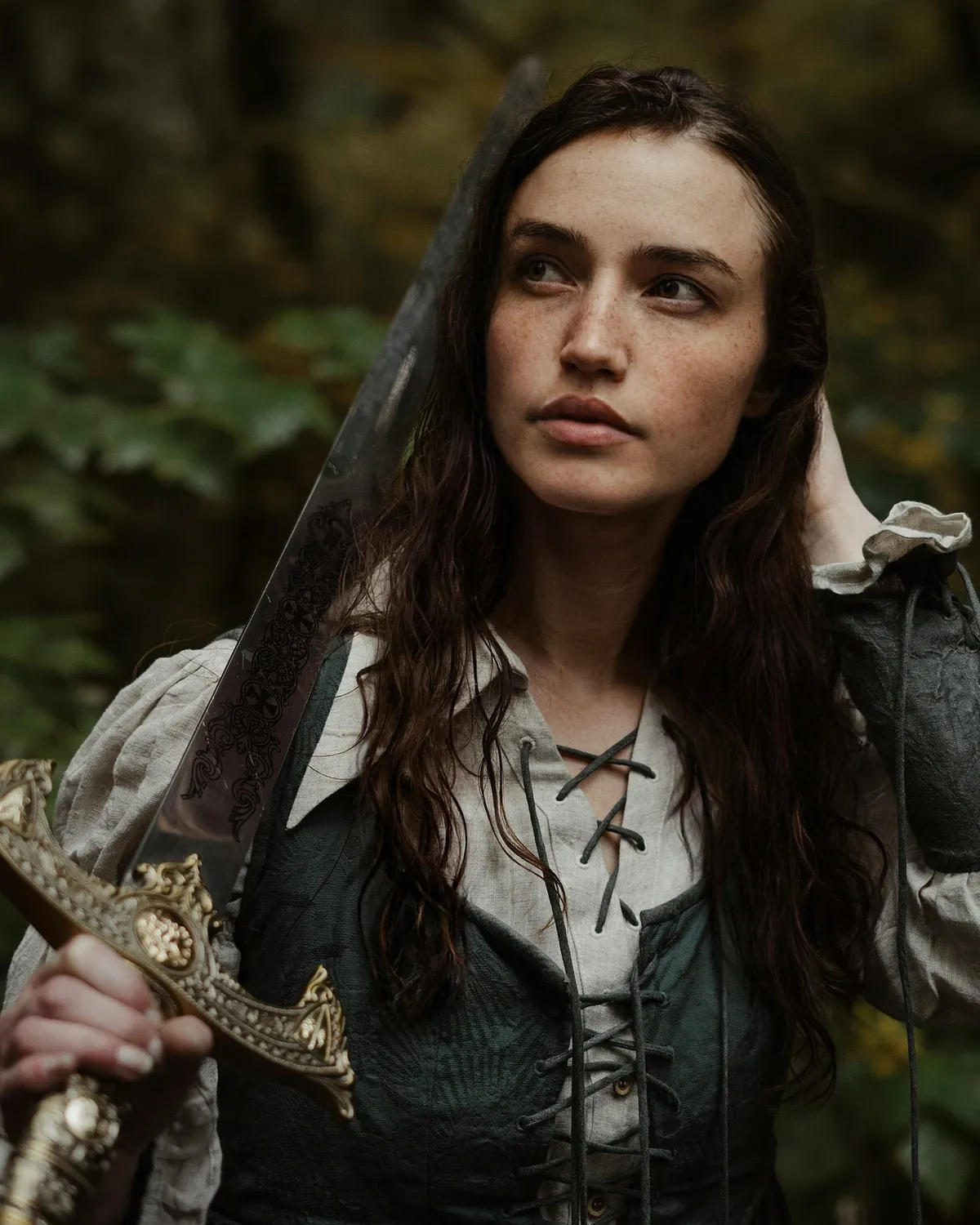
Lance Reis, 2023
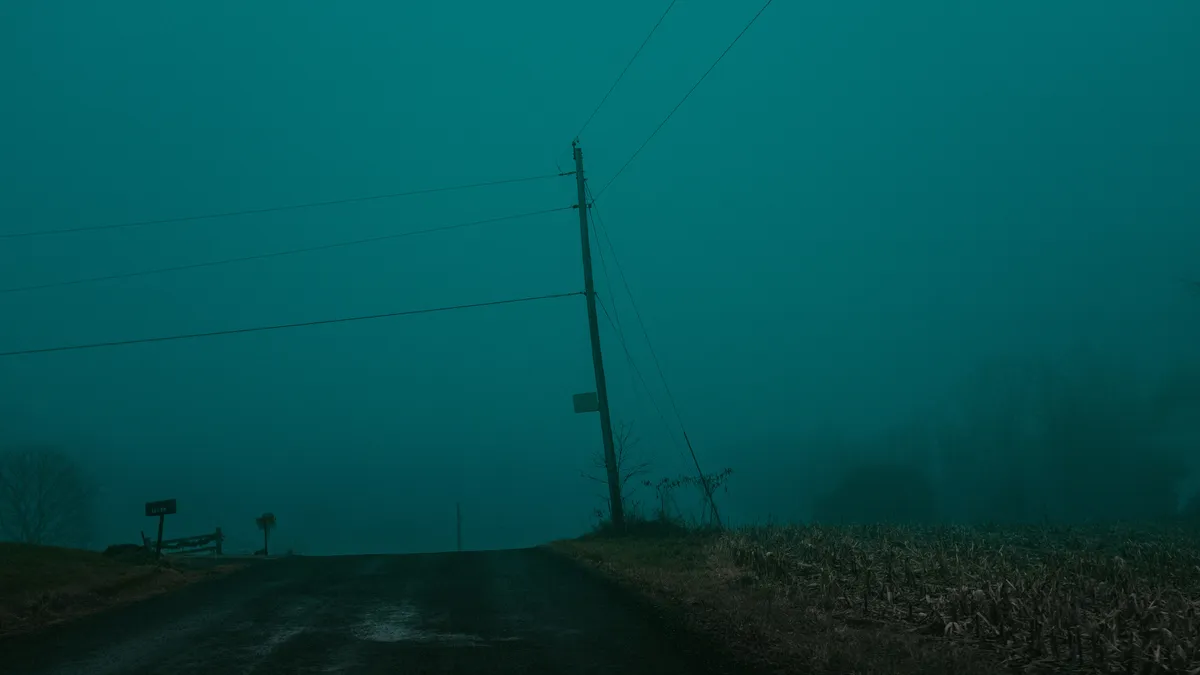
Keagan Henman, 2020
Flickr
Before I came across Unsplash, Flickr was my major source of art with a Creative Commons license. It has more robust search features than Unsplash has, allowing more orientation and license filters as well as letting you filter results by colour. I believe it also has far more photos on it than Unsplash has, with greater variety, probably on the strength of having been around longer. Unfortunately, the quality of its images vary more widely as well, which is why I usually start with Unsplash and turn to Flickr only if I'm not fully satisfied with what I found there. However, the exception is for pictures of dice or of people playing a tabletop game; I find Flickr good for that kind of thing. From time to time you'll find drawings and paintings on Flickr, in addition to the more common photographs; Kurt Komoda in particular was a life-saver for "Geminites." (Note, though, that Komoda's images are often licensed as CC BY-NC-ND 2.0, which means you can't crop or otherwise alter them.) He also has some drawings of east Asian folkloric creatures and Lovecraftian horrors.
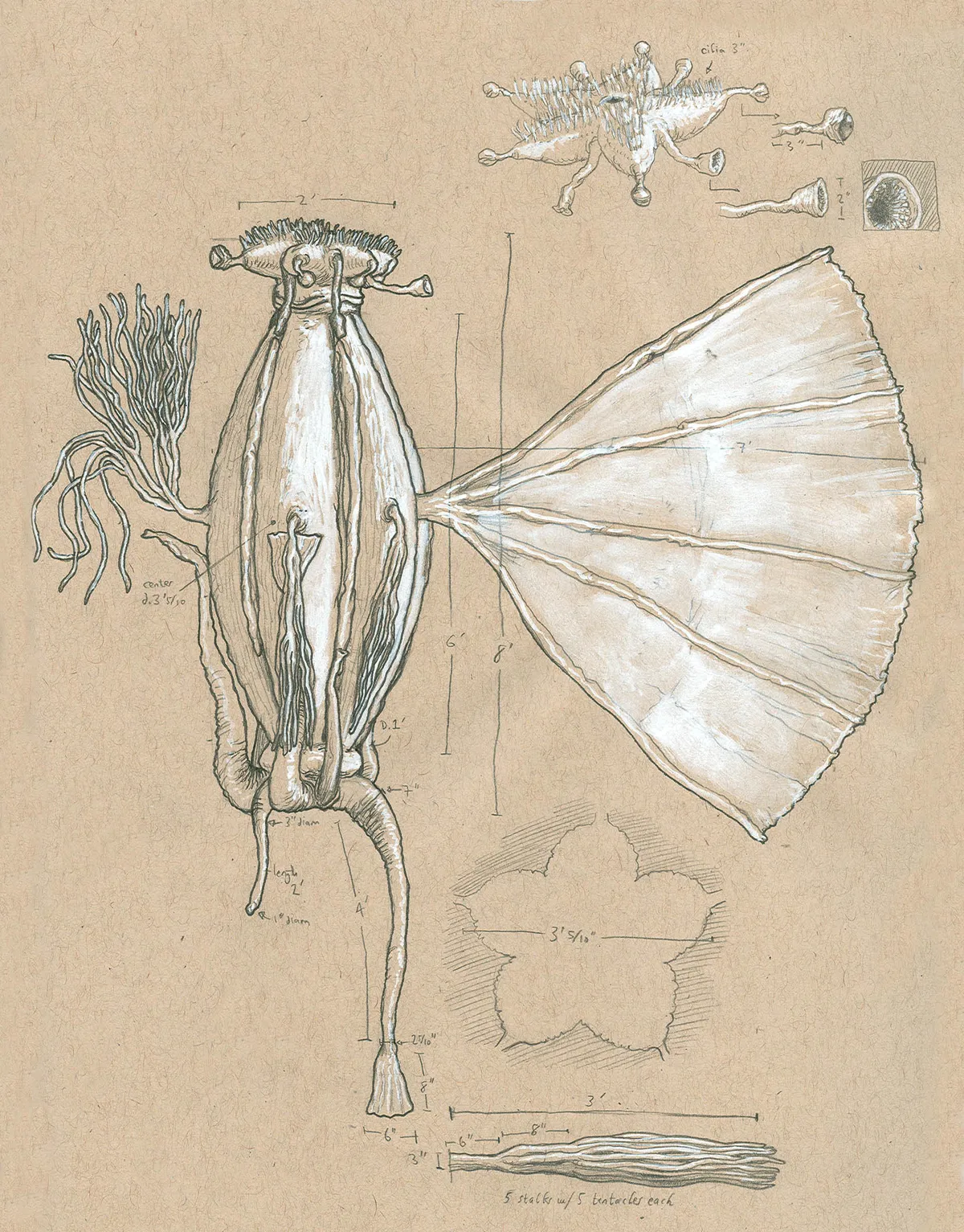
Kurt Komoda, "2008 Elder One," 2008
Spend enough time on Flickr (or Unsplash, for that matter) and you too will find some reliable artists.
Public Domain
Paintings in the public domain are extremely valuable for fantasy ttrpg art, and creators like Dael Kingsmill use them to great effect in their published work. Unfortunately, no single source collects and organizes them, so it helps to know how to look. Most often I go to Google and try a search string like, "centaurs public domain painting." However, Wikimedia has a lot of good photographs or scans of classical art, so I find some success by simply going to the "Centaur" article on Wikipedia (for example) and seeing which Wikimedia images it uses.
The other way to look, though, is to identify which painter or movement is likely to have painted the kind of image you want and search by them. As an example, I probably used something like, "pre-raphaelite painting orb," or, "waterhouse painting orb," when searing for an image for "The Natural Magic of Stones." (That's also a good example of a picture I cropped for the post, both to get the orientation I wanted and to focus more on the relevant part.) This method requires some familiarity with artists and movements, of course, which is one reason why I recommend trying to learn a bit about them. However, I know little about artistic movements, so you won't have to work too hard to get the same benefits I do. To help you out, here are the artists I've found useful for this blog, and some of those I suspect I'll find useful in the future. (I'm a bit idiosyncratic with the links, trying to direct you to the most fruitful galleries of their work I could find in a few minutes of searching; please don't follow any of these links and think that's all the art you can find by that artist.)
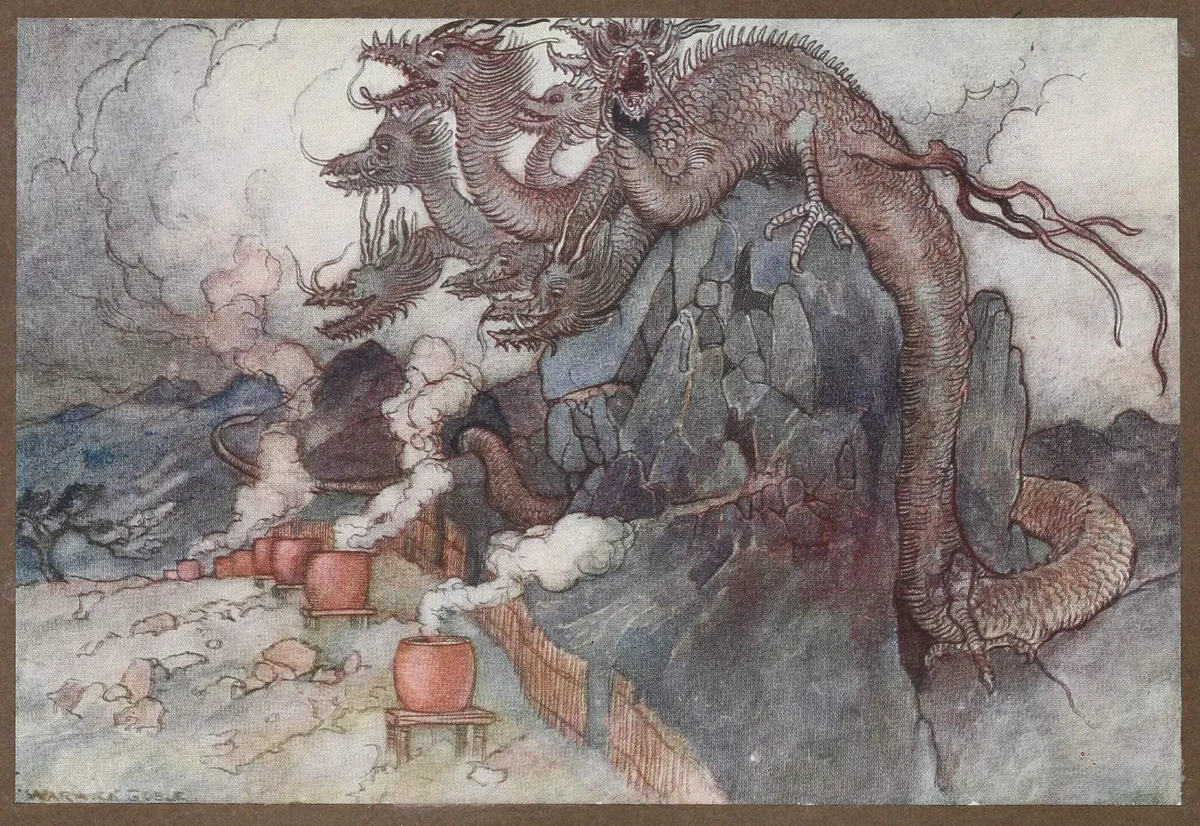
Warwick Goble, The Story of Susa, 1910
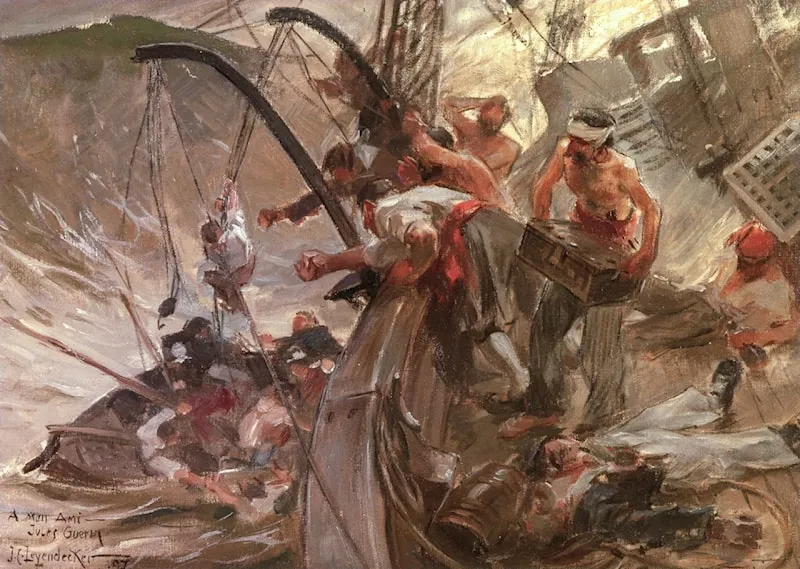
J. C. Leyendecker, Pirates Load, 1897
Edwin Austen Abbey (1852 - 1911) painted Arthurian and Shakespearean subjects, often in a striking black, white, red, and gold palette, and sometimes in long landscape orientations (ideal for a blog post).
Ivan Bilibin (1876 - 1942), in a vivid storybook style, painted figures from Russian myth and legend like Baba Yaga, Vasilisa the Beautiful, and Koschei the Deathless.
Arnold Böcklin (1827 - 1901), like many painters of his time, painted many scenes from classical mythology and Arthurian legend, sometimes in a dream-like style and sometimes in a realistic one; his centaurs are especially good.
Alexandre Cabanel (1823 - 1889) painted, in addition to many portraits, detailed well-composed scenes from classical mythology, Mediterranean history, the Bible, and early modern literature like Milton's Paradise Lost or Shakespeare's Hamlet.
John Collier (1850 - 1934) is typical of the Pre-Raphaelites, if somewhat less well-known than Rossetti or Waterhouse, and paints a variety of classical, historical, fairy tale, and literary scenes.
Walter Crane (1845 - 1915) not only painted many scenes from classical mythology and fairy tales, but also created woodcut illustrations for Edmund Spenser's The Faerie Queene, featuring strange monsters and knights in armour.
Aelbert Cuyp (1620 - 1691) painted pastoral, nautical, and city scenes that tend toward tranquility, which isn't always the best for ttrpg posts, but the castles and ruins in the background can provide appropriate set dressing.
Gustave Doré (1832 - 1883) is better known now for his engravings, which dramatically depict literary3 and Biblical scenes, but his paintings were also popular in his time and these sometimes take subjects from classical mythology.
Herbert James Draper (1863 - 1902) painted many mythological subjects in oils, though he inclined towards female nudes to a degree notable even for classical painting (which means I'm unlikely to use his work for my blog, but it might well be a selling point for some of you).
Luis Ricardo Falero (1851 - 1896) to an even greater degree than Draper painted mostly female nudes, with the classical or fantastic subject matter seeming to be a pretext for the naked curves – but if you need cavorting skyclad witches or fairies in dishabille, Falero is the place to start.
Henry Ferguson (1665 - 1730) painted grottoes and classical ruins, including in scenes nominally from myth.
Akseli Gallen-Kallela (1865 - 1931) is best known for painting scenes from Finnish mythology, especially the Kalevala.
Warwick Goble (1862 - 1943) illustrated books of European fairy tales and South and East Asian legends, in distinctive watercolours.
Charles Napier Hemy (1841 - 1917) is the painter you'll want to start with if you're looking for paintings for ships and boats at sea.
Heinrich Kley (1863 - 1945) sketched and painted scenes from classical myth and fairy tales, as well as allegorical images for German industrialism that combine then-modern steelworks with fantasy elements.
Alfred Kowalski (1849 - 1915) painted landscapes and historical or domestic scenes, often featuring wolves, horses, dogs, and sometimes camels.
Edwin Landseer (1802 - 1873) is not the only animal painter on this list, but of them he seems to have been the least likely to pass off his dog painting as a classical, historical, or literary subject – but if you need a portrait of a stag or a scene of polar bears tearing apart the wreck of a ship, he's your man.
J. C. Leyendecker (1874 - 1951) is better known for his clothing advertisements, but he painted a few mythological, historical, and adventure subjects as well.
Gustave Moreau (1826 - 1898) was a Symbolist painter and his style can be all over the place, from subdued and realistic to vibrant and chaotic; either way, he drew often on mythological subjects.
Walter Jenks Morgan (1847 - 1924) has no Wikipedia page (and precious little on Wikimedia), but a Google search of his name reveals a variety of work appropriate for ttrpg blogs, from fairies dancing in rings to knights watching masques to Mediterranean cityscapes.
Arthur Rackham (1867 - 1939) illustrated many fairy tales and Norse myths in watercolour, and is one of the first names I put into a search string for fantasy subjects.
Henrietta Rae (1856 - 1928) painted similar literary and mythological subjects as her Victorian contemporaries, which is handy if you're looking for a Hylas and the Nymphs your readers likely haven't seen before; alas, her work harder to find, in my experience.
Briton Rivière (1840 - 1920) was an animal painter whose works depicting fairy tales, chivalric romances, classical mythology, and the Bible tend to incorporate animals in one way or another.
Hubert Robert (1733 - 1808), like Ferguson, painted a lot of ruins, though Robert emphasized their scale in a way that Ferguson did not.
Dante Gabriel Rossetti (1828 - 1882), one of the best-known Pre-Raphaelites, painted various mythological, historical, and literary figures in bold, lush oils; like many of his fellow Pre-Raphaelites, his women subjects have a particular look, with strong jaws and prominent noses and chins.
Marie Spartali Stillman (1844 - 1927), like Cuyp, tends to more tranquil compositions and Christian subjects that might not seem appropriate for a TTRPG blog; however, the intricacy of her work and her mediaeval scenes, such as the enchanted garden and the women brewing a love potion, make her a worthy inclusion on this list.
Wilhelm Trübner (1851 - 1917), like so many others on this list, painted subjects from classical myth, especially nymphs, satyrs, and centaurs, but he also produced multiple paintings of his dog Caesar posing with sausages.
Apollinary Vasnetsov (1856 - 1933) preferred medieval Russian subjects and provided the world with paintings of gloomy forests and cold colourful markets.
Viktor Vasnetsov (1848 - 1926) was Apollinary's older brother, and preferred folkloric and historical subjects, with paintings of battles and bogatyrs.
Arthur Wardle (1864 - 1949) is another animal painter whose occasional fairy tale and classical mythology paintings are clearly pretexts for further animal paintings – which is perhaps exactly what you're looking for if the best picture for your post is a mermaid hanging out with some polar bears.
John William Waterhouse (1849 - 1917) chose scenes from classical myth and Arthurian legend for many of his oil paintings and is one of the first names I put into a search string for fantasy subjects.
Joseph Wright of Derby (1734 - 1797) produced paintings with dramatic lighting, often of scientific demonstrations and discoveries of the 1700s, and he's who you'll want to start with if you're looking for a moonlit pirate cove, paintings of volcanic eruptions, or depictions of early sciences like astronomy or alchemy.
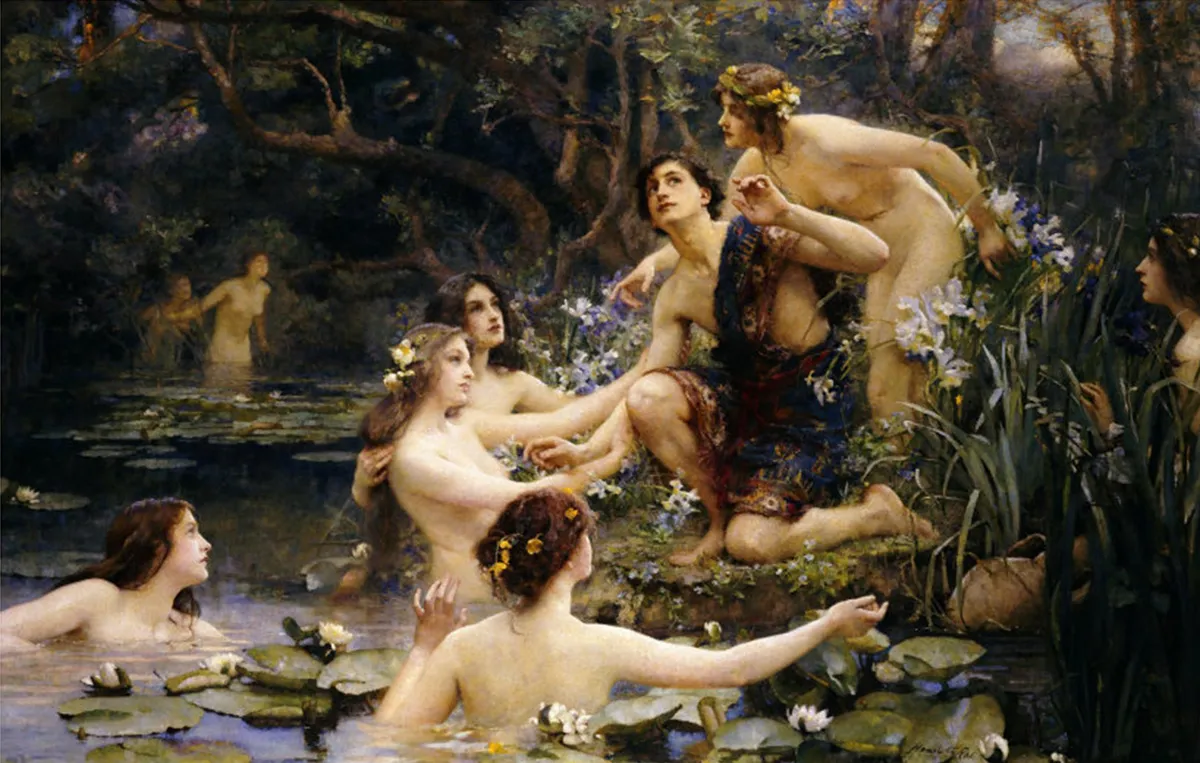
Henrietta Rae, Hylas and the Water Nymphs, 19094
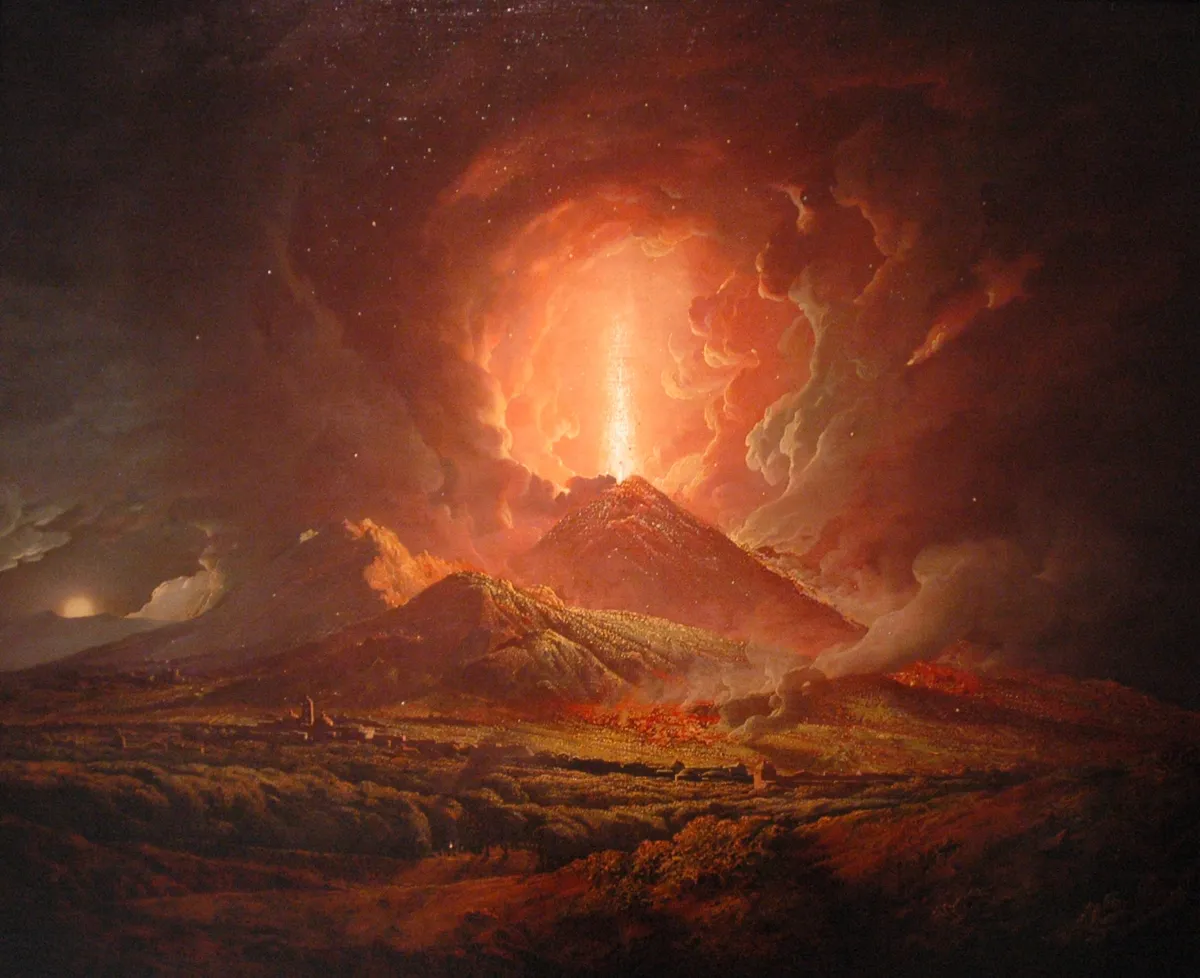
Joseph Wright of Derby, Vesuvius from Portici, 1773-1775
Two painters I'm interested in but cannot find much about are Hilda Koe (whose painting I used in "Magic on Offer: A Table") and Mary Evelina Kindom (see her painting The Song if you ever write a post about bards). As is so often the case, women's art is less disseminated than men's. If you can direct me to good resources about either, or about excellent painters and illustrators I haven't included, please leave a comment.
The other thing you can do is look for illustrations from books that were published long enough ago that those illustrations must be in the public domain. This is most helpful when you are trying to describe a dynamic that you know appears in a book popular in the 18th- or 19th-century (regardless of its actual publication), like a Jane Austen novel, a Sir Arthur Conan Doyle mystery, or William Shakespeare play.
My Own Photographs
Sometimes, if I'm talking about something very abstract, I'll take a picture of my own ttrpg accoutrements and use it. I'll wait until the mid-afternoon and gather together some relevant items on a clean table in a room with good natural light. This is especially helpful for play reports like "The Flickers and the Bandits: An Analysis of a Successful Session," or posts that about my abstract subjects, like "Preparation, Interpretation, Improvisation," because I can include handwritten tables or relevant books in the image. I try not to spend too much time on these.
Other Options
This is not an exhaustive list. I know people buy bundles of licensed work or comb through art galleries' online collections; I don't do the first and I've had limited success with the second, but you might find them right for you. If you have any favourite approaches, I'd love to hear about it in the comments, both for my own sake and for other readers' sake.
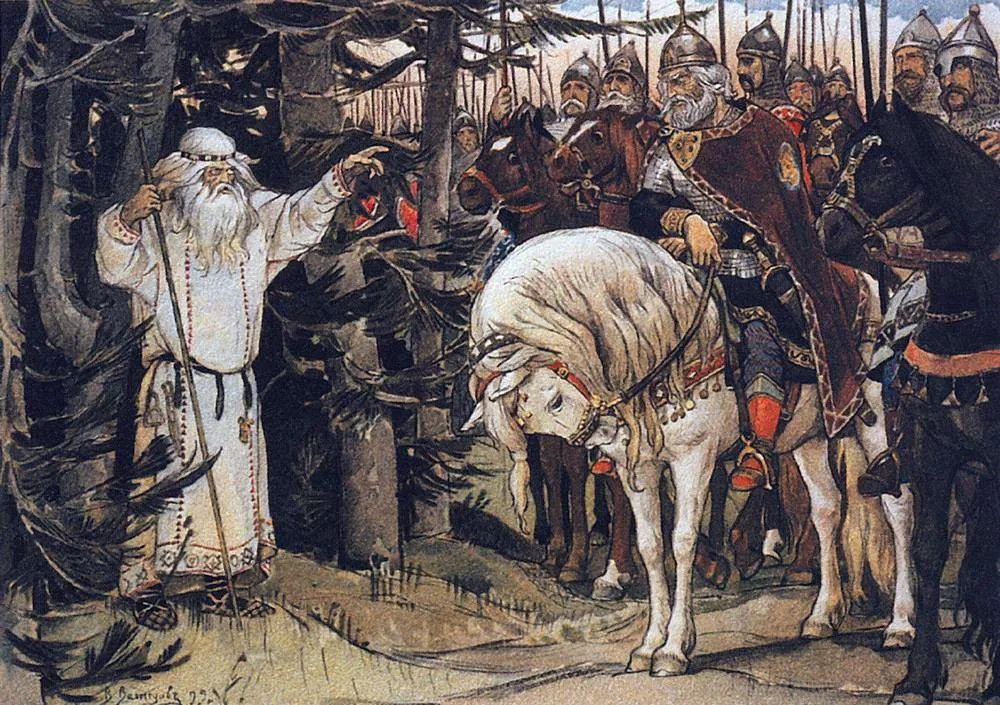
Viktor Vasnetsov, Встреча Олега с кудесником (trans: "Oleg meets wizard (volkhv)"), 1899
One of the many ways in which I'm fussy about this kind of thing is that I only want to use landscape-oriented images; the way Bear Blog renders images means that a large enough portrait-oriented image can take up the entire screen on mobile when you're scrolling down, and I don't like that. I want at least a bit of text visible at the top or bottom at all times. Therefore, at a certain point I started using exclusively landscape-oriented pictures. I'm making an exception for this post because the pictures are the point.↩
I think these are self-portraits.↩
These are often scenes from Don Quixote, which mocks chivalric romance, but since the actual images are of knights on horseback and such, they still work for posts about games in that kind of setting.↩
I think it's interesting that Rae's point of view is much lower than Waterhouse's, looking up at Hylas rather than down at the naiads. In other words, the viewer is put more in the place of the naiads than of the young man.↩
