Half-Nymphs
A Lakelands post
The Lakelands are not a safe place. They're safer than the Unbound’s petty empires to the south, or the tracts of wasteland beyond them, but this does not make them safe: death and injury are ever-present in all but the stoutest towns. Even beyond the threat of dragon swans, outlaws, and the spectre-possessed, there's the practical reality that hunting, felling trees, mining underground, and riding horses are dangerous occupations in the ordinary course of things. Injuries that aren't life-threatening in a modern city can be lethal for a person in a remote region without technologically-sophisticated medicine. Nearly every mundane human in the Lakelands must confront an unpleasant possibility: they could be wounded in the woods and die there, alone, over the course of several days.
But even when wounded and alone, far from home, death is not the only possibility.
The fungal symbiotes that make up the mould nymphs have supernaturally retained the pattern of a human body; that’s how they can replicate a humanoid form. When these symbiotes encounter a human body that is almost, but not quite, complete, they often begin completing that form, filling in what's missing, devouring and replacing what's broken or malignant. If the body is dead at the time, either the growth will fail to produce anything viable or will eat it all and form a whole new mould nymph; if the body is alive and well, its immune system will drive the fungal intruders out. If, however, the human body is alive but dying, and its immune system is beginning to fail, then something remarkable happens: the fungal symbiotes save its life, replacing the function and form of whatever is lost. In other words, a person dying alone in the forest might well awake to find themselves hale and whole, with mushrooms and mould taking the place of scar tissue.
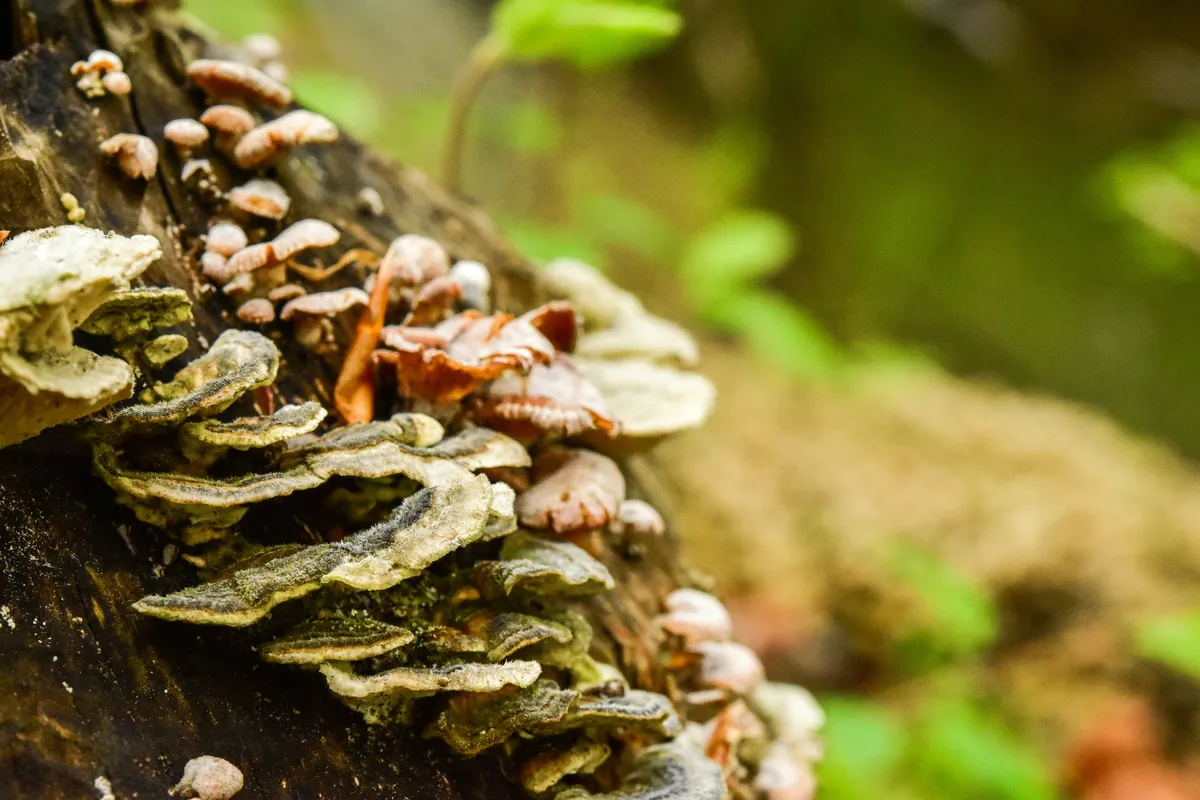 Source: Jason Mitrione, 2022
Generally called half-nymphs, people who've had the mould nymph’s fungal symbiotes make up some part of their body have so far only ever been mundane humans. It seems that the pattern which the fungal symbiotes hold is too specific for it to recognize the anatomies of new hominids or geminites, let alone those of even less related sapient peoples. While it's not unheard of for children to become half-nymphs, it's much more common in adults. Injured people who would otherwise heal on their own might occasionally gain and retain the symbiotes, but this is also quite rare and only occurs when something else is weakening their immune system, like a disease or drug. Most of the time, someone becomes a half-nymph under the following circumstances: an adult mundane human sustains a life-threatening injury that does not immediately kill them, in a region with a high number of mould nymph spores, and they do not receive medical treatment that could save their life.1
In some cases, a half-nymph can hide what they've become; anyone can cover the fungal tissue filling a stomach wound easily enough. But the symbiotes will replace almost any missing tissue: should a person lose a limb or organ in the accident that would have killed them, the symbiotes will replace it with one indistinguishable from a mould nymph’s, while lacerations will not scar but will instead seal with fungal tissue. Perhaps a replaced arm could be concealed under sleeves and gloves, but an eye made of fungus and surrounded by orange-and-green lichen is much harder to hide. Fungal growths don't only replace tissue lost in the original accident, either; the symbiotes will heal subsequent injuries, too, if the human tissue doesn’t heal back fast enough – or at all, in the case of amputations. It's hard to keep the secret forever.
Because they always start their lives as mundane humans, there's no population of half-nymphs culturally and materially independent of mundane human populations. However, they pose the same problems to settlements that mould nymphs do, if on a lesser scale: the organisms in their bodies can spread to fabric, wood, paper, and food, spoiling the last of those and damaging the rest. The much lower spore production of a half-nymph’s body does reduce the chances of this happening, but it doesn’t eliminate the possibility, so most communities treat half-nymphs the same way they treat mould nymphs. (Of course, there's a great deal of range in how settlements treat mould nymphs.) Mould nymph communities aren't well-suited for half-nymph inhabitation either, unfortunately: half-nymphs do sometimes get sick from their mycological gardens and they're as likely to find mould nymph norms alien as mundane humans do. Without the numbers to make many of their own settlements, half-nymphs might try to remain in their home cities or villages, even if that means moving to the shanty towns outside the walls, or they might try to live in similar satellite settlements outside a mould nymph town; just as often, they become drifters, build isolated homes in rural regions, or move someplace that will have them.
Fear of mould isn't the only reason people might be leery of half-nymph residents: every single one of them became a mould nymph because of a catastrophic accident. Thanks to the changes to their bodies, many half-nymphs also experience an identity crisis shortly after their first recovery, which can exacerbate, or be exacerbated by, their response to the physical trauma. Many communities struggle to include people suffering misfortune; this is as true in the Lakelands as it has been everywhere. Consequently, practical matters aside, half-nymphs find it difficult to re-integrate into communities that rapidly lose sympathy for their plight. If on top of that the reason a half-nymph nearly died is a point of contention – say, an attempted murder or a workplace accident resulting from negligent leadership – they might be driven out as a scapegoat before too long. Some half-nymphs avoid being driven out of their hometowns by leaving first of their own accord.
Of course, exclusion and distress aren't universal half-nymph experiences. More than a few are grateful for a second chance at life, and for their newfound ability to (slowly) regrow lost limbs and organs, especially if they have the support of family and friends. Even when their new condition is cause for struggle, many half-nymphs nonetheless have some affection for their fungal symbiotes; they might act or speak as if their fungal inhabitants are pets, companions, roommates, guardians, colleagues, spouses, or otherwise distinct from themselves.
Sample Half-Nymphs
Amanda "Mandy" Glamm
High Concept: Friendly Folk Musician
Trouble Aspect: Lots of Anger, All Suppressed
Peoples Aspect: Half-Nymph (Mould Leg)
Other: Sweetheart of the Thames Baronies
Other: I Keep My Knife Sharp
Other: Former Theatrical Pickpocket
Top Skills: Aesthetics, Folkways, Stealth
Basic Fear(s): Injustice, Suffering
Manifest Fear: Maggots
Consolation: Black tea
Ideal: Equality
Amanda was born into the magicians, psychics, escape artists, and contortionists of the Glamm Family Touring Show. ("Glamm," of course, was not the family's original name, but the Lakelands doesn't have the kind of paper trails where that makes a difference.) From an early age she was taught the performance trade, especially promoting in town and taking donations. Even in her childhood, though, her charming personality and deft hands lent themselves to close-up magic, and the family decided her uncle should teach her theatrical pickpocketing. She was good at it, but she and her uncle didn't get along at all; he was too sensitive to endure her frequent, if short-lived, emotional outbursts. By the time she learned to bottle up her boundless irritation, it was too late: she could not change her family's perception of her as irascible and belligerent. Furthermore, her true passion was singing, a talent that the Glamms thought too pedestrian for their repertoire. She tried working song into her magic shows, to great success in the Thames Baronies, but she got almost no support in this from the other performers. Worse, though, they struggled to make enough to survive during the Bad Years, and Amanda's family pressured her to pick pockets for real. (She started carrying a knife, just in case.) Eventually that turned into cat burglary, until one ill-fated venture when guard dogs tore her right leg off. She would have died, except that she'd picked up mould nymph spores somewhere along the way. Once she was able to walk again, she walked away from the Glamm Family Touring Show.
Now going by Mandy, the 20-something songstress bounces between different bands of wanderers: delvers, hunters, merchant caravans, cultural or religious pilgrims, and very occasionally other touring players. She sings for her supper when she can get away with it, and otherwise pitches in as she's able – which might include stealthy excursions into monster lairs or hazardous ruins. For two winter months she was equal parts guest and captive of the Bristly Rose Gang, until they let her leave, half out of affection and half out of irritation. Though she's charming and immensely likeable, her friendliness disguises a deep well of anger that will, inevitably, come out now and again, and woe to the person who triggers the outburst. She is still loved and recognized in the Thames Baronies, which she makes sure to visit for a few months every other year. She travels in a motley skirt and a pink jacket (it was once red, decades ago, but has long since been faded by salt and sun). When performing, she might change into the red sequin dress she otherwise keeps safe in a suitcase; she doesn't mind how it shows off her fungal right leg.
Clyde Ferris
High Concept: Lanky Turbine Mechanic
Trouble Aspect: Unhelpfully Laconic
Peoples Aspect: Half-Nymph (Mould Lung)
Other: Comfortable with Clambering
Other: Well-Stocked Toolbox
Other: Friends on Tri-City's Edges
Top Skills: Crafts, Machines, Science
Basic Fear(s): Absurdity
Manifest Fear: Being found out
Consolation: Watching the sunrise
Ideal: Travel
Growing up, Clyde never seemed to mind that the other kids called him "Ferret," on account of his last name. Of course, he never seemed to mind much of anything, since he spoke little and complained less. It wasn't that he was shy or tongue-tied; he just assumed, unless proven otherwise, that everyone else knew what was going on as well as he did. When he started apprenticing to the engineers who kept up Tri-City's wind turbines, at any rate, he told them he went by Ferret, which probably indicates that he really didn't dislike the name. Although Clyde was good enough at the work, he found the routine dull, so he leapt at the chance to travel to the city-state's outlying settlements, installing, fixing, and maintaining their various turbines, engines, and motors. On one of these outings he met with an ordinary accident: he fell from a windmill and was impaled on a piece of farm equipment. It was his good fortune that the farm was run by mould nymphs, whose spores saved his life. Even so, it took him a good while to recover and, by the time he did, the city'd replaced him. There's plenty of work for a competent mechanic willing to travel the Lakelands' wild country, though, and he offers his services to scavengers, surveyors, rescue crews, and the like.
Ferret is a tall skinny man with a regular farmer's tan. He keeps his honey-blond hair and beard cropped short, so there's no risk that they'll get caught in mechanical parts. So far he's been able to hide the fact that he's a half-nymph because the only external fungal growth has been a small patch on his back and another on his chest; the few people who've seen him undressed have had no reason to spill that secret. A few months ago, however, he sliced a gash open on his right forearm, and that healed over with polypores. His shirt sleeves can cover that if needed, but he knows it's only a matter of time. For now he wears his brown canvas overalls and plaid flannel shirts, and hopes for the best. He's out of breath more often then he used to be, thanks to the injury to his right lung, which is a convenient excuse for when he doesn't feel like talking.
Oda Bazlewicz
High Concept: Muscular Ex-Enforcer
Trouble Aspect: Socially Unsubtle
Peoples Aspect: Half-Nymph (Mould Eye)
Other: Raised A Farm Kid
Other: LEAD/HOOK Knuckle Tats
Other: Pick-Up Soccer Player
Top Skills: Athletics, Fight, Physique
Basic Fear(s): Guilt
Manifest Fear: Heights
Consolation: Hard manual labour
Ideal: Perseverance
Oda grew up in a farm village that was claimed by New Guelph; as a child, she wasn't aware of the intimidation tactics the city-state used to compel her neighbours to give it their allegiance. Strong from fieldwork but more interested in defending her home from monsters and miscreants, she joined the New Guelph External Militia as soon as she was old enough. They trained her to fight and in return she chose not to understand the threat they posed to her hometown and the little communities like it. It went on that way until a ghost-ridden cultist stabbed her through the eye on a mission gone horribly wrong. When she regained consciousness, a small but significant portion of her left frontal lobe having been regrown with mycelia, she discovered her whole unit was dead. She returned to her hometown and began seeing everything differently. She was seen differently, too, and soon enough she left New Guelph's whole sphere of influence.
Oda is now a mercenary in Tri-City. Many people there distrust her, fearing she's an informer still loyal to New Guelph. The suspicion suits her fine; it rhymes with the disgust she feels towards her own complicity in its imperialist ambitions. Polypores sometimes ring the fungal facsimile of a human eye that fills her left socket, which she regards as a physical token of her iniquity. A more practical consequence of her new eye is that she's no longer very good with a gun or bow, but she's still perfectly capable both with melee weapons and with her own two fists. She dresses most often in military-style boots, khakhis, and a t-shirt, all of which came from overseas in an aid shipment. A shaggy hide cloak serves her for winter wear, and she brings an assortment of knives and cudgels on her mercenary work. She's now hired variously as a bodyguard, a bouncer, a caravan guard, a delver crew look out, or a low-end monster-hunter.
In some cases, humans might deliberately recreate these circumstances with or without a mould nymph’s help. For instance, a mundane human with terminal cancer might enter a mould nymph town and give themselves a traumatic wound in the hopes that the fungal symbiotes will not only heal the wound, but also eat away the cancer. Sometimes it works, but not nearly often enough that Lakelands doctors are willing to recommend it as a course of treatment except in the most extreme hour.↩