Scavenging in the Lakelands
A Lakelands post
I don't think I can imagine post-apocalyptic fiction without the scavenger. Of course the scavenger isn't the only archetypal post-apocalyptic character: the raider also comes to mind, as a potent symbol of humanity without laws or social contract. But the scavenger seems indispensable in a way that even the raider doesn't. They personify not just the hard-scrabble survivalism that pervades the setting, but also a particular relationship to their past (and therefore our present or future): even if modern civilization is lost, parts of it remain, and one way or another the post-apocalyptic survivors try to build their own societies out of those remnants. This trope provides much of the genre's humour, nostalgia, and creativity, as the scavengers find new and surprising uses for their salvage. The road sign is now a breastplate; the cable spool is a living room table.
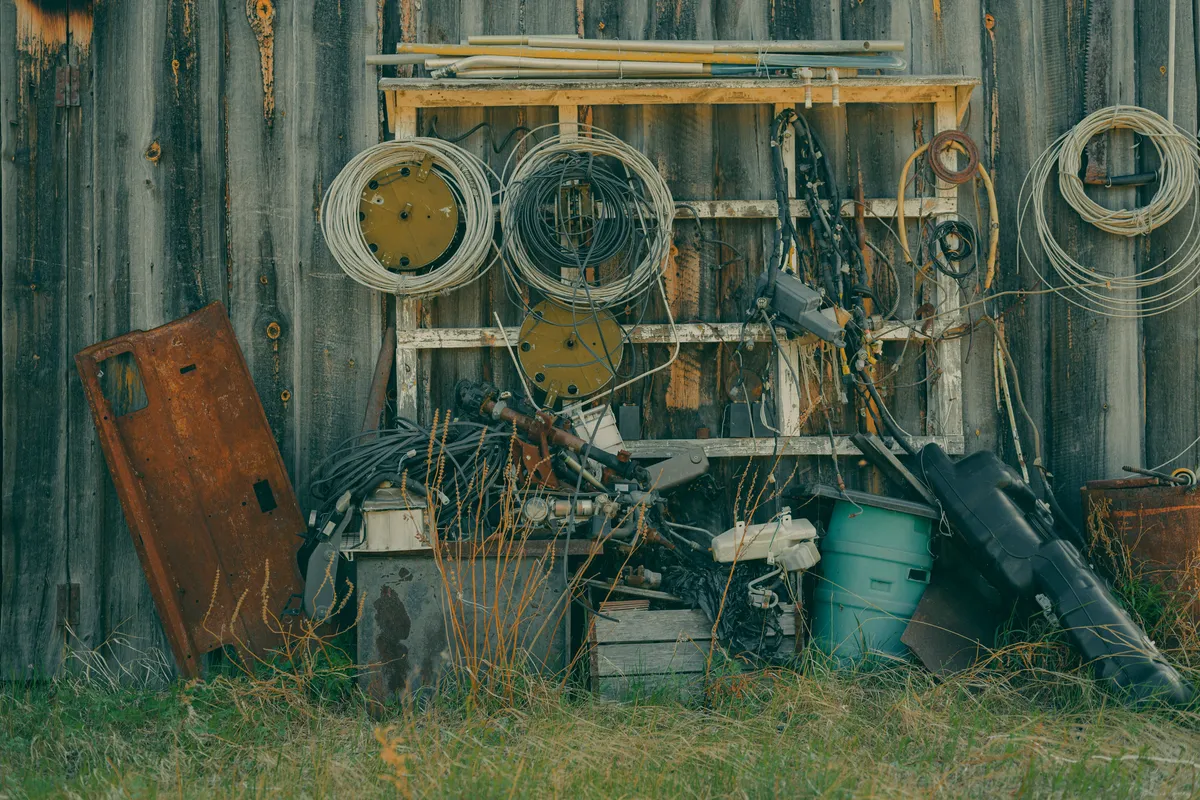 Source: Egor Myznik, 2025
I can see this especially for the Lakelands. A band of scavengers picks through the rubble of a small town that has been half-demolished through decades of flooding. A pair of geminite brothers carefully maneuver through shattered houses, one with his eyes down among the wreckage and one with his eyes scanning the horizon. For the two women alongside them, this activity has different kinds of significance: to the mundane human, what she finds here is in some sense part of her heritage; to the amazon, these are clues to an alien past into whose ruin she was born.
It's a shame, then, that this is all somewhat unrealistic.
Some parts of it are worse than others. Contra my beloved Fallout 4, survivors of an apocalypse will not be scrounging for food for very long; even if those potato chips were still edible decades later, there won't likely be any left after the initial scramble for food and resources. After all, in most of the world there's only two to six months' worth of food available at any given time, not even considering distribution issues. Even with a precipitous population drop, there simply will not be much pre-apocalyptic food left to scavenge ten or a hundred years after a cataclysmic event. Someone will have eaten it.
Other objects might fare a little better than food, but not a lot better. First of all, everything degrades eventually, due to internal chemical and physical instabilities called inherent vices. They'll degrade even faster with fluctuations in temperature and humidity; the seasons of the Great Lakes guarantee both. Second of all, just as food will have been scavenged already by the time a Lakelands game takes place, so too will most clothes, weapons, machines, and building materials. The longer the gap between the calamity and the narrative present, the less plausible scavenging becomes in post-apocalyptic fiction.
This is all just fine for something like Fallout or the latest incarnation of Gamma World, the first of which has at most a passing acquaintance with realism and the second of which was probably never introduced. For the Lakelands, though, I'm trying to walk a fine line: I want to stay grounded in what really would happen in the fantastic situation I have created, while also engaging in its genres' traditions as much as I can within those limits. Players presented with a post-apocalyptic setting will want to scavenge, of course, but I also love scavenge punk aesthetics, so for everyone's sake I want to build out a setting that takes the presence of scavengers for granted. How, then, can I create space for this indispensable part of the tradition?
There are a few conditions in which scavenging makes sense in the Lakelands, where good recoverable items have not already been taken by previous generations of scavengers.
First, there's one case where scavenging already makes sense today: marine salvage. At least one company specializes in vessel and wreck salvage and removal in the Great Lakes; after all, these waterways still host both freighting and leisure boating, with all the attendant accidents. Although the Arrival of the Unbound diminishes lake traffic considerably, it does not entirely reduce it. In particular, foreign interests in the region's resources use any available mode of transport to get in and out of the Lakelands quickly, but more on that later. However, given most Lakelanders' material constraints, salvage operations are unfeasible, so many new and old wrecks lay preserved underwater. The few outfits who have the technology and the expertise to pull it off are well-rewarded for their efforts.
The difficulty and hazards of marine salvage is a more specific case of the second, wider, condition: there are still valuables to scrounge in dangerous locations. Dreamzones are notable among these. Most Lakelanders avoid these disorienting and potentially deadly nightmare realms, which means the various equipment, scrap, and raw resources inside them might go untouched for generations. A dreamzone that grew over a fulfillment centre, self-storage lot, ball bearing factory, or a block of apartment complexes might therefore protect months' worth of salvage for the scavenger brave enough to delve into its terrors and competent enough to return. Of course, there are other more mundane hazards that might keep a patch of a scrap untouched through the decades: chemical spills, booby traps, bad air, rockfalls, structural instability, sucking mud.
Third, not all ruins are pre-Arrival. After the cascade of misfortunes over the last decade, called the Bad Years, ghost towns, abandoned farmsteads, and derelict industrial sites now dot swathes of the Lakelands. The material and equipment left behind in these locations is of much newer vintage than what can be found in the oldest dreamzones or among early 21st-century shipwrecks, meaning it's less degraded. In some cases, in fact, newer ruins yield extraterrestrial tech: a miasma-cloaked psanzomv pod might contain marvels beyond human ken. However, the flip-side to this kind of scavenging is that someone somewhere might consider these valuables to be their own inheritance; there is no law common throughout the Lakelands, so the line between "abandoned property" and "family heirloom" can shift depending on who's most persuasive in any given disagreement.
Finally, some scavengers prefer foreign goods. People from the wider world stage expeditions into the Lakelands for various reasons, and they generally bring things with them. Humanitarians come with shipments of foreign aid. So too do representatives of the Canadian government, now based in Québec and the Atlantic maritimes, though they are motivated as much by geopolitical interests as by altruistic ones. Then there are the various overseas corporations that hope to strip the Lakelands of its resources, or that provide security and logistical support for the others. All of these groups send boats, aircraft, and truck convoys through the Lakelands, and build depots, docks, and landing pads at strategic locations. When Lakelanders attack and pillage one of these facilities, it's called "raiding." When a pack of hellpigs destroy a facility and the Lakelanders come by afterwards to collect what remains, it's called "scavenging." At least, that's how the locals see it. The folks in fancy offices far away might see it differently.
No one is obliged to care about realism the way I do; if you want to run a Lakelands game, you don't have to think about the plausibility of scavenging if you don't want to. However, my goal is a game that's both grounded and fantastic, so it's up to me to help you achieve that if you want to. (Michael at 1999 A.D. has an excellent recent post on this topic.) These situations, then, are my pretexts for this indispensable post-apocalyptic trope. I hope they are also exciting and interesting pretexts, which pose fruitful challenges and suggest compelling hooks. Of course, they're only part of the answer: if food cannot simply be found under the dust of a gas station's shelves, then someone must grow or gather it. Agriculture and manufacturing, however, will be subjects for future posts.