Highlands and Lowlands in a Pointcrawl
This month the RPG Blog Carnival is hosted by Attronarch at their eponymous Athenaeum. On the topic, Attronarch has this to say:
The theme is Underworld & Wilderness Adventures, and your contributions can be anything related to it, from your procedures and practices for creating and running them to random tables for generating and populating them to actual adventuring sites.
[...]
The theme is quite broad, and I encourage you to focus on gameable contributions—ideally something from or for your table that others could benefit from as well.
In that spirit, I thought I might share a small aspect of the Char pointcrawl game I sporadically run, specifically to do with dividing the different nodes (or points, I suppose) in the pointcrawl into highlands and lowlands, and what this means mechanically.
First things first, though: I don't really know anything about pointcrawls. Most of what I've learned came from reverse-engineering them from posts about fluxcrawls and from posts hexcrawls. Therefore I'm only guessing that this is something you can apply to your own pointcrawls. Apologies if it isn't. I'm also only guessing that this idea has not been done a million times before. Apologies if it has been.
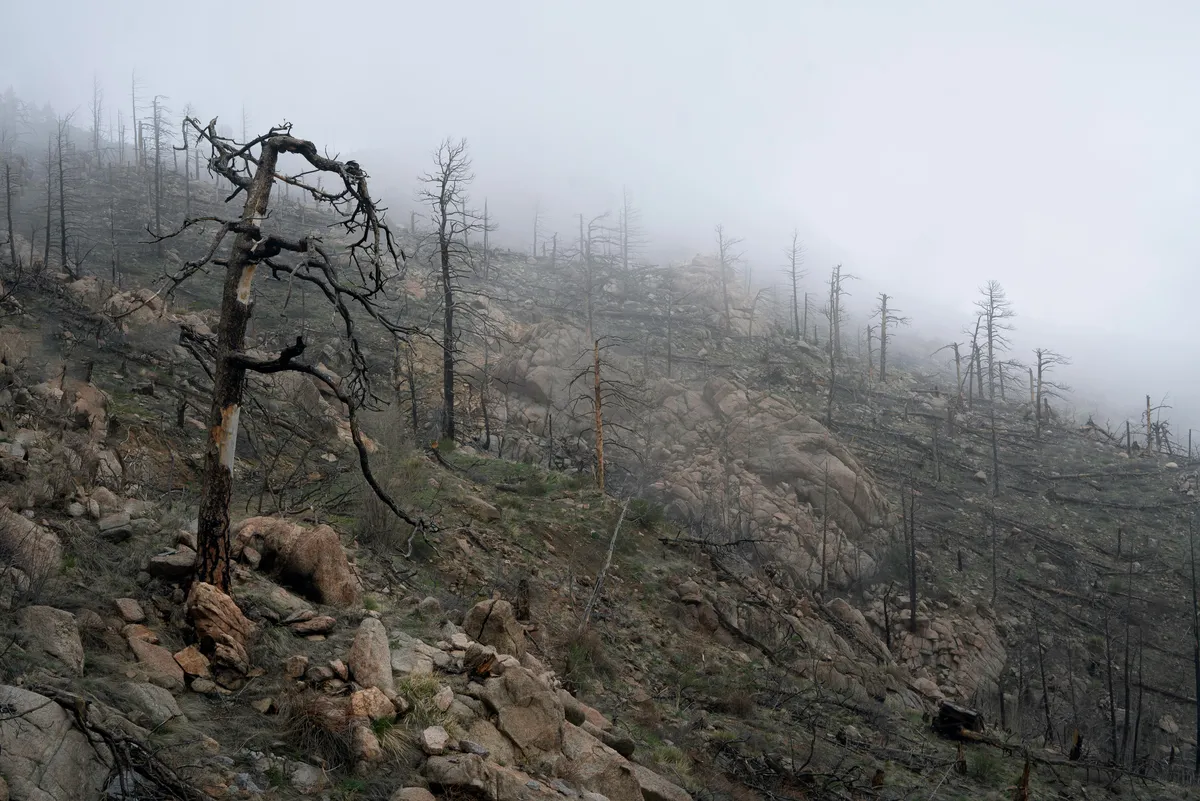 Source: Intricate Explorer, 2021 (Unsplash license).
In the Char pointcrawl game, the PCs get a chance at each node to squint into the distance and see if they can discern anything in the adjacent nodes. I have each node designated as either highlands or lowlands, and furthermore some highland nodes have towers on them. Highlands, lowlands, and towers get different rules for scouting (ie. squinting into the distance).
From highlands, characters can do the following:
- they can observe whether adjacent nodes are highlands or lowlands without having to make a test;1
- they can observe landmarks at adjacent nodes without having to make a test;
- they can make a test to observe random encounters at adjacent nodes; and
- they can make a test to observe landmarks at nodes two away.
From lowlands, characters can do the following:
- they can observe whether adjacent nodes are highlands or lowlands without having to make a test (as always); and
- they can make a test to observe landmarks at adjacent nodes.
From towers, characters can do the following:
- they can observe whether adjacent nodes are highlands or lowlands without having to make a test (as always);
- they can observe landmarks at adjacent nodes without having to make a test (like in highlands);
- they can make a test to observe random encounters at adjacent nodes (like in highlands);
- they can make a test to observe landmarks at nodes two away (like in highlands);
- if they have binoculars or some other aid, they can expend a usage point to make a test to observe landsmarks at nodes three away; and
- if they have binoculars or some other aid, they can expend a usage point to make a test to observe encounters at nodes two away.
Also, a note about the kind of information I give in these circumstances: I don't read out exactly what it says in the map key. Instead, I try to describe what they could see from a distance: a big boxy building, a wide flat expanse with a small cluster of structures in the middle, etc. Most towers are clearly identifiable, though: there's no way they can't identify a water tower, for example. Sometimes that should be enough to tell you what's below the tower, too: an airport tower has an airport beneath it. When it comes to the encounters they see, I describe if the figures are human, robot, or animal, what size they might be, and that kind of thing: they aren't going to be able to see what faction any humans might be, though, or distinguish between animals of about the same size and frame.
I also have two different encounter tables for the area, one for the highlands and one for the lowlands. Altogether, that means the pointcrawl map is somewhat intelligible even just in terms of highlands vs. lowlands, and players can make choices based on altitude alone if they lack any other information. That's handy because, if you lack any other information, then altitude is exactly what you need to improve your chances of getting more information.
Note, of course, that if the PCs make a successful test to see random encounters at adjacent nodes, you have to roll then, and not later, to determine whether there is a random encounter there and what it might be.
This is gameable, right? In case it isn't quite gameable enough, at least as Attronarch means it, here's a bifurcated encounter table for an AllOut Apocalypse game, drawing on the creatures and factions found in these three bestiaries. This is not the table I use for the Char game, which I am keeping secret for my players' sake.
Char Random Encounter Table
| 2d6 + 1d3 | Highlands | Lowlands |
|---|---|---|
| 3 | 1 scythe lizard | 1 military treadbot |
| 4 | 1 man-tyger | 1 thirster bear |
| 5 | 2 utility-bot, 1 floating armbot | 1 thirster pack-beast |
| 6 | 2 ogreman trash | 2 autoglot thralls, 1 autoglot hypnologist |
| 7 | most recently met faction | most recently met faction |
| 8 | nearest faction | nearest faction |
| 9 | 1 medly herder, 1 dog medly, 2d6+10 goats | 2d3+1 blood beetles |
| 10 | 1d3 sneakthieves, 1-in-3 chance of sneak-thief shellbreaker | 1 snallygaster |
| 11 | 1 skunk-thing | 1 medly drifter, 1 dog medly, 2d6+10 goats |
| 12 | 2 cultist acolytes, 1 cultist consecrated | 2 bandit ruffians, 1 bandit bruiser |
| 13 | 3 thirsters | 2 road toads |
| 14 | 2 junk gunk collectives | 2 lobstrosities |
| 15 | 1 breaker-bot | 1 hydreel with 1d6+9 hp |
This table assumes that the factions in the region are (unlike the actual Char pointcrawl game) as follows:
- Autoglots.
- Their "nearest faction" encounter is 2 autoglot thralls, 1 autoglot hypnologist, and 1 autoglot drone.
- Their "most recently met faction" encounter is 1 autoglot thrall, 1 autoglot hypnologist, and 2 autoglot drones.
- Bandits.
- Their "nearest faction" encounter is 3 bandit ruffians and 1 bandit bruiser.
- Their "most recently met faction" encounter is 1 bandit ruffian, 1 bandit bruiser, and 1 bandit gorelord.
- Cultists. On the cult name table I rolled the Blessed Swine Sorority, so it sounds like this is a women-only group that uses pig iconography or pig parts.
- Their "nearest faction" encounter is 2 acolytes, 1 consecrated, and 1 keeper.
- Their "most recently met faction" encounter is 2 consecrated and 2 keepers.
- Medly herders, for whom you can use medly drifters with a chance of carrying a rifle with 3 usage points (1-in-3) or a sling with 3 usage points (1-in-3).
- Their "nearest faction" encounter is 3 medly herders and 2d6+10 goats.
- Their "most recently met faction" encounter is 2 medly herders, 2 medly guards, 1 donkey wagon (below) bearing goods, and 2d6+10 goats.
- Ogremen.
- Their "nearest faction" encounter is 1 ogreman greenspear and 1 ogreman ravager.
- Their "most recently met faction" encounter is 1 ogreman trash and 1 ogrelord.
I code each node with whichever faction's HQ is closest, literally by counting how many nodes away the HQs are. If two are equidistant, you can give it to whichever faction is most powerful (for which reason it is helpful to rank them in influence). The exception here would be the itinerant medly herders, who don't have an HQ but instead have many camps, which they travel between; each of those camps has the medly herders as the nearest faction, but no other nodes do. (This last detail is, again, similar but not identical to what I actually do for the Char game, which uses the slightly-different Wandering Clans in place of the medly herders.)
Now, I don't like reaction tables very much: I prefer to figure out how the random encounter reacts based on the fiction that has been established so far. That's not to dismiss the practice, which I understand can be important for certain cultures of GMing. I just don't plan to provide one. But I do like tables that establish what the creature was already doing at the moment that they're encountered, so here's the one I've made for the above table.
What Are The Creatures Doing? Table
2d6
02 - hiding from something that just left (avoiding a predator or trying to ambush prey)
03 - squabbling (groups) or making threat displays at something innocuous or already dead (individuals)
04 - singing, bellowing, using a radio, etc.
05 - eating or drinking
06 - seeking food or water
07 - resting and watching surroundings
08 - going somewhere
09 - cleaning a lair or grooming
10 - making, breaking, or fixing something
11 - playing
12 - digging a hole
This may require creative reinterpretation in some situations. A robot hardly eats or drinks, but if you roll a 5 on this table for a robot encounter, maybe it's charging at some kind of docking station or refilling its coolant tank. If there really is no way to creatively reinterpret it because you cannot imagine, for example, a thirster playing, then choose the next-most-likely choice on the table.
Finally, you'll need stats for the donkey wagon I mentioned above. It uses the AllOut vehicle rules.
Donkey Wagon
An ATV with a small trailer hitched to the back
Occupancy 2 (4 if it has no cargo)
All-Terrain
Engine OOOOOOOO
Attronarch, thanks for hosting the carnival this month. The rest of you, let's go to the Atheneum at the end of the month to read all of the other posts on the topic, shall we?
In fact, I gave the players a map with each node marked as either highlands or lowlands, so they have that information anyway. However, had I not given them that map, I would always allow them to observe neighbouring node's status as highlands or lowlands.↩