Gods Must Give: An RPG Blog Carnival Post
I don't generally care for the idea, seen in some fantasy stories, that the gods need worship.
I've been meaning for a while to write something about this, but as it happens Sean Holland, who at their blog Sea of Stars is hosting this month's RPG Blog Carnival with the post, "Beginning this month’s RPG Blog Carnival – Dragons, Gods and other Powerful Beings." The emphasis, here, is the adjective powerful:
What they may be varies from world to world, Gods and Goddesses, Dragons, Lords of the Hells and the Dark Realms, once living beings kept alive through fell enchantments and esoteric pacts, and many more. Beings powerful enough that no sensible person would dare to oppose them. But heroes might! For this Carnival, we will look at these dominant beings and see how they can be best used to make games and campaigns more interesting.
And in the traditional list of suggested topics, they ask, "What do these beings want? [...] Are Gods sustained and empowered by worship?" With no disrespect meant to Holland, who is after all only suggesting possible topics, this is a bit of a bugbear of mine (not that kind), so let me use February's blog carnival as a pretext to describe what's lost when we use this trope and give an alternative relationship between gods and mortaldom in fantasy settings.
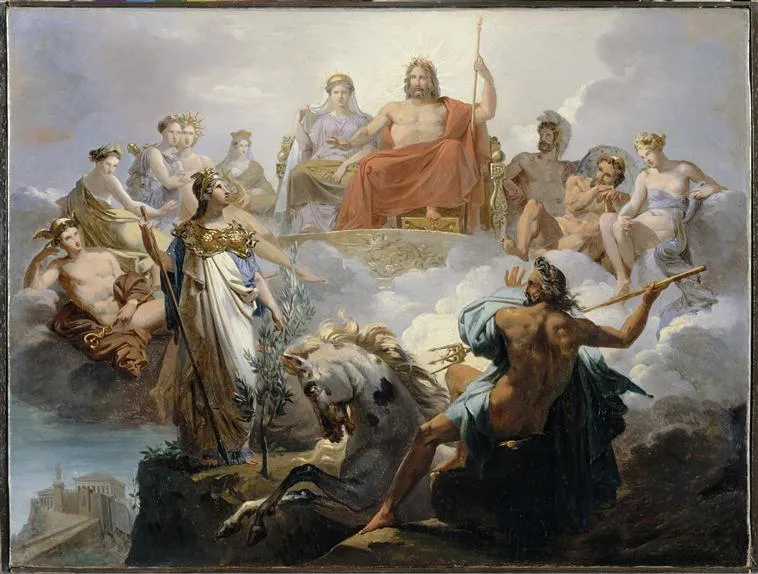
Merry-Joseph Blondel, La dispute de Minerve et de Neptune au sujet d'Athènes, 1821
To begin, though, I do think there are some uses for the trope. I can understand that you might tell a story about gods needing worship as an analogy, example, or similar rhetorical device. Maybe you're a particular kind of humanist who doesn't believe in gods and you want to square a god-filled high fantasy setting with your conviction that gods are human inventions: in that case, it makes sense to say that gods exist in the setting, but only because mortals believe in them. Gods such as these might need worship as well as belief (and, anyway, my complaints apply equally to the idea that gods are created by human belief). Or maybe you're a devout Christian by way of the existential theologian Paul Tillich, and you believe God exceeds human understanding, so any particular conception of God is human-invented. Your fantasy setting might be very similar to the atheist humanist one, with mortals' imperfect worship of a transcendent ineffable God creating a pantheon of various intermediate gods. That God-beyond-the-gods who sits in the back of everything unseen doesn't need worship, but all those other gods do. Or maybe you aren't thinking about the philosophy of religion at all and you're more interested in politics: a story about worship creating the gods might analogize the way power flows up, even if the powerful want you to believe that it flows down. In particular, I imagine this might be a way of thinking about egregores, or at least a materialist version of the esoteric idea, the kind according to which a country or a corporation is its own kind of entity; clearly, that's something I'm interested in myself, given that it shows up in my cosmic horror/post-apocalyptic Lakelands setting. So I do think there are times this trope does something useful. I don't want to suggest that no one can use it to some interesting end.
However, I think we should acknowledge that, when we tell stories about gods who need to be worshipped, something is lost: the god as a symbol for all that's beyond our control. Part of the idea of a god is of a being that exceeds mortal scope. I don't just mean the God of monotheism, either, though certainly exceeding mortal scope is pretty central to God as understood by monotheists (the unmoved mover of Aristotelian philosophy, the maybe-impassible God of classical theism, tawhid and the Names of God in Islam, Tillich's ground of all being). The gods of the ancient polytheisms seemed to have been pretty independent, as well; at least, while they might desire worship from mortals, I'm not aware of any stories about them that suggest they'd suffer without it. That seems fundamental to the whole concept, not just theologically but also symbolically. Greater-than-mortal gods drive home a crucial idea or feeling: there are things beyond our control, but to which we are subject. Poseidon is the mighty untamable sea. Hades is death, inevitable and omnipresent. Even Ares and Aphrodite exceed us: mortals may wage war but, once it begins, it's beyond the means of any individual to shape it; none of us can choose with whom we fall in love nor who falls in love with us. If gods are going to operate as symbols along any of these lines, they cannot need us to survive or to exercise their power, because that would undermine the point. You don't have to be religious for gods to be valuable as symbols for all that mortals cannot control, so long as you think there are things that exceed our control, but to which we are subject. Thanks to their cultural histories, gods are very effective at evoking the related feelings and ideas.
Importantly, these feelings and ideas are interesting in tabletop roleplaying games. We regularly explore situations in which our heroes overcome all manner of terrible and powerful foes: dragons, liches, psychic brain-suckers from outer space, psychic fish who remember the beginning of the world, immortal fairy princes, and so on. Confronting them with beings who have power over them, but over whom they have no power at all, provides variety in tone, roleplay opportunities, and game challenges. A world with limits is more interesting than a world without any.
Now, again, you can make a certain point by subverting the gods as symbols for all that exceed our control. I would never say that you can't or shouldn't. Everything is a trade-off; you make one choice over another because you think the trade-off is worth it. What I'm trying to capture here is what the trade-off is, both so that you can decide if you're willing to take this loss and so that I can explain why I don't generally care for the trope. I don't think using the gods-need-worship trope implies you don't believe there are things beyond human control, of course. Maybe, in your games, archfey or elementals or primordial spirits or eldritch horrors are what personify those things that exceed mortal control. For example, in David Somerville's Planegea, all gods were once animals, plants, or objects that human awe divinized, but mortaldom seems so small and contingent in Planegea that I don't think that sense of mortals' contingency is lost. The Worldheart still dreams all of Planegea into existence, and she seems unassailable, while no one can defeat the Hounds of the Blind Heavens or survive breaking the Black Taboos they enforce. Dependent gods can be done, and done well. For the most part, though, given the history we have with the idea of divinity, I'm hesitant to give up the symbolic potential of gods that don't need us.1
I shouldn't be coy: another reason I don't like the trope very much is that I am, and more importantly was raised, Christian. I haven't discussed my own religion on this blog because I don't think it often pertains to tabletop roleplaying but, if I'm honest, it does here. It's not that I need fantasy games to conform to Christian theology, obviously; the setting of my main campaign, The Fortunes of Ewistar, is polytheistic, in the standard anthropologically-implausible D&D way, and I've been making up fantasy pantheons since I was a kid. I also have virtually no instinct for orthodoxy for its own sake. It's more that my basic conception of a god, my idea of what gods are, has a kind of gravity that I find hard to escape. It mostly just feels incorrect to have gods that need mortals, like it would feel incorrect for a setting's vampires not to drain anything from others, or for a setting to have a living, corporeal ghost. Those just aren't vampires; that's just not a ghost. A god that needs worship isn't quite as bad as that, but for me it's close. I can't expect anyone to feel the same way, of course, so this hasn't been the main thrust of my argument; I mention it at all only for the sake of honesty. I'm more interested, really, in thinking about what's lost when we use this trope.
But, for all the same reasons I mentioned above, I don't want to be restricted to stories about distant and inscrutable gods, either, and I don't think we are. Holland asks what gods need, and though the theologian might say that's a paradox, the GM can provide a different answer. What if the need that the gods have in relation to humans is a need to give? Perhaps of more interest to me personally than to the TTRPG community at large, is there a way to tell high fantasy stories, with pantheons of gods both good and evil, in which the idea of grace, the unearned gift, is fundamental to divinity? What if, to remain good, to remain themselves, the gods must give freely and gratuitously? What if they don't need us, but they do need to act for us?
From the source of everything cascades Divinity like a river of light. Divinity runs through the void, and everything that exists emerges from it. Near its headwaters, the Heavens have built up around it like banks. From there the river of light falls down into nothingness like a waterfall off an endless cliff; it disperses like water into droplets, and in that mist the mortal world was formed and still hangs, equal parts Divinity and void, light and shadow, creation and dissolution. Beneath the mortal world, far beneath it, where Divinity is thin in the nothingness, strange aberrations stir, hungering to reduce everything back into the primordial silence. All these are sustained by the endless movement of Divinity.
Flowing Divinity is pure, all creation and kindness. Stagnant, however, it curdles. Stagnant Divinity sours. When Divinity does not flow, when it is kept, it loses not its potency but its goodness. A thing which bottles Divinity grows evil and avaricious.
The gods that now reside in the Heavens were not the first to build their palaces there along the banks of Divinity. Many generations of gods preceded them. The gods take their being from that great River, like mortals drink water or trees drink sunlight. So close, there, to the source of everything, the gods are originally good, and use their celestial powers to create and sustain. They create and sustain their great estates in the Heavens, and they create and sustain the choirs of angels in the paradises suspended from the Heavens like so many hanging lamps, and they create and sustain the living and thinking and growing things in the mortal world. And as long as they do this, they remain good.
It is natural, perhaps, that the gods, perceiving what good they can do with Divinity, seek to store it. In their estates, those first gods built great cisterns for Divinity, as have all the gods that followed them. Some of them might tell themselves they're saving this Divinity for great works that exceed what they can do with the Divinity that simply flows through them, while others see these reservoirs as insurance against the unlit hungers that move along the edges of the great cascade of light and seek to devour all it creates. It doesn't matter. Over seasons and centuries, the Divinity sours and the gods fall.
It might have been that the first gods fell fast, or they might have fallen slow. One way or another, it began with avarice, as it always does: in seeking to hold Divinity, they will seek to hold more, and sooner or later the gods will love having it more than they love what good they can do with it. In their efforts to gain and keep goodness, they turn their backs on creating and sustaining what's good in the world, and one day they will harm others for the sake of gaining more Divinity. Scraps of ancient legend suggest that an early generation of gods turned to tyranny and their children were forced to kill them, breaking them into pieces to let the sour Divinity spill out. The stories are only stories, mortal attempts to articulate the great mysteries of Heaven, passed down and changed, but there are recurring themes: after gods turn foul, if they are not killed by later generations, their cisterns will shatter and the great flood that follows will wash away their wicked palaces. There is no generation of gods that has not broken or been broken; all gods up until now have tried to store Divinity, and all gods have therefore fallen.
When the gods fall, and especially when they fall altogether, the torrent of curdled Divinity pours from the Heavens. It poisons the paradises it passes through and, running unseen across the mortal world, it creates great wars and jealousies and catastrophes. Some of the paradises are torn from the upper worlds and fall beneath the mortal world into the midden of previous lost elysia and shattered cisterns and the shards of dead gods. There, nearly at the bottom of all things, beneath which are only the aberrant terrors of void given form, the piled wreck of Heaven forms the unnumbered Hells. In that dim waste heap, the two halves of a sundered deity might war against each other for mere drops of Divinity, while hosts of ruined angels fight each other in despair of having anything worth fighting for.
What can a god do instead? How can a god grow in their power to do good without storing Divinity? A god can grow in power by increasing the amount of Divinity that can flow through them at a time. Rather than widening their reservoirs, they must widen their apertures. They can do this in only the most obvious, straightforward way: by allowing Divinity to flow through them. They can only increase their capacity by using it to their limits. If a god wishes to grow without falling, they must continually exercise their celestial power in the paradises and the mortal world.
To remain good, a good god must give. A god does not strictly need a mortal to pray before they can grant a miracle. Gods perform unseen miracles all the time in small ways. Goodness is wary of coercion, however, so a god who is still good will prefer to answer a prayer than perform a miracle unasked. When a mortal asks the gods for something which it is according to that god's nature to give, then the god can pass Divinity through themselves and into the world to make that change: the god of bounty bringing the grain to fruit, the god of the sea bringing the sailor to her wife, the god of love bringing the lonely together. Often the god pours Divinity into the petitioner themselves so they can work their own will, or binds it to a champion who has sworn to uphold particular laws and ideals, or uses it to make an item or monster2 that by its nature is likely to accomplish the prayer and further serve the god's ends. As long as the god continues to do this, to give as much as they can without holding back, they can grow in power and goodness both and they will not fall. Even a god who has started to turn, who is neither wholly good nor wholly evil, can preserve themselves for a while if they empty out their poisoned Divinity and seek to store it no longer.
Gods must give, and give they do. Each generation of gods begins this way, overflowing with grace. And yet, each generation of gods has eventually begun to store as well, to hoard Divinity like a dragon hoards gold or a lich hoards secrets. There are some who say that the world will continue on as it does, beset by a battle between love and hate, a war between creation and destruction, everything and nothing, until a god learns to give so perfectly that all the boundless river of Divinity can pass through them and no thought of keeping it to themselves could enter them.
Therefore, pray to the gods and ask them for aid. The gods need not your worship, nor do they need your prayers, but the gods must give, so they desire greatly that you ask.
That being said, once I wrote out the Tillich-based version of the gods-need-our-worship trope, I actually quite liked it. I think I could do something with that.↩
Perhaps you know that the word monster means, originally, divine portent or warning. Infants and animals born with birth defects were believed to be signs from God that some evil remained afoot or unaddressed. Monstrosity was a language from the divine for humanity. It is appropriate, then, any time in a roleplaying game when monsters come from the gods: sphinxes and nagas in Dungeons & Dragons are rightly monstrosities exactly because they are divinely-appointed protectors, and it is right that chimerae in Draw Steel are miraculous instruments of judgement.↩