Carnival, Festivals, and a Thought on Realism
The Carnivalesque
Russian philosopher and literary critic Mikhail Bakhtin (1895-1975) is perhaps best known for his work on "carnival," often now called "the carnivalesque."1 Bakhtin wasn't really writing about carnivals as we might understand them in the modern day, with midways and funhouses and whirling teacup rides; he pointed out that even in his own time these carnivals separated spectator from spectacle, which is fundamentally at odds with the medieval celebration of Carnival on which he in part based his understanding of the carnivalesque. (Carnival is a Christian festive season ending with Shrove Tuesday, which you may know as Mardi Gras.)
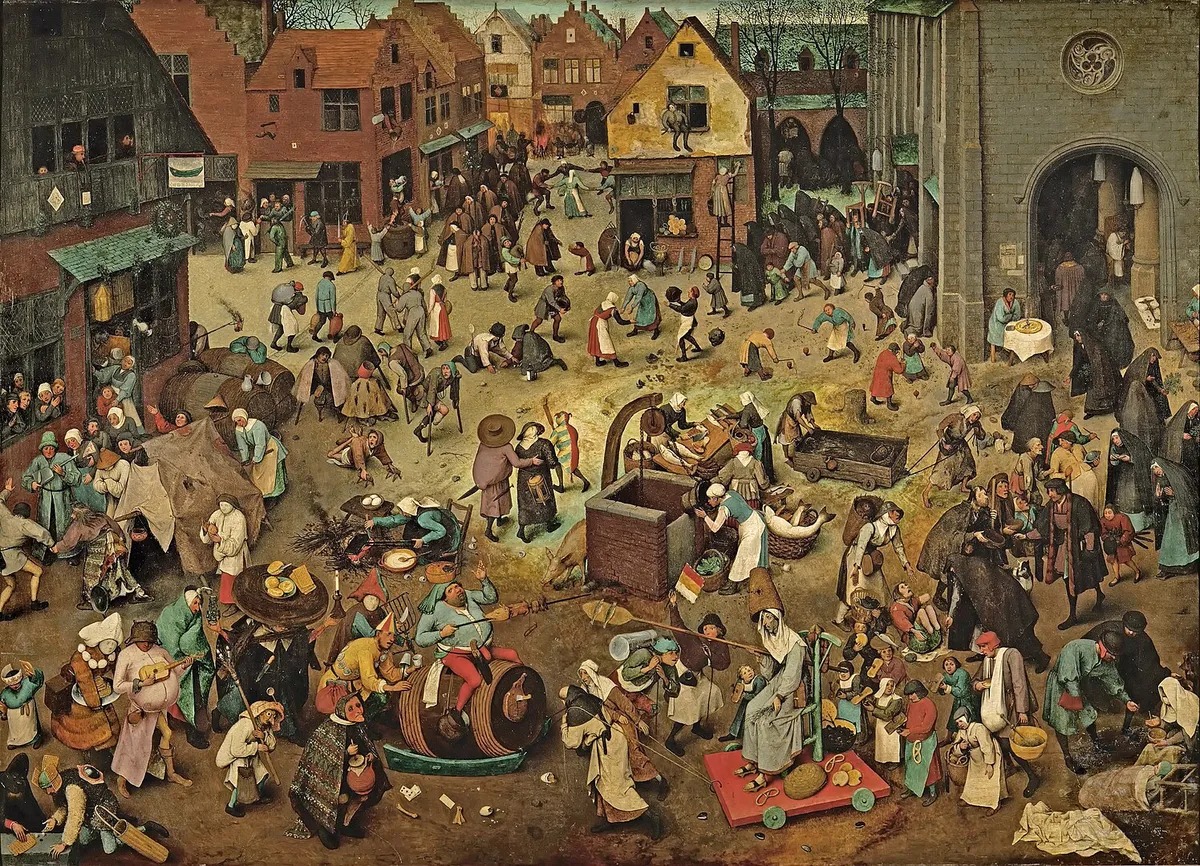 Pieter Bruegel the Elder, The Fight Between Carnival and Lent, 1559
The Wikipedia article is pretty good for what it is, I think, so I'll direct you that way rather than repeat it. In short, though, the carnivalesque is a festive attitude that occurs to some extent in all societies, in which the usual hierarchies, taboos, binaries, and pieties are suspended temporarily during certain times of the year or at certain milestone events. In these events people give voice to latent and suppressed bodily realities: birth, death, sex, eating, farting, and so on. It also reinforces a basic egalitarianism implied by human bodies; as the sage says, everybody poops, and so too does everybody die.
Mardi Gras is a modern case of carnival still alive and well, but for many readers Hallowe'en, New Year's Eve, and perhaps St. Patrick's Day may be more familiar examples. These are pale versions of what Bakhtin described in the medieval period, but think in particular of the way we overlook a bit of drunken debauchery on New Year's Eve that we wouldn't so quickly overlook any other time of the year. If you've seen Trousdale and Wise's The Hunchback of Notre Dame (1996), then you might remember the Feast of Fools in the song "Topsy Turvy," which is as pure an example of the carnival as you can get in a 90s Disney film for children. Many people in North America treat Las Vegas as a place, rather than a time, where carnival rules apply.2 Not every festival is carnivalesque, of course (Christmas and Easter aren't), and not every norm is loosened during the ones that are; the Feast of Fools isn't simply the Purge. Nor are any taboos abandoned altogether; nearly everyone in a society understands which rules you can break on this kind of occasion, and by how much.
Bakhtin emphasized the non-hierarchical, non-binary, profane aspects of the carnivalesque and the way it can create opportunities for the oppressed to express themselves. Subsequent scholarship, in my experience, has tended to emphasize the way the carnivalesque still fundamentally enforces the norms it suspends: these scholars use the metaphor of a release valve, arguing that the destabilization is useful to the established hierarchies in that it allows the oppressed to blow off some steam and get a little disrespect and blasphemy out of their systems before the regular order is calmly reestablished. The carnivalesque eases tensions; it does not remove the source of those tensions, and by easing the tensions it allows the powers that be to postpone their reckoning indefinitely.
Festivals in TTRPGs
This month, of Dice and Dragons hosts the 2025 RPG Blog Carnival again, asking us to think about feasts and festivals. Among the various questions Scot Newbury suggests answering is the following:
- World-Building: What does a culture celebrate, and how do they celebrate it? The traditions, food, music, and attire of a festival can tell players volumes about the history, values, and social structure of a region. Is it a somber remembrance, a boisterous harvest celebration, or a solemn religious observance?
If you've read much of what I've written, it will not surprise you that I zeroed in on this prompt. Indeed, I brought up a similar point in my post on theatre, including religious pageants in local festivals. Not every festival has a carnival atmosphere, after all, and most festivals reinforce their culture's norms in a more straight-forward way. Some are carnivalesque, though, and I'd like to suggest something that a carnival feast can do: it can highlight a culture's taboos by showing the celebrants breaking them in a festival atmosphere. Imagine the PCs are visiting a region for two or three weeks, and when they arrive they find many of the residents preparing for a big festival in a few days. The day of the festival arrives and, along with some heavy drinking and a parody parade mocking local nobles and religious figures, a number of the villagers also make toasts to each of the last year's deceased. This might communicate to the PCs something interesting, that they might not have noticed before: speaking the names of the dead is taboo in these parts. That might be important information for them to know.
Let's look again at what the carnivalesque subverts: it flattens hierarchies, suspends taboos, subverts binaries, and profanes the sacred. Therefore there are four things you can use a carnival atmosphere to tell your players something about:
- a social hierarchy (maybe people with trades are considered superior to people without trades);
- a taboo (maybe it is scandalous to insult a person);
- a binary (maybe the villagers draw a sharp distinction between day and night, with rules governing behaviour appropriate to each);
- a piety (maybe the villagers consider a particular stone sacred).
If you think it's important for your players to understand this cultural detail, you can show them a festival that is recognizably carnivalesque – it has drinking, feasting, and a parade satirizing important figures – and then also show the participants gleefully and deliberately breaking the rule or disrespecting the thing worthy of respect: beggars ostentatiously costumed as masons; ritual insult bouts; shops closed in the day and open at night; and laughing children placed on the sacred rock, where they dance and make rude noises.
Of course, there are other ways to share such information: a traveller passing by as the party enters the region might give them a head's up about an important local custom, or when they arrive in the village they might see someone publicly punished for a violation of the rule. That's not always the way you want to do it, however; when it isn't, maybe the carnivalesque can do the job. Besides, the carnivalesque can be fun, what with all the other carousing going on, and players might pay more attention to a bit of cultural detail if it's highlighted by some minor debauchery.
Coda: The Trouble with Realism
Except … there's a problem, isn't there? What if your players take the wrong cue from all this? Not everyone knows what the carnivalesque is. Not all players will see the carnival atmosphere and understand that they're seeing all the usual rules being turned upside-down. A person might see a joking insult match and think that, in fact, locals are good-humoured about insults around here; they would be sorely mistaken, but I don't think I could blame them for such a misunderstanding. Maybe I'm underestimating people; maybe a person who's never heard of Bakhtin can still intuitively recognize a carnival atmosphere and know what it means. But do I want to count on that? Even if they do understand more or less what's going on, are they always going to parse exactly which parts of the celebration break the usual rules and which parts don't? And maybe it's not so bad if the player makes that mistake, if the character would also make that mistake and it leads to an interesting situation. Or maybe you can just explain it to the player as the GM: You get the sense that this is a festival where everything is upside-down, so some of the behaviour you see today won't be acceptable tomorrow. That robs the fun out of the players figuring it out for themselves, though.
I've started thinking about this in terms of what S. John Ross at Rolltop Indigo calls "invisible rulebooks," the various unspoken assumptions by which we constrain what goes on at the table, including both procedures and beliefs about genres and reality. Most people don't have a primer of Bakhtin's basic ideas among their invisible rulebooks. And that's OK! (Not that you need me to tell you that's OK, of course.) I'm missing some pretty important ones, too. I don't have the one called What Does 30' Look Like, Actually?, while my volume of How Economies Work Through History has lost most of its pages, and these come up more often in games I run than I had ever expected. The trouble with verisimilitude is that it's not actually a comparison between the illusion we create and what reality is like, but instead between the illusion we create and what we think reality is like. If not everyone at the table has the same editions of the relevant invisible rulebooks, well, the verisimilitude falls apart a bit. More importantly, perhaps, the clues you use to give your players a fair chance to understand what's happening also stop pointing in the right directions if they don't have access to the same invisible rulebooks you're using.
A lament is building up in me which starts with something like, "How do you create verisimilitude in a society where people ingest horse medication as a prophylactic against a deadly pandemic they don't fully believe in anyway?" Verisimilitude matters to me, not more than some other considerations but still a lot, so even if I'm not likely to play with a person who's taken ivermectin, this sort of thing still gnaws at me a bit. That lament isn't really the point of this post, however, so I'm going to cut it off here, excepting one last point.
I'm being a perfectionist when I worry about this kind of thing, which is not at all in the spirit of carnival. The carnivalesque should remind me that, like everyone else, I am a mass of meat and bone and mucus whose capacity for abstract thought is therefore surprising. I should not expect to get it right at the table every time. The carnivalesque has lots of potential to be fun all by itself; if I try to do something more with it and fail, I can still hope the players enjoyed the failure anyway.
I'm more familiar with his writing on heteroglossia but if I hear him mentioned online, it's almost always to do with the carnivalesque.↩
I had started to write that Rumspringa, among the Amish, has a bit of the carnivalesque to it, but when I looked into it further it seems that the popular conception of Rumspringa is a bit exaggerated. There is some relaxation of norms, yes, but not generally so much as we see depicted in contemporary media.↩