Factions of the Lakelands: Delvers
DRAFT: I don't know why, but I've been struggling to write the final section of this post for weeks. Rather than let this stall out any longer, I'm going to post it as a draft and then update it later. It's therefore also only incompletely edited. I'll enable comments (by posting to Bluesky) and link everything properly at that point. Sorry for the inconvenience.
Delvers
Common locations: Settlement archives, marketplaces, pre-Arrival ruins and environs.
Common activities: Exploring pre-Arrival ruins, building tools and machines.
Roles in a campaign: Patrons, rivals, sources of equipment and information.
Delvers are explorers, salvagers, and tinkerers. Any group of people that braves a pre-Arrival ruin, takes something valuable out of the wreckage, and uses it to make or improve tools for a future venture, is a delver crew. They can vary from a small team of half a dozen individuals to an outfit with a few hundred employees. Delver groups can be strictly hierarchical or largely decentralized but, either way, they have specialized roles depending on the needs of the project and the skills each person has.
Many outsiders assume delvers are motivated by profit but, while some certainly are, at least as many are driven by curiosity, a sense of adventure, or dedication to their crewmates. Some are creatives looking for the parts, or maybe the instruction manual, needed to fix a beloved machine. Others are intellectuals, however grease-smudged their faces might be, seeking to better understand the pre-Arrival world. And many simply love poking around potentially dangerous places with their friends.
A delving operation has a regular life cycle, seen across the Lakelands and beyond. First, delvers must find a ruin to delve. This stage might involve talking to locals or sifting through community archives; some delvers just strike out into a likely-looking bit of woods. Second, delvers establish a nearby working camp, which could be a few rented rooms in a local inn, a well-fortified outpost, or a tent in a nearby field, depending on the available resources. Third, delvers prepare for the delve, which could involve further research but always involves assigning work tasks, packing gear, testing and repairing equipment, building any custom tools needed for the particular job, and getting rested. Fourth, delvers enter the ruin, as many times as needed. If time is limited, they might breach the perimeter, identify and clear threats, assess available materials, assemble the necessary equipment, and remove any valuables all in one trip; if time is abundant, they might attempt each of these activities on a separate excursion. Fifth, delvers prepare their salvage for future repairs or sale to their buyers. Many delvers use this repair time to tinker with their favourite devices, machines, and gear. If the delve turned up any leads, they might also at this stage identify the next ruin they intend to scavenge.
When the players are not delvers themselves, delver factions might appear in a campaign in a number of ways:
- as merchants who can buy and sell useful things;
- as rivals or partners (or rivalrous partners) exploring the same ruin as the party;
- as sources of information about ruins and delving;
- as patrons looking for protection or escort;
- and as victims of calamity in need of rescue.
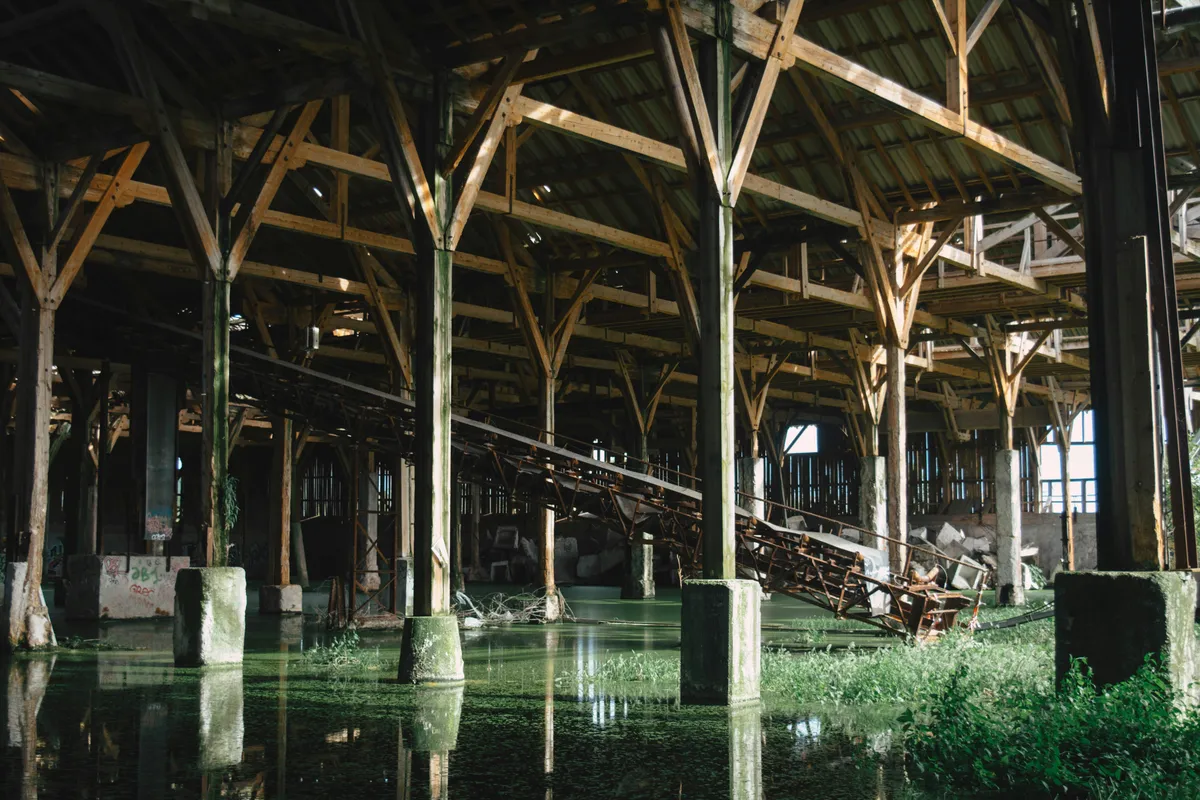 Source: Lucas Barrere, 2018 (Unsplash license).
Provisional Thoughts About Mechanics
Delvers pretty much always have tools ready to hand and, if they don't, they know who does. I'm thinking that delver factions get a Stunt much like Fate Core's Always Making Useful Things, which allows players to spend a fate point to declare that they have the proper tools for a Crafts checks, regardless of the circumstances. In the delver's case, I might say instead that a check can always be made to see if the delver faction has the tools needed and, in the case of a failure, they still know the nearest other delvers who have them.
Example: Erie Light Salvors
Many mining new hominids work an inherited claim, some ruin or mine that they defend as their own to delve across the generations. Although such groups might present themselves as a company, they are equally well-understood as a town or as one to three extended families (understanding that new hominid family networks are polygynandrous and therefore look different from most cultures' extended families). Erie Light Salvors is not much different in this regard; it's also more or less a village and a handful of families. It is unusual in one respect, though: its claim is a cluster of several shipwrecks off the northeastern coast of Lake Erie.
Despite living on the surface and spending much of their time on the water, all but one of the Erie Light Salvors new hominid families are mining new hominids, with that culture's mores and attitudes. (That one outlier is of course a fishing new hominid family, though it has been wedded and interwoven so much with the other family networks that it could hardly be considered separate much longer.) Like many new hominid companies, Erie Light Salvors has a tutelary spirit as a mascot; theirs is an animal angel named Zun Fleengtid, the five-lined skink. Over generations they have recovered tools and techniques for underwater salvage; even if they are not the only salvors in the Lakelands, they are indisputably the best. No one can explore and break down a shipwreck, all underwater, like the Salvors can. They're not bad at driving off leviathan pikes in the murky deep, either, though more than a few divers meet their end in a giant fish's jaws each decade. (They also know more about the movements of the strange lights that rise out of the Lake, but they still don't know how they form or why they drive off the Unbound.) Of course, not everyone in the town, or the families, works in the ships; enough of them are hunters, fishers, farmers, mechanics, craftsfolks, and traders to feed and supply Erie Light Salvors. The majority dive, however, which may soon be a problem: the claim is almost exhausted and within this generation Erie Light Salvors will need to figure out what to do next.
The responsibility for these next steps lies on the shoulders of Bohljis Pfraad, the company's current president, which is an inherited position. It's true that he answers to a board of family elders, but Bohljis has proven himself enough times that the current board members give him a lot of free reign, seeing themselves as providing advice and support and ensuring there's a structure of accountability if it's ever needed. Bohljis has been greying for a while now; although he still thinks of his look as "salt-and-pepper," salt predominates. Three of his grandparents were mining new hominids, well-reflected in how he thrives in and nurtures stability and tradition. His mother's father was an itinerant fisherman, though, and as time goes by, he wonders how much he'll need to draw on the fishing new hominids' more flexible, accepting ethos. He knows his legacy depends on whether he can prepare for the transition after Erie Light Salvors' claim is exhausted, and he's pursuing diverse leads. He has sent his eldest daughter and her half-brother with teams to scout for other viable shipwreck delves. He's also considering whether the company town's auxiliary industries could be enough to live off of, if they invested in them early and heavily enough. The numbers don't look good, but Bohljis figures there's still time.
Example: Open Skies Charter
If a Lakelander sees a helicopter or small airplane fly overhead, there's a good bet it's from elsewhere, carrying humanitarians, mercenaries, or researchers – not that the difference between those groups is always clear. If it's a floatplane painted a pleasant grey-blue, however, and has a white gull logo on its side, then they can breathe easier. That's an Open Skies Charter aircraft.
Open Skies Charter is a highly-organized delver company interested particularly in maps, schematics, and scientific equipment. Those who work with one of their crews say Open Skies delvers are both competent and fussy, always doing things according to their official guidelines and processes. No other delvers spend nearly as much time researching a delve before entering. Open Skies crews always show up with maps and historical accounts of the ruin already in hand, and even then the first place they go is whatever passes for the local history experts, whether that's consulting an actual archival collection, sifting through some local eccentric's mildewed boxes of pre-Arrival newspapers, or interviewing elders at the pub. Most other delvers consider this an obnoxious amount of work, and only useful half the time. They must admit, though, that Open Skies delvers are good at sharing delves. Open Skies trades exclusively in information (ie. schematics, historical documents, research data) and advanced technology. Sometimes they're in a ruin looking for one thing in particular, which might even be the location of a different delve that holds what they actually want. They'll also take anything that they could use to repair their floatplanes, which seem to be grounded half the time for need of parts. Anything else, though, they leave to other delvers. That means other delvers are often happy enough to work with them, off-loading the research. Also, unlike most outfits, Open Skies will sell to their partners the location of any ruins they're finished with, along with maps, notes, and sometimes even photographs or video. Between this collegiality and their ability to procure parts for vital scientific and medical equipment, most Lakelanders are willing to put up with the Charter's fussy and methodical ways.
Geminite brothers Sunfield and Woodbury Lanus are Open Skies Charter's co-directors. Letting two people share leadership equally was not an uncontroversial decision on the board, and it was much debated before the vote. However, in the end, the result was close to unanimous: it was decided that the Lanus brothers were the best choice for the position and could probably manage any disagreements they might have. Sunfield and Woodbury grew up with a strict sense of concord, which they appear to be quite good at keeping by dividing decisions up into domains (Sunfield takes logistics, Woodbury everything else). At 45 years old, they have a well-coordinated sense of which professional decision is whose. Although their calmness and consistent rationality can make them appear detached and, to some people, cold, they're never unkind to the people who work with or for them, and their expectations are always reasonable.
Example: Red Leaf Salvage Co-op
The Red Leaf Salvage Co-op sounds maddening to anyone who isn't part of it. Indeed, it sounds maddening to half the people who are part of it, and that includes a surprisingly high percentage of Lakelands delver crews, at least on paper. The Co-op is not a company in any traditional sense. It's a roaming free association of diverse tinker crews that work together on delves. There is paperwork involved: outfits sign up in the rolls and agree to abide by certain rules at any delve where two or more Red Leaf Salvage Co-op crews are present. Those rules don't lay down who's in charge of what, how profits are distributed, or how risks are managed; the rules only dictate that and how the crews will decide those things between them. Indeed, the first thing that happens when Red Leaf crews appear at a new delve is that they renegotiate the organizational structure for the site, in a process that can sometimes take up to a week. In other words, no one's in charge, except when everyone else agrees that they're in charge, and they're only in charge at this delve, and they're only in charge of a particular set of decisions. One outfit might be responsible for blasting the doors, and no one can tell them how to do it. Another outfit is responsible for camp security and another outfit is responsible for running lights into the delve. These roles can change from one job to another, too, though of course crews that get good at a particular thing will usually wind up with the job at most delves. (That said, if someone else figures they could do it better, the regular crew can suddenly find themselves with competition.) It feels like anarchy, and in some ways it is: the people who got the Co-op started were self-professed anarchists, and utopian political theorizing isn't uncommon in Red Leaf camps. Most members aren't actual anarchists, though; most of them probably don't know what anarchism is. To them, this is just how the Co-op does things, and if they're still around it means they feel the constant aggravating meetings are an acceptable price for getting in on the action.
Given its ground-up endlessly-renegotiated organization, the Red Leaf Salvage Co-op has no leader; naturally, then, everyone knows that an amazon woman named Niyalne runs it.1 She doesn't really run it, of course, but if anyone can make something happen in the Co-op, it's her. …
To be updated later.
A Lakelands post. See also "Factions of the Lakelands: Archetypes."
Niyalne (neɪjəni or, roughly, nie-yul-nee) is a Ladhis recreation of Naomi.↩